
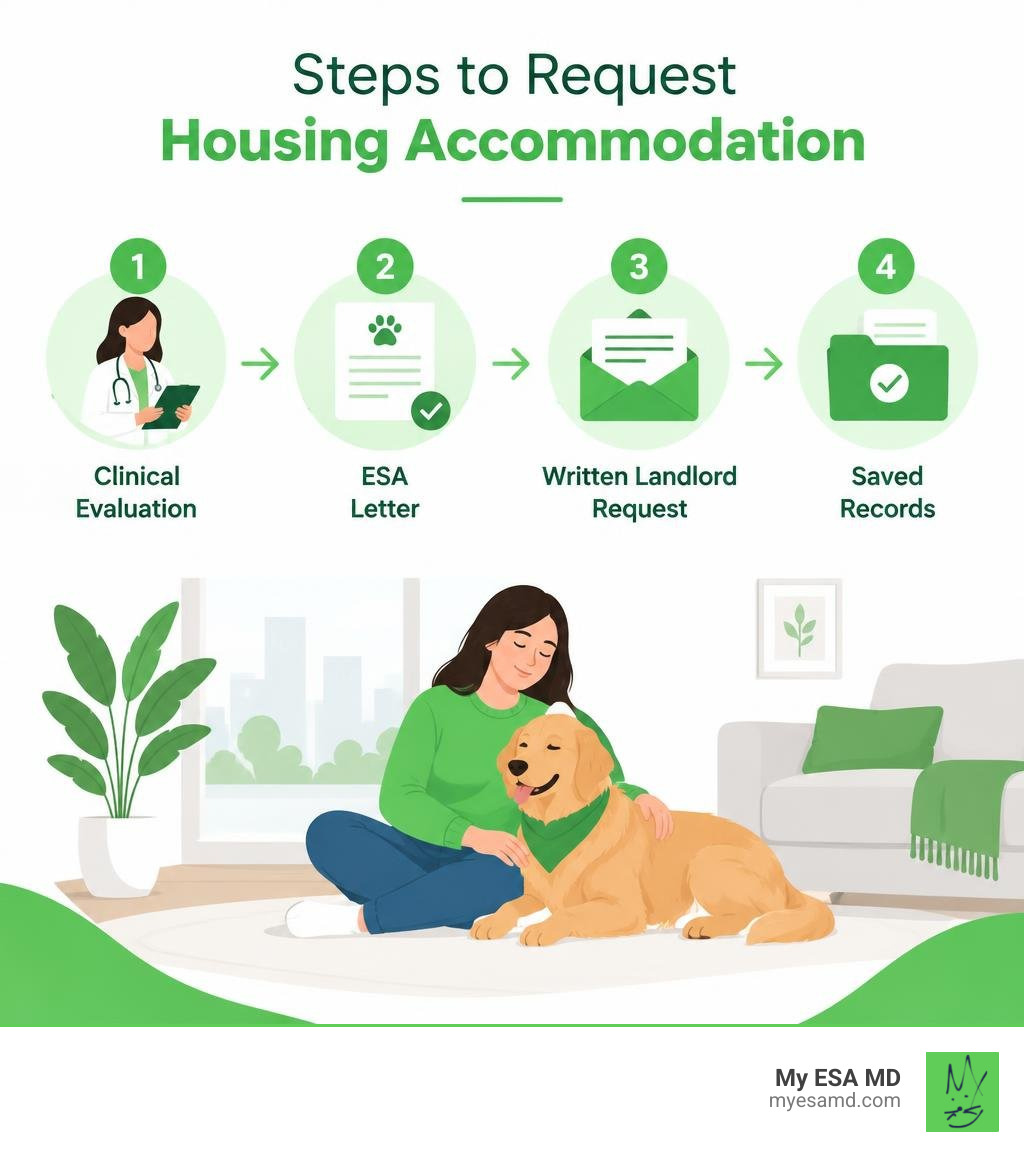
To get an ESA letter for housing, start with an evaluation by a licensed healthcare professional. If the professional finds that you have a qualifying disability and an animal helps with a disability-related need, they can write a letter explaining that connection. Send the letter to your landlord with a written request to keep the animal, and save copies of both.
Under the Fair Housing Act, a qualifying emotional support animal may be allowed in a no-pets rental without pet fees. The letter supports your request; it is not an automatic approval. This guide explains what to expect from a doctor evaluation and how to submit your request.
I'm Joscelyn Rieser, director at My ESA MD, where I help coordinate doctor-led telehealth services for renters seeking an ESA letter for housing. My background in service coordination and web development helps me explain each step clearly.
Legal Foundations of an ESA Letter for Housing Under Federal Law
Your right to live with an emotional support animal (ESA) comes from disability law, not from your landlord's pet policy. The most important federal law in this area is the Fair Housing Act (FHA). In May 2026, the U.S. Department of Housing and Urban Development (HUD) changed the way it handles complaints involving untrained emotional support animals. The Fair Housing Act itself did not change, however, and many states have their own laws that protect ESAs.
Under the FHA, an emotional support animal is not classified as a "pet." Instead, it falls under the broader umbrella of "assistance animals." When a tenant presents verified documentation establishing a disability-related need for an animal, the tenant is making a formal reasonable accommodation request. Federal law requires housing providers to make reasonable modifications to their rules, policies, and practices—including strict no-pet rules—to afford a person with a disability an equal opportunity to use and enjoy a dwelling.
It is common for landlords and renters to confuse emotional support animals with service animals, but they are distinct legal classifications governed by different statutes.
| Legal Feature | Emotional Support Animal (ESA) | Service Animal (e.g., Guide Dog) |
|---|---|---|
| Primary Governing Law | Fair Housing Act (FHA), Section 504 | Americans with Disabilities Act (ADA), FHA |
| Species Allowed | Common household animals (dogs, cats, small birds, rabbits, etc.) | Dogs (and in rare cases, miniature horses) |
| Specialized Training | No task-specific training required; presence provides therapeutic relief | Must be individually trained to perform specific tasks directly related to a disability |
| Public Access Rights | Limited to residential housing (and select university dwellings) | Full public access rights (restaurants, stores, hotels, transit) |
| Documentation Standards | Documented clinical letter from a licensed healthcare professional | No documentation legally required for public access under ADA |
| Pet Fee Protections | Exempt from standard pet fees, deposits, and monthly pet rent | Exempt from standard pet fees, deposits, and monthly pet rent |
HUD's current assistance animal guidance, issued on May 22, 2026, focuses the agency's own investigations on animals that have been individually trained to help with a disability. That memo replaced earlier HUD documents from 2013 and 2020, which were withdrawn in September 2025. Even so, tenants may still bring private lawsuits under the Fair Housing Act, and state fair housing agencies continue to enforce their own laws. Knowing established ESA housing letter requirements helps ensure your documentation meets all criteria under federal law and state-specific assistance animal statutes.
Medical Eligibility and Provider Requirements
Not everyone qualifies for an emotional support animal simply by wanting their pet in an apartment. Under federal law, you must have a diagnosed mental or emotional health condition that meets the statutory definition of a disability. According to the FHA and the Diagnostic and Statistical Manual of Mental Disorders (DSM-5), a qualifying condition is a mental impairment that substantially limits one or more major life activities, such as sleeping, concentrating, regulating mood, working, or social interaction.
Conditions that frequently qualify include:
- Generalized anxiety disorder and panic disorders
- Major depressive disorder
- Post-traumatic stress disorder (PTSD)
- Bipolar disorder and mood dysregulation
- Severe chronic stress and insomnia
To determine whether you meet these criteria, you must complete a clinical evaluation with a licensed healthcare professional. When confirming who is eligible for an emotional support animal, housing providers generally look for documentation from a licensed mental health professional (such as a licensed psychologist, psychiatrist, licensed clinical social worker, or licensed marriage and family therapist) or a medical doctor (MD/DO) who has established a professional, therapeutic relationship with the patient. HUD recognized these same providers in its earlier guidance, and some states, including California, give little weight to online certificates that skip an individualized assessment.
What Clinical Elements Must Be in an ESA Letter for Housing
A landlord or property manager is not required to accept a generic note written on a blank piece of paper. For a housing provider to take it seriously, a valid letter should contain specific administrative and clinical details:
- Provider Credentials and Licensing: The professional’s full name, medical or clinical license type (e.g., MD, LCSW, LMFT), license number, and the state in which the license is active.
- Official Letterhead and Contact Details: The document must be printed on the clinic or physician's professional letterhead, complete with a phone number, physical clinic address, and email for legitimate verification.
- Date of Issuance: The exact date the letter was drafted. Most housing providers accept documentation issued within the past 12 months.
- Patient Identification: Clear identification of the tenant making the accommodation request.
- Confirmation of Disability: A formal statement that the patient meets the definition of having a mental or emotional impairment under the Fair Housing Act (without disclosing specific diagnoses or private notes).
- Provider Signature: An authentic, verifiable handwritten or secure digital signature from the evaluating clinician.
Understanding the Disability Nexus Statement

The single most critical element of an ESA letter is the nexus statement. A nexus statement is the clinical bridge that connects your diagnosed mental health condition directly to the functional support provided by the animal.
Federal law does not require you to disclose your private medical history, past trauma, or specific diagnostic codes. Instead, the clinician must explain how the animal alleviates one or more identified symptoms or functional limitations resulting from your condition.
For example, a valid nexus statement might indicate:
"The presence of this companion animal directly mitigates the patient's severe nighttime panic and hyperarousal, allowing them to regulate their sleep cycle and engage in daily activities."
Without a clear nexus statement demonstrating therapeutic justification, housing providers have valid legal grounds to request additional clarification or deny the accommodation.
Landlord Rules, Pet Fee Waivers, and Property Exemptions
When a tenant submits valid documentation, the Fair Housing Act provides broad protections against standard pet policies. Understanding comprehensive ESA protections helps tenants navigate discussions with leasing offices confidently.
Landlord Verification Limits and Pet Fee Protections
Landlords must follow strict federal guidelines regarding what they can and cannot ask during the accommodation process:
- No Pet Fees or Pet Rent: Because an emotional support animal is legally an assistance animal rather than a pet, landlords cannot charge upfront pet deposits, one-time pet admission fees, or ongoing monthly pet rent.
- No Breed or Weight Restrictions: Building-wide restrictions against specific dog breeds (such as pit bulls or German shepherds) or weight ceilings (such as a 25-pound limit) do not apply to assistance animals.
- Medical Privacy Protections: Landlords are strictly prohibited from asking for your complete medical records, demanding access to your clinician's private therapy notes, or interrogating you about the details or severity of your condition.
- Verification Rights: Landlords do have the legal right to confirm that the evaluating professional is actively licensed in their state and that the letter is authentic.
Keep in mind that although landlords cannot charge pet fees, renters remain fully liable for any actual damage their animal causes to the unit or common areas.
Legitimate Denial Grounds and FHA Housing Exemptions
A landlord cannot reject an ESA out of personal preference, but there are specific scenarios where an accommodation request can be lawfully denied:
- Direct Threat to Health and Safety: If an individual animal exhibits documented, unprovoked aggressive behavior, biting, or creates severe disturbances that cannot be mitigated, the housing provider may deny it. This determination must be based on actual conduct, not generalizations about breed.
- Substantial Property Damage: If the animal causes significant structural or material destruction.
- Undue Burden: If accommodating the animal imposes an unreasonable financial and administrative burden or fundamentally alters the nature of the housing provider's operations.
Additionally, certain properties are completely exempt from the Fair Housing Act's assistance animal mandates:
- The "Mrs. Murphy" Exemption: Owner-occupied buildings with four or fewer independent rental units.
- Single-Family Rentals: Single-family houses sold or rented without the use of a real estate broker or property management company, provided the private owner owns no more than three such homes at one time.
- Private Clubs and Religious Organizations: Dwellings operated by religious institutions or private clubs that limit occupancy exclusively to their own members.
For students living on campus, university-operated housing must comply with Section 504 and the FHA. You can review specific guidelines for assistance animals in university dorms to navigate campus housing approvals.
The Doctor Evaluation Process: What to Expect During Telehealth Screening
Getting an ESA letter for housing through modern telemedicine is straightforward, secure, and fully compliant with federal standards.

During your evaluation, you will meet with a licensed medical professional who reviews your symptoms, medical history, and daily functional challenges.

Here is how the doctor-led clinical consultation typically works:
- Intake Screening: You call or email our office and have a private, secure conversation with an intake counselor about your symptoms, the emotional challenges you face, and how your animal helps you through your daily routine. Once your flat-fee invoice is paid, you are scheduled for the next available appointment with the doctor, or for a time that suits you better.
- Clinical Review: A licensed physician or mental health provider reviews your background to assess whether your challenges align with DSM-5 criteria for a mental health disability.
- Direct Consultation: You participate in a telehealth session with the doctor to discuss your symptoms, functional limitations, and therapeutic needs.
- Letter Issuance: If the clinician determines you qualify, they write an individualized, signed letter on official clinical letterhead containing your disability nexus statement and their active licensing information.
To understand the complete process from consultation to document delivery, review how legitimate telehealth evaluations work.
Protecting Yourself from Invalid Documentation and Misrepresentation Scams
Federal agencies, including HUD and the Department of Justice, do not recognize non-clinical commercial websites or unverified credentials as legal proof of an assistance animal. Under federal law, housing rights cannot be established without a legitimate clinical assessment.
Using unverified documentation does not protect your housing rights. In fact, a growing number of states have passed laws that penalize assistance animal misrepresentation. In California, for example, Assembly Bill 468 established strict notice requirements and civil penalties for falsely presenting an emotional support dog as a service dog or for selling misleading documentation. Fines start at $500 for a first violation and increase with each repeat offense. A separate section of California's Penal Code makes it a misdemeanor to fraudulently claim that a dog is a service dog. Legitimate protection requires a clinical evaluation by an actively licensed healthcare professional.
Submission Guidelines and Resolving Landlord Disputes
Submitting your accommodation request properly ensures your legal rights are protected from day one.
How to Properly Submit an ESA Letter for Housing to Property Management
Follow these best practices when delivering your documentation:
- Submit in Writing: Always submit your reasonable accommodation request in writing (via email or through your property management portal) rather than having an informal verbal conversation. This creates a clear, timestamped record of your request.
- Include All Documents: Attach a copy of your doctor's signed letter alongside a polite, written statement formally requesting a reasonable accommodation under the Fair Housing Act.
- Request in Advance: Whenever possible, submit your letter before moving the animal into the apartment or signing the lease addendum to prevent misunderstandings.
- Keep Organized Records: Retain digital and printed copies of your ESA letter, your initial submission email, and all subsequent communications from property management.
Steps to Take if Your Request Is Denied or Ignored
Housing providers are expected to answer reasonable accommodation requests promptly, and about 10 business days is a common benchmark. A long, unexplained delay can be treated the same as a denial. If a landlord fails to respond or improperly denies your valid documentation:
- Send a Formal Written Follow-Up: Reiterate your request in writing, cite your rights under Title VIII of the Civil Rights Act of 1968 (Fair Housing Act), and request a written explanation for any delay or denial.
- Engage in the Interactive Process: Landlords are legally required to engage in an "interactive dialogue" before issuing a formal denial. If they have questions regarding your provider's credentials, offer to let them verify the license on the state licensing board website.
- File a HUD Housing Discrimination Complaint: If your landlord refuses to comply or insists on charging illegal pet fees, you can still submit a Title VIII complaint online through HUD’s Office of Fair Housing and Equal Opportunity (FHEO) within one year of the incident. Please keep in mind that since May 2026, FHEO has concentrated on cases involving trained animals, so it may decline to pursue a complaint about an untrained ESA. You also have the right to file a private lawsuit under the Fair Housing Act.
- Contact State or Local Human Rights Commissions: Most states have dedicated human rights agencies that investigate tenant discrimination claims and enforce assistance animal protections. For many ESA owners, this is now the most effective place to turn. Our state-by-state guide explains the protections where you live.
For more information on resolving tenancy hurdles and legal updates, explore frequently asked tenant questions and helpful updates on housing disability rights from our blog.
Frequently Asked Questions About Emotional Support Animals in Housing
Conclusion
Securing your rental housing rights with an emotional support animal does not have to be an overwhelming process. By understanding Fair Housing Act regulations, working with a licensed healthcare provider, and ensuring your documentation includes a clear disability nexus, you can keep your companion animal by your side without facing unlawful pet fees or housing denials.
At My ESA MD, we provide direct, doctor-led telehealth consultations with licensed medical doctors. We offer transparent flat-fee pricing, zero recurring memberships, same-day delivery upon clinical approval, and a 100% money-back guarantee if our physicians determine you do not qualify. When you are ready to secure your rights, schedule your clinical evaluation to secure your official housing accommodation with confidence. The only exception to same-day delivery is California, where state law requires residents with dogs to follow a 30-day process.
Ready to Talk to a Doctor?
Book a telehealth evaluation with a licensed MD. One flat fee, no memberships, and real people who answer the phone.