
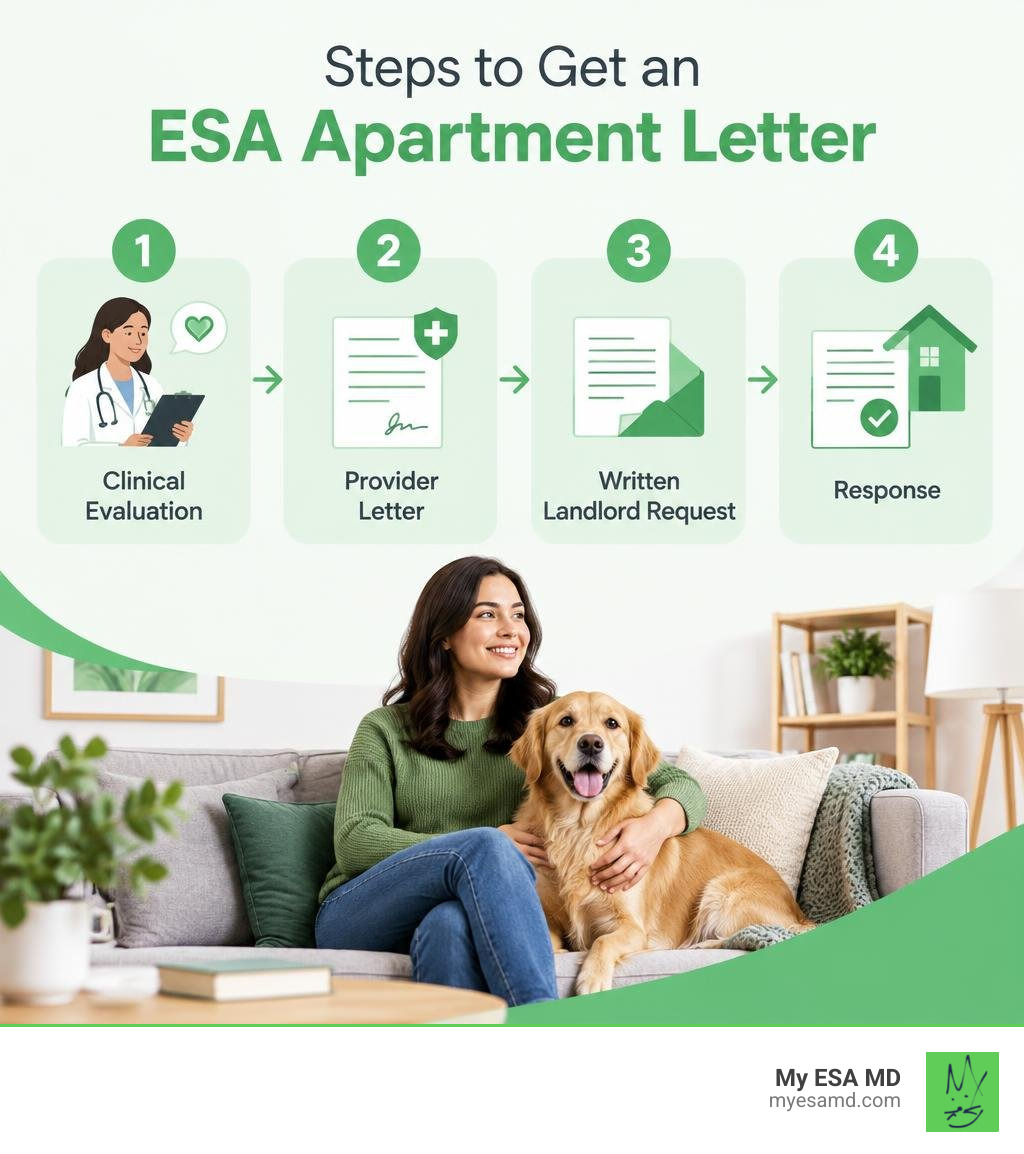
To get an emotional support animal apartment letter, start with an evaluation by a licensed healthcare professional. If they find that you have a disability-related need for the animal, ask for a signed letter confirming that need. Then send your landlord a written request to allow the animal as a reasonable accommodation, with the provider letter attached. Keep copies of both.
Under the Fair Housing Act, a landlord generally cannot treat an approved assistance animal as a pet or charge pet fees for it, even in a no-pets building. Approval is not automatic, though. The letter needs to support your request, and the landlord may ask for limited verification when your disability or need is not apparent.
I’m Joscelyn Rieser, Director at My ESA MD, where I help make doctor-led telehealth evaluations and housing documentation easier to understand and access. My work coordinating those services informs this guide to getting and using an emotional support animal apartment letter.
Understanding Your Rights: Assistance Animals vs. Pets and Service Animals
Navigating apartment rules when you rely on an animal for mental health support can feel overwhelming. Many property managers see four paws and immediately hand over a pet addendum with a list of fees. However, federal housing law views assistance animals entirely differently from standard household pets.
To understand your rights, it helps to understand what qualifies as an emotional support animal. An emotional support animal (ESA) is an animal that provides therapeutic benefit, comfort, or companionship to alleviate one or more identified symptoms or effects of a person's mental or emotional disability. Unlike regular pets, ESAs serve an important health-related role. Unlike service animals, they do not require specialized behavioral or task training.
| Feature | Household Pet | Emotional Support Animal (ESA) | Service Animal |
|---|---|---|---|
| Primary Function | Companionship, leisure | Therapeutic support for emotional/mental disability | Specifically trained tasks for a physical or mental disability |
| Specialized Training Required? | No | No | Yes (individually trained to do work or perform tasks) |
| Protected by Fair Housing Act (FHA)? | No | Yes (classified as an assistance animal) | Yes (classified as an assistance animal) |
| Protected by Americans with Disabilities Act (ADA)? | No | No (housing only) | Yes (public access everywhere) |
| Subject to Pet Rent & Deposits? | Yes | No | No |
| Exempt from "No-Pets" Rules? | No | Yes | Yes |
Because emotional support animals work primarily through their presence and connection with their owners, their support is critical for individuals living with non-obvious disabilities such as major depression, generalized anxiety disorder, or post-traumatic stress disorder (PTSD).
Legal Protections Under the Fair Housing Act
The primary legal shield for renters with ESAs is the federal Fair Housing Act (FHA). In May 2026, the U.S. Department of Housing and Urban Development (HUD) changed the way it handles complaints involving untrained emotional support animals. The Fair Housing Act itself did not change, however, and many states have their own laws that protect ESAs.
Under the FHA, housing providers must grant a reasonable accommodation to individuals with disabilities. According to comprehensive Fair Housing Act guidelines for reasonable accommodations, a housing provider cannot refuse to make reasonable adjustments to rules, policies, practices, or services when such accommodations are necessary to afford a person with a disability an equal opportunity to use and enjoy a dwelling.
This protection applies directly to rental leases that contain strict "no-pets" rules. An assistance animal is not legally a pet, meaning standard pet prohibitions do not apply.
These protections exist for good reason: over half of all housing discrimination complaints filed locally and nationwide involve allegations of discrimination on the basis of disability. Knowing which qualifying mental and emotional health conditions meet the standard under the FHA helps you stand on solid legal ground when communicating with your property manager.
Public Access vs. Private Housing: ADA and FHA Rules
A common point of confusion among both tenants and landlords is the distinction between the Americans with Disabilities Act (ADA) and the Fair Housing Act (FHA).
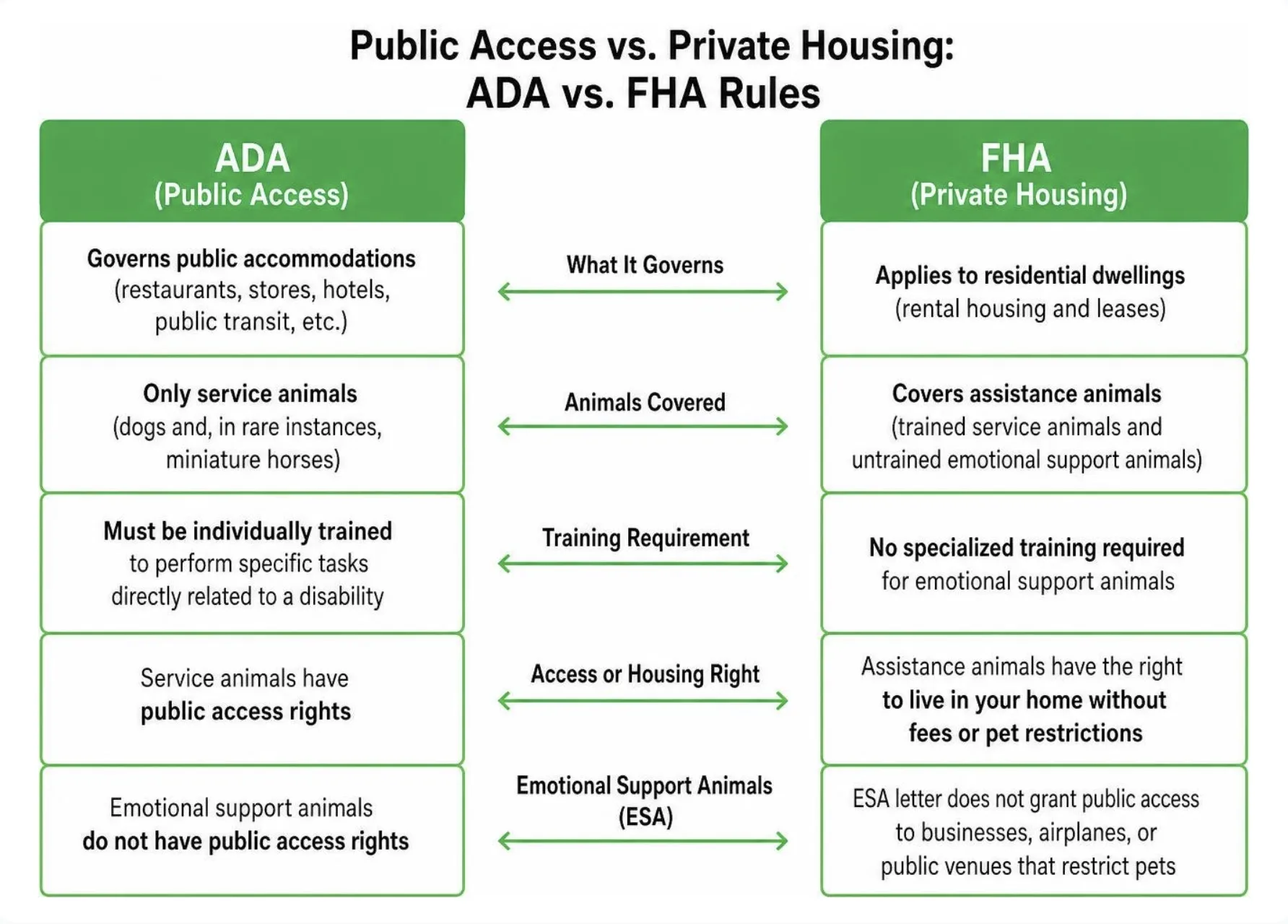
The ADA governs public accommodations—such as restaurants, grocery stores, hotels, and public transit. Under Title II and Title III of the ADA, only service animals (dogs and, in rare instances, miniature horses) that have been individually trained to perform specific tasks directly related to a person’s disability have public access rights.
In contrast, the FHA applies strictly to residential dwellings. It uses the broader category of "assistance animals," encompassing both trained service animals and untrained emotional support animals. While your ESA letter grants your companion the right to live with you in your private apartment without fees or pet restrictions, it does not provide legal clearance to bring your animal inside local businesses, airplanes, or public venues that restrict pets.
Landlord Verification Rules and Fee Prohibitions
When you submit an ESA accommodation request, your landlord has specific legal boundaries regarding what they can verify and what they cannot do under federal guidelines.

Understanding these rules ensures you protect your personal privacy while remaining fully compliant with state-level ESA regulations and HUD policy updates.
Permissible Verifications vs. Prohibited Medical Inquiries
If your disability and the disability-related need for an assistance animal are not obvious, your housing provider has the right to ask for reliable documentation confirming both points. However, their verification powers are strictly limited.
Landlords CAN:
- Confirm that you meet the definition of disability under the Fair Housing Act.
- Request documentation explaining how the animal provides support that alleviates at least one symptom of your disability.
- Verify that your documentation comes from a licensed healthcare professional with personal knowledge of your condition.
Landlords CANNOT:
- Ask for your specific medical diagnosis, clinical history, or therapy notes.
- Demand access to your medical records or require your doctor to speak directly to them about confidential details.
- Demand that an animal demonstrate specific training, certifications, or registration numbers.
- Refuse documentation simply because it was issued via a telehealth evaluation.
Housing providers generally accept documentation from a licensed medical doctor, psychiatrist, psychologist, clinical social worker, or other licensed mental health professional. This resource guide on third-party disability verification, published by the City of Sacramento, explains the standard in more detail.
Complete Exemption from Pet Fees, Deposits, and Breed Restrictions
One of the most practical benefits of FHA protections is financial relief. Under federal law, housing providers are strictly prohibited from charging pet-related fees for assistance animals.
This exemption includes:
- Upfront pet security deposits (refundable or non-refundable)
- Monthly pet rent or surcharges
- One-time pet application fees
Additionally, general property restrictions—such as breed bans, weight limitations, and height maximums—do not apply to assistance animals. A landlord cannot reject an emotional support German Shepherd or Labrador simply because the property has a 25-pound weight limit or a ban on specific breeds.
However, exemption from pet fees does not mean freedom from basic tenant responsibilities. You remain fully liable for any actual physical damage your animal causes to the apartment unit or common areas beyond normal wear and tear. Furthermore, your animal must adhere to basic community health and safety standards, such as remaining non-disruptive and not posing a direct physical threat to other residents.
How to Request Housing Accommodations with an Emotional Support Animal Apartment Letter
Securing a valid accommodation begins with obtaining legitimate clinical documentation from a qualified medical provider.

Learning how telehealth medical evaluations work allows you to schedule a consultation with a licensed professional who understands both clinical mental health standards and housing regulations. At My ESA MD, we provide same-day, telehealth-issued emotional support animal housing letters written directly by licensed MDs, operating as a family-run, doctor-led service with transparent flat-fee pricing, zero recurring memberships, and a full money-back guarantee if you do not qualify. California residents with dogs follow a 30-day process required by state law.
Essential Elements of a Valid Emotional Support Animal Apartment Letter
A legally compliant ESA letter must contain specific information to meet Fair Housing Act standards and the expectations of housing providers. Most housing providers expect letters dated within the past 12 months.
Reviewing established sample medical verification letter guidelines demonstrates that a valid letter should include:
- Professional Letterhead: The provider’s full clinical practice name, physical address, and contact telephone number.
- Licensing Credentials: The provider's professional license type, issuing state, license number, and expiration date.
- Provider-Patient Relationship: A clear statement indicating that the healthcare professional has evaluated you and has personal knowledge of your condition.
- Disability Statement: Confirmation that you have an impairment that substantially limits one or more major life activities (without disclosing confidential diagnostic codes or medical records).
- Therapeutic Nexus: A clear professional assessment stating that the emotional support animal provides necessary support that mitigates one or more symptoms of your condition.
- Signature and Date: The provider's direct signature and the date of issuance.
How to Draft and Submit an Emotional Support Animal Apartment Letter
Once your healthcare provider issues your letter, submit it alongside a formal reasonable accommodation request letter. Putting everything in writing creates a clean paper trail.
Here is a step-by-step checklist for assembling and submitting your formal request:
- Format a Clear Letter: Draft a concise letter addressed to your property manager or landlord.
- Reference the Fair Housing Act: State explicitly that you are requesting a reasonable accommodation under the FHA.
- Describe the Accommodation: Clearly identify the animal (e.g., "my domestic short-hair cat, Oliver") and request a waiver of any pet policies, restrictions, or fees.
- Attach Your ESA Documentation: Attach the signed letter from your licensed medical provider.
- Set a Response Window: Request a written response within a reasonable timeframe (typically 10 business days).
- Send with Delivery Tracking: Deliver the request via certified mail with return receipt requested, or send it by email with read receipts enabled, keeping copies of all dated materials for your personal records.
You can reference trusted sample assistance animal request templates to structure your written request clearly and professionally.
Resolving Landlord Delays, Inquiries, and Unlawful Denials
Even with legitimate documentation, some landlords may delay their response, ask improper questions, or issue an unlawful denial. When this happens, knowing how to navigate the interactive process is critical.
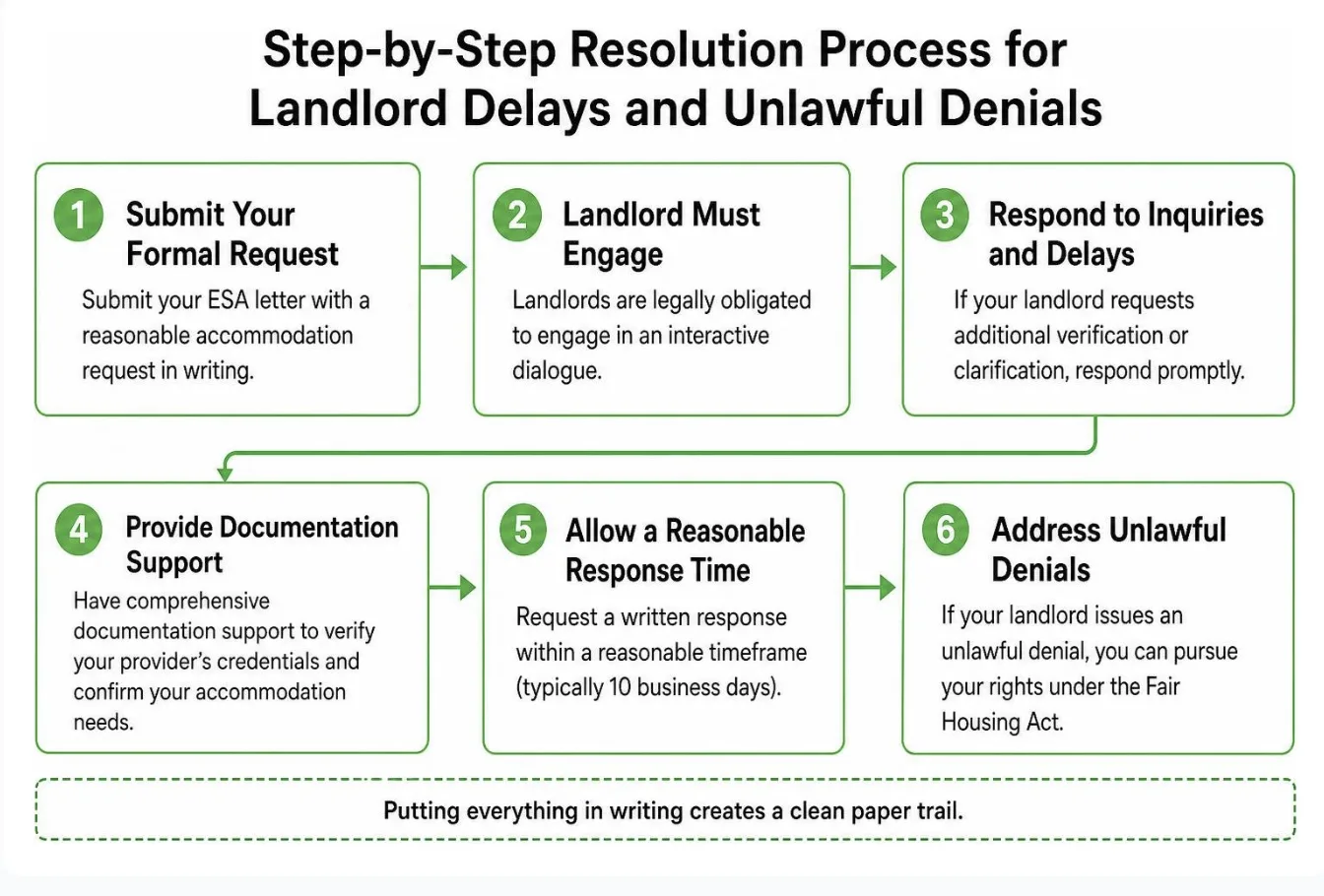
Landlords are legally obligated to engage in an interactive dialogue rather than issuing flat, unexplained rejections. If your landlord requests additional verification or clarification, having comprehensive documentation support beyond the letter ensures your provider can promptly verify their credentials and confirm your accommodation needs.
Legitimate Grounds for Denial vs. Unlawful Refusals
While the Fair Housing Act provides broad protections, a landlord can legally deny an assistance animal under narrow, clearly defined statutory exceptions:
- Direct Safety Threat: The specific individual animal poses a documented, direct threat to the health and safety of others that cannot be eliminated or reduced by other reasonable actions. (This must be based on actual behavior, not breed assumptions.)
- Substantial Property Damage: The specific animal has a history of causing severe, documented physical damage to property that cannot be mitigated.
- Undue Burden: The request imposes an undue financial or administrative burden on the housing provider, or fundamentally alters the nature of their housing operations.
- Statutory Property Exemptions: The property is an owner-occupied building with four or fewer rental units, or a single-family home sold or rented without the use of a real estate broker (provided the owner holds no more than three such homes).
Outside of these narrow exceptions, blanket denials—such as refusing an ESA due to general property rules, demanding unreasonable medical history, or rejecting telehealth letters—are unlawful.
Actionable Steps When Facing Delays or Housing Discrimination
If your housing provider ignores your request, stalls past reasonable timelines, or issues an unlawful denial, take these proactive steps:
- Send a Written Follow-Up: Remind the property manager in writing that you submitted a formal reasonable accommodation request under the Fair Housing Act and request an immediate status update.
- Document Everything: Keep a chronological log of all interactions, including dates, email exchanges, voicemail recordings, and copies of submitted documents.
- Contact a Local Fair Housing Organization: Reach out to local advocacy groups or regional fair housing counseling agencies that specialize in resolving tenant disputes and educating landlords on federal compliance.
- File a Housing Discrimination Complaint: If the landlord refuses to comply, you can file a formal housing discrimination complaint with your state's civil rights agency or with the HUD Office of Fair Housing and Equal Opportunity (FHEO). Please keep in mind that since May 2026, FHEO has concentrated on cases involving trained animals, so it may decline to pursue a complaint about an untrained ESA. For many ESA owners, the state agency is now the more effective choice, and our state-by-state guide explains the protections where you live.
Frequently Asked Questions about ESA Apartment Documentation
No. While a landlord may provide internal property forms for administrative convenience, fair housing guidance has long held that housing providers cannot require tenants to use specific company forms, nor can they deny a request simply because a tenant used a different format.
Furthermore, landlords cannot demand "ESA certifications," "official registrations," or training certificates. Under the Fair Housing Act, there is no legitimate federal registry for assistance animals; online registries selling badges and certificates carry no legal standing. The only document required by law is a valid verification letter from a licensed healthcare professional.
You can submit an accommodation request at any time—whether applying for a new apartment, preparing to move in, or requesting an accommodation during an existing tenancy.
While some renters worry that disclosing an ESA on an initial rental application might lead to hidden bias, you are legally entitled to request the accommodation as soon as you have your documentation. Making your written request before bringing the animal onto the property ensures all approvals are documented, protecting you from unwarranted pet violation notices or lease disputes.
Conclusion
Living with an emotional support animal is a right, protected by the Fair Housing Act and by many state laws, that helps individuals with mental and emotional health conditions enjoy equal comfort, safety, and well-being in their homes. By understanding the distinction between pets and assistance animals, knowing landlord verification boundaries, and securing a legitimate clinical evaluation, you can navigate apartment living with confidence.
At My ESA MD, we take the stress out of the documentation process. Our doctor-led telehealth evaluations connect you directly with licensed physicians who provide legitimate, legally compliant housing letters tailored to federal and state standards. With transparent pricing, same-day delivery, and zero recurring membership fees, securing your verified ESA letter for apartment living is straightforward, reliable, and backed by a full money-back guarantee. The only exception to same-day delivery is California, where state law requires residents with dogs to follow a 30-day process.
Ready to Talk to a Doctor?
Book a telehealth evaluation with a licensed MD. One flat fee, no memberships, and real people who answer the phone.