
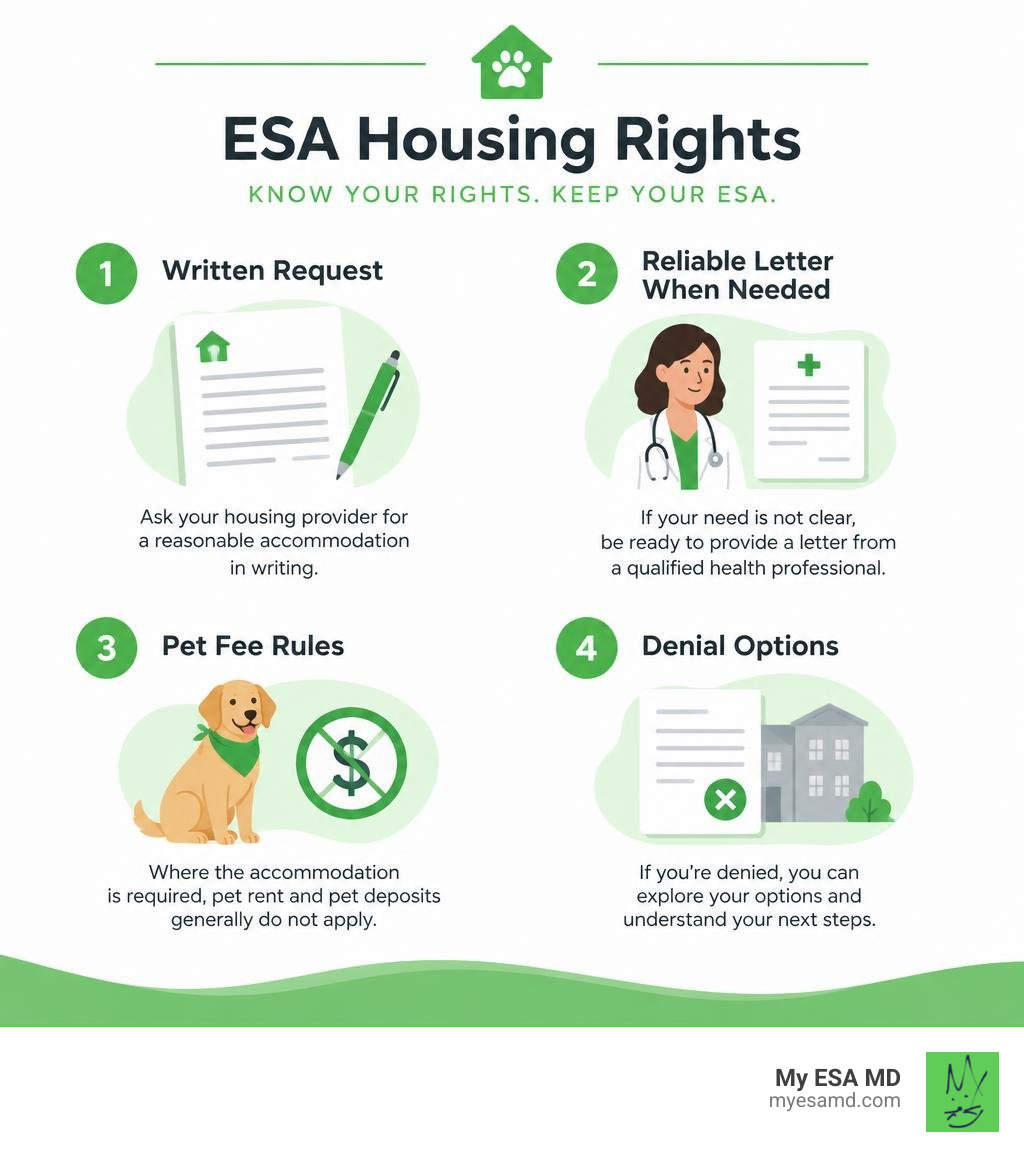
Emotional support animal housing rights may let you keep an ESA in a no-pet rental if you have a disability-related need. Ask your housing provider for a reasonable accommodation in writing. If your need is not clear, be ready to provide a letter from a qualified health professional. Where the accommodation is required, pet rent and pet deposits generally do not apply, though you can be charged for damage your animal causes.
HUD changed how it handles complaints about untrained ESAs in 2026. That shift did not repeal the Fair Housing Act or stronger state protections. This guide explains what to request, what a landlord can ask, and what to do if you are denied.
I’m Joscelyn Rieser, Director at My ESA MD, where I help coordinate access to doctor-led telehealth evaluations for emotional support animal housing letters. My background in web development and service coordination shapes how I explain the process in clear, practical steps.
Federal Laws Governing Emotional Support Animal Housing
Navigating rental markets while managing mental health challenges can be overwhelming. Fortunately, federal civil rights legislation shields tenants living with qualifying mental or physical impairments from discriminatory housing practices. The primary federal shield is the Fair Housing Act (FHA), enforced across the country to guarantee equal housing opportunities. Under the FHA, housing providers must offer reasonable accommodations—exceptions or changes to existing rules, policies, or lease clauses—so individuals with disabilities can fully enjoy their dwellings.
Beyond the FHA, Section 504 of the Rehabilitation Act of 1973 protects individuals living in federally funded or subsidized housing (such as HUD-assisted developments and public housing authorities). While the Americans with Disabilities Act (ADA) governs public entities and commercial spaces, its Title III provisions generally do not govern private residential leases. The FHA is central to residential accommodation requests; Section 504 applies to federally funded programs, and ADA Title II can also apply to housing programs operated by public entities.
Under these fair housing statutes, assistance animals are categorized distinctly from ordinary domestic pets. Landlords cannot treat an assistance animal as an optional luxury. The table below illustrates the critical distinctions between standard pets, task-trained service dogs, and emotional support animals in residential settings:
| Category | Primary Legal Definition | Federal Housing Protection | Public Access Rights (ADA) | Individual Task Training Required? | Pet Fees & Deposits Permitted? |
|---|---|---|---|---|---|
| Household Pet | Companion animal kept for pleasure or companionship without medical necessity. | No disability-related assistance-animal protection solely because the animal is a pet; leases and applicable laws govern. | No public access rights. | No training required. | Yes. Landlords may charge pet deposits, monthly pet rent, and initial pet fees. |
| Service Animal | Under the ADA, a dog individually trained to perform disability-related work or tasks; miniature horses are addressed by a separate accommodation provision. | Protected under applicable disability laws; FHA, Section 504 and ADA coverage depends on the housing provider and setting. | Access to covered public settings, subject to applicable rules and lawful exclusions; transportation rules vary. | Yes. Must perform specific disability-mitigating physical or psychiatric tasks. | No pet fees or pet deposits where disability accommodation protections apply; charges for actual damage may still apply. |
| Emotional Support Animal (ESA) | Animal that provides therapeutic support, comfort, or companionship alleviating disability symptoms. | May qualify for reasonable accommodation under the FHA and applicable state laws; HUD's current FHA enforcement standard does not presumptively protect untrained ESAs. | No general ADA public-access rights; housing accommodation is a separate protection. | No specialized behavioral task training required. | Pet rent, pet fees and pet deposits generally do not apply where an ESA accommodation is legally required. |
Service Animals vs. Emotional Support Animals
A frequent point of confusion for both renters and property managers is the legal difference between a service animal and an emotional support animal. Under Title III of the ADA, a service animal is a dog individually trained to perform disability-related work or tasks. A separate provision addresses reasonable modifications for trained miniature horses. These tasks include guiding visually impaired individuals, pulling wheelchairs, alerting deaf handlers to sounds, or actively interrupting self-harm behaviors. A psychiatric service dog (PSD) is individually trained to perform disability-related tasks, which may include responding to panic attacks or performing trained grounding tasks.
Conversely, understanding what qualifies as an emotional support animal involves looking at the therapeutic effect of the animal's presence. ESAs provide companionship, security, and calming emotional grounding that alleviates symptoms of conditions like generalized anxiety disorder, major depression, or post-traumatic stress disorder. They do not require task-specific training or obedience school certificates. Instead, eligibility centers entirely on whether the handler has an identifiable disability and whether the animal's presence mitigates those functional limitations. If you are exploring whether your mental health condition qualifies, learning who is eligible for an emotional support animal can provide clarity before requesting accommodations.
Securing Emotional Support Animal Housing in College Dorms
Campus life brings intense academic pressure, social adjustments, and shared living arrangements, making emotional support animals vital for many university students. College residence halls generally fall under fair housing law. Section 504 also applies to institutions receiving federal funding, and ADA obligations depend on the institution and setting. An ESA request requires an individualized assessment of disability-related need and applicable accommodation requirements; submitting a request does not guarantee approval.
Check your university's disability services and housing procedures. Deadlines and procedures vary from school to school, so it is wise to contact your school's disability services office well before the semester begins. For an in-depth breakdown of dorm requirements, check out our guide on emotional support animals in college dorms.
You can also review national disability education resources, such as A Home Away from Home: Understanding Housing Accommodations | National Center for College Students with Disabilities, as well as university-specific workflows like the Housing Accommodation & ESA Requests | Residence Life | Elon University portal. Check the institution's current disability-related documentation and housing application requirements; a diagnosis or provider recommendation does not automatically establish entitlement to a particular housing assignment.
HUD Enforcement Guidance and Changing Regulations in 2026
HUD issued new animal-accommodation enforcement guidance on May 22, 2026. Its Fair Housing and Equal Opportunity office (FHEO) now uses an individual disability-related task-training standard when deciding whether to pursue FHA animal-accommodation complaints.
For a comprehensive overview of how these federal policy revisions interact with local statutes, consult our guide to ESA laws by state and HUD changes.
Current Federal Enforcement and Reasonable Accommodations
Under HUD's May 22, 2026 enforcement guidance, requests involving untrained ESAs are not presumptively reasonable for FHEO's FHA enforcement purposes. Instead, federal administrative investigators now align their primary enforcement priorities more closely with the ADA's individual training standards. When an administrative complaint involves an animal lacking specific disability-related task training, HUD may close the administrative file without issuing a formal charge of discrimination.
It is crucial to understand what this administrative change does not do:
- The Fair Housing Act itself has not been amended. Only Congress can rewrite federal civil rights statutes; an administrative memo cannot eliminate the statutory duty of housing providers to offer reasonable accommodations.
- The Private Right of Action remains fully active. Tenants still hold the independent legal right to file federal civil lawsuits against landlords who unlawfully deny legitimate ESA accommodations. The enforcement memo does not itself change the FHA or establish that courts must exclude untrained ESAs from housing protections.
- Other federal laws still apply. The May 2026 memo addresses the Fair Housing Act. Federally funded housing is also covered by Section 504, and housing run by public entities is covered by ADA Title II, so those obligations continue to apply. For an example, see the Department of Justice's East Hampton Housing Authority settlement, which concerns an ESA housing denial.
Stronger State-Level Protections Across California, Texas, and Beyond
Because HUD's internal policy shift primarily alters federal administrative complaint screening, state-level fair housing statutes have become the frontline of tenant protection. Many state civil rights laws grant broader protections than baseline federal agency enforcement.
- California: Under the Fair Employment and Housing Act (FEHA) and its regulations, a support animal does not need specialized training to qualify as a reasonable accommodation. California also has its own documentation rules: under AB 468, a healthcare practitioner generally must have a client relationship of at least 30 days before providing a letter for an emotional support dog. A letter alone does not guarantee approval of an accommodation request. Explore our detailed guide to California ESA housing rules for local procedures.
- Texas: The Texas Fair Housing Act requires reasonable disability accommodations. Depending on the circumstances, an ESA accommodation can include an exception to a no-pets policy and to pet-related charges or restrictions. You can review our Texas housing protections breakdown for state-specific filing processes.
- Florida: Florida statutes explicitly prohibit charging extra fees for assistance animals and separately penalize fraudulent ESA documentation. Read our guide on Florida ESA regulations to stay fully compliant.
The Reasonable Accommodation Process and Required Documentation

Securing an accommodation for an emotional support animal is a formal legal process. You do not need to disclose your complete medical chart, surgical history, or psychiatric therapy session notes. Instead, the law requires establishing a clear connection (or "nexus") between your disability-related need and the support provided by your animal.
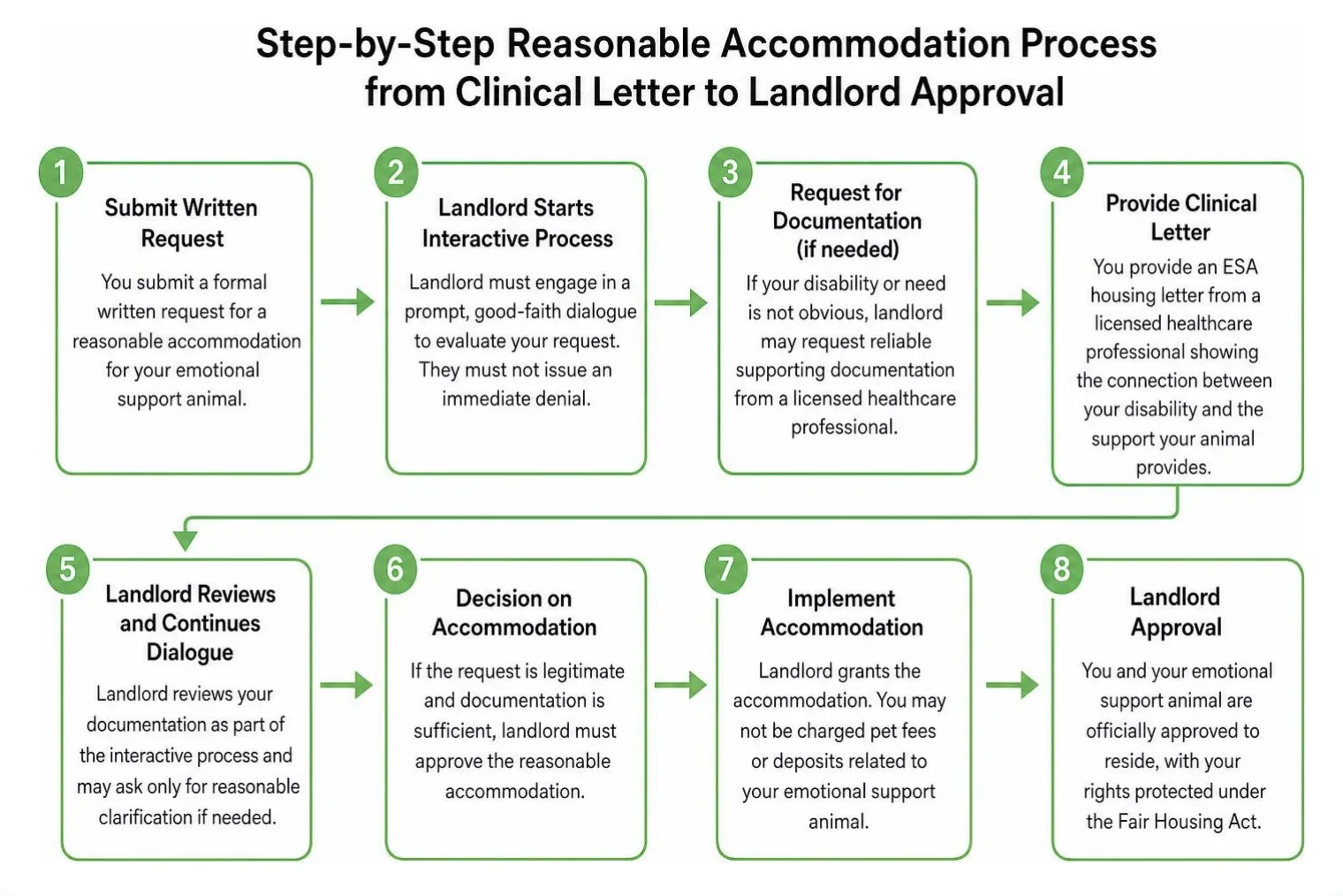
Tell your housing provider that you need a disability-related accommodation for an assistance animal. A written request helps preserve a record, but the FHA does not generally require a formal written application. The housing provider should evaluate your request individually and seek clarification when needed; applicable state law may also require an interactive process—a dialogue about your accommodation needs. If your disability or disability-related need for the animal is not apparent, the housing provider may request reliable information sufficient to establish what is not apparent. A qualified healthcare professional's letter may help provide that information. To better understand this clinical evaluation stage, see how the consultation process works.
Legitimate Clinical Letters for Housing
When supporting documentation is needed, a letter from a qualified healthcare professional can help establish the disability-related need. Applicable state rules may govern the clinician's qualifications and relationship with you. Useful letter contents include:
- The clinician's full name, professional license number, state of licensure, and active contact information.
- The clinician's official letterhead and professional signature.
- Confirmation that you have an impairment that substantially limits one or more major life activities (without disclosing your specific private medical diagnosis).
- A clinical statement affirming that the emotional support animal provides symptom relief or therapeutic assistance directly related to that impairment.
At My ESA MD, we specialize in providing authentic, doctor-led clinical evaluations. We operate in the telemedicine healthcare sector, connecting patients directly with licensed MDs who issue verifiable, compliant ESA housing letters. As a doctor-led, family-run service, we offer transparent flat-fee pricing with zero recurring subscriptions or hidden membership fees—backed by a full money-back guarantee if our physicians determine you do not qualify.
You can streamline your documentation by getting an authentic ESA letter signed by a licensed physician to support your accommodation request, subject to applicable state requirements and an individualized housing review. Having thorough, doctor-backed clinical documentation provides confidence when presenting your accommodation request to property management, illustrating the benefits of comprehensive clinical support.
A quick note on commercial scams: Landlords are legally permitted to reject fake "registrations," novelty badges, online certificate registries, and ESA ID cards purchased from predatory websites. These commercial items carry no legal authority under the Fair Housing Act and do not establish a disability-related need for an accommodation. When reliable supporting documentation is necessary, a qualified healthcare professional's letter can help establish that need.
Special Considerations for Seniors and Vulnerable Populations
Emotional support animals are especially beneficial for vulnerable populations navigating major life transitions. Senior citizens living in age-restricted independent living communities, assisted living centers, or retirement facilities frequently rely on companion animals to mitigate chronic loneliness, cognitive decline, and depressive symptoms. Learn more about senior housing rights in our guide to ESAs for senior citizens.
Similarly, individuals fleeing abusive household environments face unique challenges. Many survivors delay leaving unsafe relationships because standard emergency shelters cannot accommodate pets. Organizations like Crisis Center North provide vital transitional housing, emergency pet boarding, and veterinary stipends to ensure survivors and their emotional support animals can find safety together without sacrificing their animal companions.
Landlord Restrictions, Fee Waivers, and Lawful Denials

Where an ESA accommodation is legally required, the animal is treated as an assistance animal rather than a pet, and pet fees and conflicting pet restrictions generally do not apply. Applicable safety, nuisance and damage rules still apply.
Rules on Pet Rent, Deposits, and Breed Bans
Where an ESA accommodation is legally required, the following limits generally apply to pet-related leasing clauses:
- No Pet Deposits or Upfront Pet Fees: Housing providers cannot demand an additional security deposit, non-refundable pet deposit, or cleaning fee as a condition for permitting an ESA.
- No Monthly Pet Rent: Landlords cannot charge monthly pet rent or surcharge the tenant's base lease rate.
- Exemption from Breed, Size, and Weight Limits: Blanket building restrictions prohibiting specific breeds (e.g., Pit Bulls, German Shepherds, Rottweilers) or imposing weight ceilings (e.g., animals under 25 lbs) cannot be applied to assistance animals. Every ESA must be assessed individually.
- Standard Property Damage Rules Apply: While pet deposits are prohibited, tenants remain financially liable for any actual physical damage caused by their animal to the apartment or common areas beyond normal wear and tear. Landlords may deduct eligible repair costs from an ordinary security deposit, subject to the lease and applicable state law.
Lawful Grounds for Denying Emotional Support Animal Housing
Fair housing protections are extensive, but they are not absolute. Landlords are not required to grant every request unconditionally. A housing provider can legally deny an assistance animal accommodation under specific circumstances:
- Direct Threat to Health and Safety: If the specific animal exhibits severe aggression, lunges at or bites other residents or staff, or displays an unmanageable temperament that cannot be mitigated by reasonable handling, the landlord may deny or revoke the accommodation.
- Substantial Physical Property Damage: A substantial risk of physical property damage may justify denial if reasonable measures cannot sufficiently reduce or eliminate it. Any eviction must separately comply with applicable law and required procedures.
- Fundamental Alteration of Housing Operations: If accommodating the animal would fundamentally alter the essential nature of the housing provider's operations.
- Undue Financial or Administrative Burden: If accommodating the animal would impose an undue financial or administrative burden on the housing provider (assessed individually, including whether reasonable alternatives can avoid the claimed burden).
- Statutory Fair Housing Exemptions: Certain small-scale private rental arrangements are exempt from FHA reasonable accommodation mandates:
- The "Mrs. Murphy" Exemption: Owner-occupied buildings containing no more than four dwelling units in total, including the owner's unit.
- Single-Family Housing Sold/Rented Without a Broker: Single-family homes rented directly by a private owner who owns no more than three such homes at one time, provided no real estate agent is utilized and no discriminatory advertising is published.
- Private Clubs and Religious Organizations: Narrow FHA exceptions permit certain membership or religious preferences; they are not blanket exemptions from every fair housing obligation.
Federal exemptions have specific conditions, and state or local fair housing laws may still require an accommodation.
Tenant Obligations and Recourse for Unlawful Denials
Holding an ESA letter does not give a tenant permission to ignore community safety and public health rules. As an assistance animal handler, you have continuous responsibilities to ensure your animal remains an asset rather than a community disruption:
- Active Physical Control: You must maintain continuous control over your ESA. Follow applicable leash and animal-control requirements in hallways, elevators, and outdoor common areas. If your disability prevents using a required device, request an appropriate accommodation and maintain effective control of the animal.
- Hygiene and Waste Removal: You must promptly pick up and properly dispose of all animal waste in designated trash receptacles. Repeated failure to clean waste in shared courtyards can result in valid lease violations.
- Adherence to Local Ordinances: Your ESA must comply with municipal animal control laws, including mandatory rabies vaccinations, municipal pet licensing, and local spay/neuter mandates.
- Noise Control and Nuisance Prevention: While occasional barking or vocalization is natural, constant, unabated barking that breaches local quiet hours or building nuisance rules can jeopardize your accommodation.
How to Handle an Unlawful Landlord Rejection
If your housing provider refuses to review your accommodation paperwork, insists on collecting prohibited pet rent, or denies your accommodation request without lawful justification, follow these steps to defend your rights:
- Request Written Explanation: Always ask your landlord to state their specific, documented reasoning for the denial in writing. Keep complete copies of all emails, letters, and timestamps.
- Engage in Clarification: If the property manager claims your letter lacks specific details, work with your healthcare provider to supply a supplemental clarification note confirming their licensure and clinical relationship.
- File a State Civil Rights Complaint: Because HUD's 2026 administrative screening favors trained service animals, contact your state civil rights agency to ask whether state law provides an enforcement route for your ESA accommodation complaint.
- Pursue Private Legal Action: Under the Fair Housing Act's private right of action, you can retain a tenant rights attorney or legal aid organization to file a civil lawsuit in federal or state court. An attorney can explain the remedies potentially available in your case; filing suit does not guarantee relief.
Frequently Asked Questions About ESA Housing Protections
Conclusion
Securing your legal rights under federal and state assistance animal regulations should be a straightforward, empowering experience. While HUD's 2026 procedural updates have placed greater emphasis on state-level protections and private enforcement for untrained support animals, the underlying statutory foundation of the Fair Housing Act remains unchanged: tenants with disability-related needs may qualify for reasonable accommodations to live with their ESAs without pet fees or blanket breed restrictions, depending on applicable law and the individual circumstances.
Reliable clinical documentation can support an accommodation request when documentation is needed, but it does not guarantee approval or prevent disputes. If you need verifiable, compliant documentation, schedule a consultation with My ESA MD. Our licensed physicians conduct comprehensive telehealth evaluations, providing authentic, legally sound ESA housing letters backed by transparent pricing, no subscription traps, and a complete money-back guarantee. Protect your peace of mind and your living space today.
Ready to Talk to a Doctor?
Book a telehealth evaluation with a licensed MD. One flat fee, no memberships, and real people who answer the phone.