
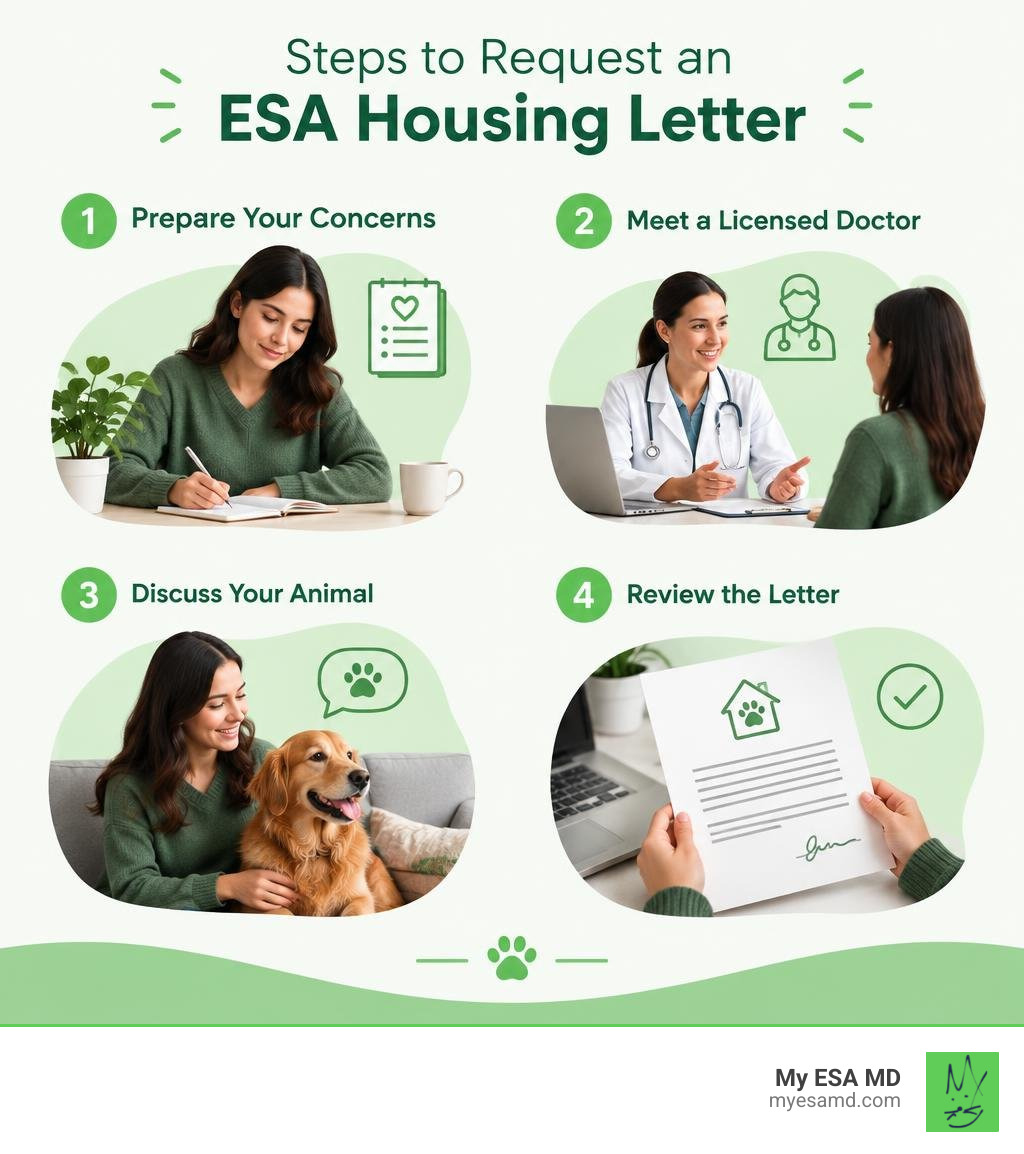
To get an ESA letter from a licensed doctor, schedule an evaluation and explain how your condition affects daily life and how your animal helps. If the doctor determines that an ESA is appropriate, ask for a housing letter with their license details and an explanation of your need for the animal. Check your state's rules before giving the letter to your landlord.
An ESA letter is not an instant certificate. A doctor needs enough information to make a sound clinical decision, and a letter does not give an animal the same public-access rights as a service animal.
I'm Joscelyn Rieser, director at My ESA MD, where I support doctor-led telehealth evaluations for ESA housing letters. My background in operations and web development helps me make the licensed doctor ESA letter process easier to understand.
Understanding Emotional Support Animals vs. Service and Therapy Animals
Navigating working and support animals can feel like wading through an alphabet soup of legal terms. Many people inadvertently conflate emotional support animals (ESAs), service animals, and therapy animals, but federal law draws distinct lines between them.
Under the Americans with Disabilities Act (ADA), a service animal is a dog individually trained to perform specific tasks directly related to an individual's physical, sensory, psychiatric, intellectual, or mental disability. Separate ADA provisions address reasonable modifications for individually trained miniature horses. Examples include guiding someone with vision loss, alerting a person with diabetes to dangerous blood sugar shifts, or interrupting self-harm behaviors during a panic attack. Service animals generally may accompany their handlers in public places such as restaurants, grocery stores, hotels and public transit, subject to applicable access rules and exceptions.
In contrast, an emotional support animal provides therapeutic companionship, comfort, and emotional stability that helps alleviate one or more identified symptoms of a person's mental or psychological disability. Crucially, ESAs are not required to undergo specialized behavioral training to perform physical tasks. Emotional support alone does not qualify an animal for public-access rights under the ADA. Businesses may permit ESAs voluntarily, but an ESA letter does not create a right to enter. ESA housing accommodation options depend on applicable federal, state and local law.
Finally, therapy animals are trained alongside their owners to provide comfort, affection, and emotional support to groups of people in structured clinical or community environments, such as hospitals, hospices, disaster areas, or schools. Therapy animals do not have individual housing protections or general public access rights; their entry is granted solely by permission of the facilities they visit.
To make these legal and functional differences crystal clear, consider the following breakdown:
| Feature | Emotional Support Animal (ESA) | Service Animal (ADA) | Therapy Animal |
|---|---|---|---|
| Primary Legal Protection | Housing accommodation laws; protections vary by jurisdiction | Americans with Disabilities Act (ADA) | None (Facility permission only) |
| Public Access Rights | No general ADA public-access right | Generally yes under the ADA, subject to exceptions; flights follow separate air-travel rules | No general public-access right; facility permission needed |
| Specialized Task Training | Not required | Mandatory individual task training | Basic obedience and socialization |
| Species Permitted | Various species; accommodation requirements depend on applicable law and circumstances | Dogs; separate ADA provisions address miniature horses | Dogs, cats, horses, rabbits, etc. |
| Documentation Needed | Reliable disability-related documentation may be requested when disability or need is not apparent, subject to applicable law | No certification required for ADA public access; limited questions may be permitted. Airlines may require U.S. Department of Transportation (DOT) forms | Facility-specific requirements |
For individuals exploring their rights, understanding what qualifies as an emotional support animal is essential to ensure they do not accidentally overstep legal boundaries. The distinction is also heavily highlighted in clinical literature; for example, the American Family Physician framework explores these distinctions in Emotional Support Animals: Considerations for Documentation, providing guidance on separating clinical housing needs from public access tasks.
Clinical Benefits and Potential Risks of Emotional Support Animals
From a clinical perspective, an emotional support animal is not just a beloved household pet—it functions as a genuine adjunct to ongoing psychiatric and psychological care. For patients navigating major depressive disorder, generalized anxiety disorder, or post-traumatic stress disorder (PTSD), the presence of an animal can offer profound symptom relief.
The daily routine required to care for an animal creates an external structure that encourages patients to engage in behavioral activation. A dog needing a morning walk or a cat requiring scheduled feedings gives an individual experiencing severe depressive episodes a tangible reason to get out of bed, take their prescribed medications, and step outside. Furthermore, the tactile stimulation of petting an animal is clinically shown to lower cortisol levels and elevate oxytocin, mitigating acute panic and grounding patients during dissociative episodes.
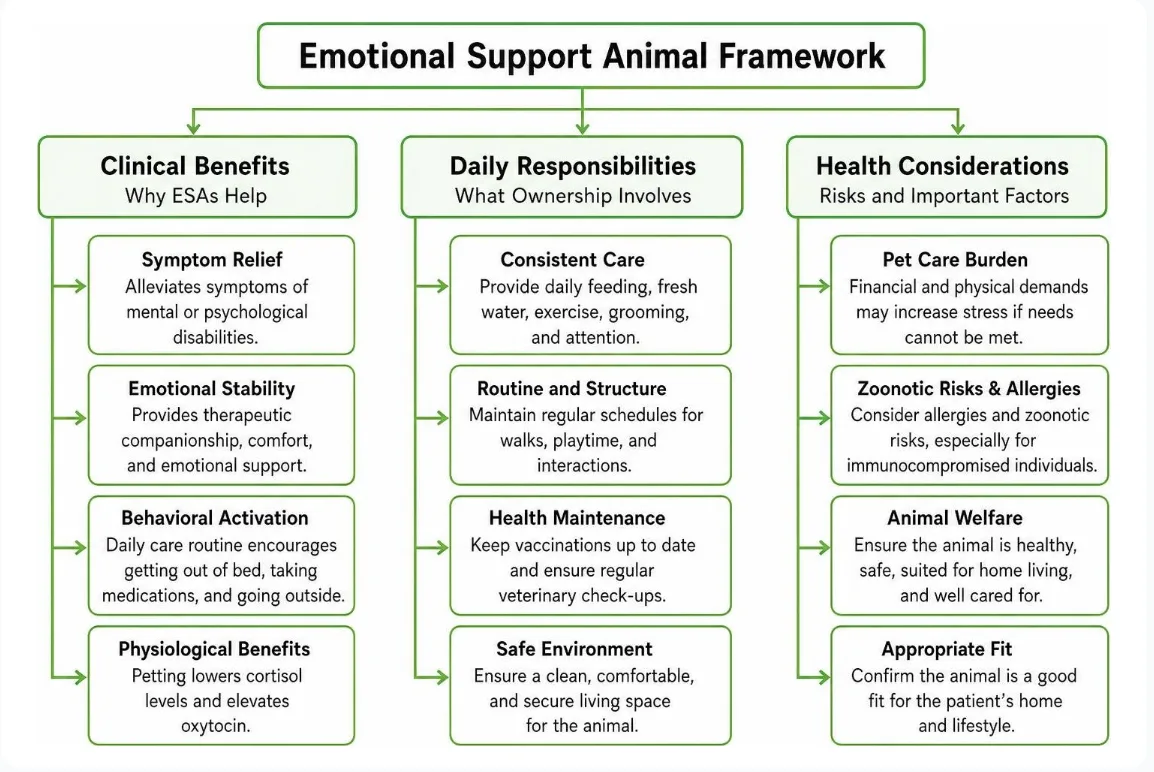
However, responsible clinicians also evaluate the potential risks associated with an ESA recommendation:
- Pet Care Burden: If a patient is severely functionally impaired, the financial and physical demands of pet care can paradoxically increase stress or trigger feelings of guilt if the animal's needs are neglected.
- Zoonotic Risks and Allergies: Immunocompromised individuals or households with severe animal dander allergies require careful medical screening before introducing an animal into the home.
- Animal Welfare: Ensuring that the animal is physically healthy, safe, up to date on vaccinations, and well-suited for living in a residential environment is vital for both tenant well-being and animal welfare.
How an ESA Letter Can Support a Housing Accommodation Request
The U.S. Department of Housing and Urban Development's (HUD) May 2026 enforcement approach focuses animal-accommodation complaints on animals trained to provide disability-related assistance. The Fair Housing Act itself has not been repealed, and ESA housing accommodation options depend on applicable federal, state and local law. Check the rules that apply to your housing rather than assuming an ESA letter overrides a no-pets policy.
An ESA letter from a licensed doctor can document your disability-related need, but it does not automatically establish housing protections. Depending on applicable law and your circumstances, a reasonable accommodation may include:
- Exceptions to no-pets rules: A qualifying accommodation may allow an ESA despite a no-pets policy.
- Pet-fee waivers: Where applicable law requires an ESA accommodation, pet-specific deposits, pet rent and pet fees may not apply. This does not eliminate ordinary rental application fees or liability for damage.
- Exceptions to breed or weight limits: Applicable assistance-animal protections may require exceptions to pet restrictions. Requests remain subject to legally recognized exceptions, including individualized safety assessments and undue-burden considerations.
Housing providers have the legal right to request reliable disability-related documentation when a disability or the need for an accommodation is not obvious. Understanding the criteria for who is eligible for an emotional support animal helps ensure that your housing request is supported by medical necessity.
What Qualifies as a Legitimate Licensed Doctor ESA Letter?
A legally compliant ESA housing letter is a formal medical document. It is not an ID card, a certificate, or a digital badge. Documentation should support your disability-related need and meet applicable current requirements.
The following information can help document and verify a request; exact requirements depend on applicable law:
- Professional Letterhead and Contact Information: Identify the practice and provide contact information for appropriate verification.
- Provider Credentials and License Details: The issuing clinician’s full legal name, professional title (e.g., MD, DO, Psychiatrist), license type, active license number, and the state jurisdiction in which they are licensed.
- Established Provider-Patient Relationship: A clear statement confirming that the clinician has conducted a comprehensive clinical evaluation of the patient.
- Disability-Related Need: When documentation is required, it should support the disability and the connection between that disability and the animal's assistance, consistent with applicable law. A diagnosis under the Diagnostic and Statistical Manual of Mental Disorders (DSM-5) alone does not establish the legal disability standard, and detailed diagnostic information need not be disclosed in the letter.
- Medical Necessity Statement: A direct clinical explanation affirming that the animal provides therapeutic support that mitigates one or more symptoms of the identified condition.
- Date and Signature: The date of issuance and the clinician’s physical or secure digital signature. There is no universal federal rule that ESA letters expire after 12 months; whether updated documentation may be requested depends on applicable law and circumstances.
Legal and Ethical Risks of Online Letter Mills and Fake Registries
The rapid expansion of internet commerce has brought an explosion of commercial "letter mills" offering instantaneous ESA certificates for an upfront fee of $50 to $99. These websites frequently make fraudulent promises, claiming that buying their "official lifetime registration" or plastic badge grants instant housing and airline rights without requiring an evaluation with a licensed physician.
These operations carry severe consequences. A purchased certificate alone does not establish a right to accommodation. Where documentation is appropriately requested, a housing provider may verify credentials and seek permitted clarification, but this does not create unrestricted access to confidential clinical records.
Misrepresentation penalties vary by state and by the conduct involved; buying an inadequate certificate is not automatically the same as fraudulently representing a pet as a service animal.
Who Can Legally Write Your ESA Letter and State Compliance Requirements
To satisfy federal and state housing standards, your emotional support animal evaluation must be performed by an authorized, licensed health care professional operating within their scope of practice.
Professionals who can typically write an ESA letter include:
- Licensed Physicians (MD or DO): General practitioners, primary care physicians, and board-certified psychiatrists.
- Licensed Mental Health Professionals (LMHPs): Clinical psychologists, licensed clinical social workers (LCSWs), licensed professional clinical counselors (LPCCs), and marriage and family therapists (LMFTs).
- Advanced Practice Clinicians: Psychiatric nurse practitioners (PMHNPs) and physician assistants (PAs) practicing within mental health disciplines.
Crucially, telehealth is a fully recognized, legal medium for receiving an ESA evaluation, provided the clinician is appropriately licensed or otherwise authorized to practice where the patient is physically located during the consultation and follows applicable state requirements. You can review detailed jurisdictional changes and state-specific ESA laws and HUD updates to confirm how your local regulations align with federal standards.
California AB 468 and State-Specific Mandates
In response to consumer abuse and fly-by-night online operations, several states have passed stringent legislation regulating assistance animal documentation. The most prominent example is California Assembly Bill 468 (AB 468).
California AB 468 sets specific requirements for practitioners providing documentation of a person's need for an emotional support dog:
- Established 30-Day Relationship: For emotional-support-dog documentation, the practitioner generally must establish a client-provider relationship at least 30 days beforehand, subject to the limited statutory exception for verified homelessness.
- Clinical Evaluation: The practitioner must complete a clinical evaluation of the person's need for an emotional support dog. AB 468 does not require two clinical sessions.
- License Information and Notice: The documentation must include the required license information, and the practitioner must notify the client that knowingly and fraudulently representing oneself as the owner or trainer of a guide, signal or service dog is illegal.
- Disciplinary Oversight: Clinicians who violate these documentation standards face formal sanctions from state boards, including the California Medical Board or the California Board of Behavioral Sciences.
Instant approval without a genuine evaluation may fail applicable documentation requirements. Check the rules for your state and animal; an online platform alone does not determine a document's legal validity or the outcome of an accommodation request.
Step-by-Step Guide: How to Prepare and Ask Your Doctor for an ESA Letter
Initiating a clinical conversation about mental health and assistance animals can feel daunting. Approaching your medical provider with an organized, transparent presentation of your history helps your doctor evaluate your situation through a structured clinical lens.

Step 1: Document Your Symptoms and Functional Limitations
Before your appointment, write down specific details regarding how your condition affects your day-to-day life. Clinicians evaluate requests using the DSM-5 framework. Identify specific functional impairments:
- Does severe anxiety impair your ability to sleep or trigger panic attacks in your living space?
- Does clinical depression cause periods of isolation or severe executive dysfunction?
- Does trauma or PTSD create hypervigilance when you are home alone?
Step 2: Track How Your Animal Actively Mitigates These Challenges
Be prepared to explain the therapeutic mechanism of your animal. Avoid generic statements like "I love my dog and he makes me happy." Instead, use clinical cause-and-effect examples:
- "When I experience acute sensory overload or panic, placing my hands on my cat provides tactile grounding that shortens the duration of the episode."
- "My dog creates a mandatory daily routine that helps me overcome depressive paralysis, ensuring I get out of bed and take my prescribed medications."
Step 3: Gather Animal Health and Behavioral Records
A responsible doctor must consider the safety and welfare of both the patient and the residential community. These records are not a standard prerequisite for a My ESA MD consultation. If your clinician requests animal health or behavior records, available information may include:
- Current vaccination and rabies records from your veterinarian.
- Spay/neuter confirmation.
- A brief summary confirming the animal is housebroken and displays no aggressive behaviors toward humans or other animals.
How to Request a Licensed Doctor ESA Letter During a Consultation
When you sit down with your physician—whether in person or via secure, HIPAA-compliant telehealth—open the discussion collaboratively. Treat the emotional support animal as one component of a broader, holistic mental health plan rather than an isolated administrative request.
Example Conversation Opener:
"Doctor, I’ve been struggling with severe anxiety that significantly impairs my sleep and daily functioning at home. Alongside our discussions regarding therapy and medication management, I’ve found that caring for my animal significantly stabilizes my symptoms and helps me self-soothe during panic attacks. Could we discuss evaluating my need for an emotional support animal as part of my ongoing treatment plan, and whether you would be comfortable documenting this for my housing provider?"
This clinical approach signals to your doctor that you respect their professional judgment and understand that an ESA is an adjunct to comprehensive medical care. Be ready to discuss ongoing follow-ups to review how the animal continues to impact your symptom management over time.
What to Do If Your Primary Care Provider Won’t Write an ESA Letter
It is not uncommon for patients to encounter primary care physicians who decline to write ESA letters. In most instances, this refusal is not a dismissal of your symptoms. Common reasons include:
- Clinic Policy Restrictions: Many large hospital networks and primary care groups enforce internal administrative policies barring general practitioners from signing housing accommodation forms, deferring all disability documentation to mental health specialists.
- Unfamiliarity with Housing Law: Some physicians are simply unfamiliar with Fair Housing Act guidelines or state-specific statutes like California AB 468 and fear legal liability.
- Scope of Practice: A doctor focused primarily on physical medicine may feel uncomfortable assessing psychiatric functional impairments without specialized mental health training.
If your primary doctor cannot write the letter, ask them for a direct referral to a licensed mental health professional or psychiatric clinician who specializes in assistance animal evaluations. Alternatively, you can book an appointment with our family-run, doctor-led telehealth team, where licensed medical doctors conduct comprehensive clinical evaluations tailored to state and federal accommodation guidelines. You can start by booking a direct clinical consultation to evaluate your eligibility with a licensed physician.
Frequently Asked Questions About Doctor ESA Letters
Conclusion
Securing an official ESA letter is a medical and legal process designed to protect individuals living with genuine mental and psychological health challenges. A purchased certificate without a genuine evaluation may not support a housing accommodation request. Misrepresentation penalties depend on state law and the conduct involved; purchasing a certificate alone does not automatically establish an offense.
When professional documentation is needed, seek an authorized, licensed health care professional who can evaluate your disability-related need and provide appropriate documentation. The documentation required and the protections available depend on applicable law and your circumstances.
At My ESA MD, we provide comprehensive, doctor-led telehealth evaluations. Our licensed physicians work directly with you to assess your therapeutic needs with transparent, flat-fee pricing. To learn more about navigating regional legal frameworks, review our comprehensive California ESA legal guide or schedule your clinical consultation today.
Ready to Talk to a Doctor?
Book a telehealth evaluation with a licensed MD. One flat fee, no memberships, and real people who answer the phone.
Approved by: Dr. Rick Rieser, MD — Medical Director, My ESA MD. Stanford-trained physician, 30+ years of clinical experience.