
An ESA letter for rental property helps you ask your landlord to make an exception to a no-pets rule. To use one, send a written request with a letter from a licensed healthcare professional confirming your disability-related need for the animal. Ask the landlord to waive pet fees, deposits, and pet rent for the ESA, and keep copies of everything you send.
A valid letter supports your request; it does not mean every animal must be approved. Your landlord may ask for reliable documentation when the need is not clear, and must consider the request under applicable housing law.
In May 2026, HUD narrowed its enforcement approach to animals trained to provide disability-related assistance. The FHA itself did not change, but protections for untrained ESAs and available enforcement routes vary by state and legal circumstances.
I'm Joscelyn Rieser, director at My ESA MD, where I help coordinate doctor-led telehealth evaluations for people seeking an ESA letter for rental property. My background in service coordination and web development helps me explain the rental request process in clear, practical steps.
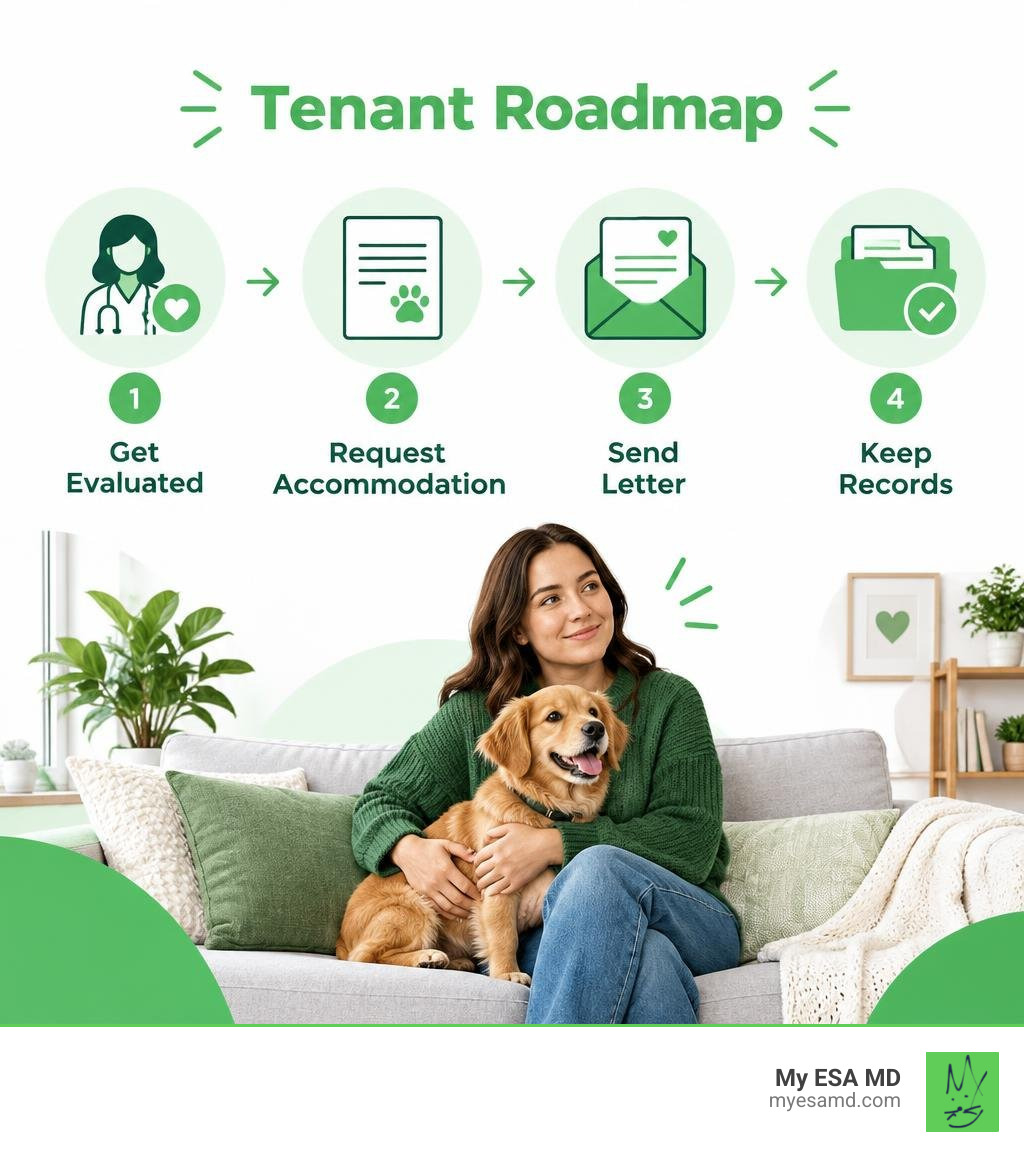
What Is an ESA Letter for Rental Property and How Does It Protect Tenants?
Searching for housing when you rely on an animal for mental health support can feel like navigating an obstacle course. Over 60% of U.S. renters share their homes with pets, yet pet-friendly listings make up only about 40% of available rentals in competitive areas like Southern California. When buildings enforce strict "no-pets" rules or steep surcharges, finding a safe home becomes challenging.
This is where the federal Fair Housing Act (FHA) steps in. Under the FHA, emotional support animals are not classified as standard pets. Instead, they fall under the broader legal category of "assistance animals." A disability-related need for an animal can support a reasonable accommodation request. Whether an untrained ESA is protected, and how a tenant can enforce that protection, depends on applicable law and the circumstances; current HUD enforcement does not cover untrained ESAs in the same way as trained assistance animals.
A recommendation letter from a licensed healthcare professional can support your accommodation request when reliable documentation of the disability or disability-related need is necessary. It informs your landlord that you have a qualifying condition and that your animal plays an essential therapeutic role in your daily life. To learn more about emotional support animals, check out our detailed guide on what qualifies as an emotional support animal.
Service Animals vs. Emotional Support Animals Under Housing Law
Many renters confuse service animals with emotional support animals, and landlords often make the same mistake. Understanding the legal difference ensures you request the right accommodation without misunderstandings.
Under the Americans with Disabilities Act (ADA), service animals are dogs individually trained to perform disability-related work or tasks. Separate ADA provisions address reasonable modifications for trained miniature horses. Examples include guiding someone with visual impairment, alerting a handler to seizures, or interrupting self-harm behaviors. Service dogs generally have access rights in ADA-covered public places, such as restaurants and grocery stores, subject to applicable exceptions. Air travel is governed by separate federal rules, not the ADA.
Emotional support animals, on the other hand, provide therapeutic comfort, affection, and emotional grounding simply through their presence. They do not require specialized behavioral task training. ESAs do not have public access rights under the ADA. Housing accommodations may be available under applicable federal or state law, but current HUD enforcement is limited to trained assistance animals, and state protections vary.
| Feature | Service Animal (ADA & FHA) | Emotional Support Animal (FHA) | Standard Pet |
|---|---|---|---|
| Primary Legal Protection | Americans with Disabilities Act / FHA | Applicable federal and state housing law; current HUD enforcement excludes untrained ESAs | None (Contractual Lease Terms) |
| Training Required | Individually trained for specific tasks | No specialized training required | Subject to applicable laws and lease rules; no universal task-training requirement |
| Species Allowed | Dogs under the ADA; separate provisions for trained miniature horses | Depends on applicable housing law and the individual request | Any landlord-approved pet |
| Public Access Rights | Yes (Restaurants, retail, transit) | No (Housing only) | No |
| Housing Pet Fee Exemptions | Pet-fee exemptions apply when protected under applicable housing law | Pet-fee exemptions apply when protected under applicable housing law | Subject to deposits and pet rent |
| Documentation Allowed | ADA public access: two permitted questions when the need is not obvious; housing rules differ | Reliable supporting information when permitted and needed under applicable housing law | Pet screening application / photos |
Understanding regional nuances is also important. For example, local legal analyses such as Georgia assistance animal regulations emphasize that Georgia's Fair Housing Law mirrors federal standards while noting changing federal administrative priorities. In May 2026, HUD issued an enforcement memorandum limiting reasonable-cause findings and recommended charges in animal-accommodation cases to animals trained to provide disability-related assistance. However, the underlying Fair Housing Act statute remains unchanged by Congress, so private FHA claims remain possible, while state-law protections and enforcement routes vary. A state law that mirrors federal law does not necessarily provide an independent ESA protection.
Exemption from Pet Fees, Pet Deposits, and Monthly Pet Rent
When an ESA qualifies for protection under applicable housing law, pet-related charges generally cannot be imposed for that animal. This includes:
- Upfront Pet Fees: Non-refundable fees charged when you move in with an animal.
- Pet Deposits: Additional security deposits collected specifically to cover pet wear-and-tear.
- Monthly Pet Rent: Recurring charges added to your baseline monthly rent.
For regular pet owners, these costs add up quickly. About 75% of pet owners report being willing to pay a premium for pet-friendly rentals, and typical monthly pet rent in Southern California ranges from $25 to $75 per pet. Over a standard two-year lease at $60 per month, a tenant pays an extra $1,440 solely in pet rent. When your ESA is protected under applicable housing law, pet-fee exemptions can prevent these additional charges; a letter alone does not establish every exemption.
Recent state laws have also adjusted standard security deposits for all tenants. For example, under California AB 12 deposit restrictions, California generally caps residential security deposits at one month's rent, with a limited two-month exception for qualifying small landlords. Eligibility and tenant-specific exceptions must be checked under current California law. Where an ESA is protected under applicable housing law, a landlord cannot impose an additional deposit specifically because of that animal.
However, exemption from pet fees does not mean an exemption from property damage liability. Landlords report that pet-related damage claims occur in approximately 15% of tenancies. If your ESA chews door frames, scratches flooring, or causes carpet staining that exceeds normal wear and tear, your landlord can deduct the repair costs from your standard security deposit or bill you directly upon move-out.
Requirements and Documentation for a Valid Accommodation Request
Reliable documentation may be requested when the disability or disability-related need for the animal is not readily apparent or already known. Understanding who is eligible for an emotional support animal begins with recognizing that an ESA is a healthcare intervention. An ESA accommodation request generally requires a qualifying disability and a disability-related need for the animal under applicable housing law; a diagnosis alone does not establish eligibility.

A valid letter must come from a licensed healthcare professional who has evaluated your condition. This includes licensed clinical psychologists, psychiatrists, licensed clinical social workers (LCSWs), licensed professional counselors (LPCs), licensed marriage and family therapists (LMFTs), and medical doctors (MDs or DOs). A telehealth evaluation may support an ESA letter when the clinician is authorized to provide care where the patient is located and meets applicable professional and state requirements.
Do not assume an ESA letter automatically expires after 12 months; documentation and update requirements depend on applicable law and the circumstances.
Information Commonly Included in an ESA Letter for Rental Property
An ESA letter commonly includes the following information. Exact documentation requirements vary, and these elements do not guarantee acceptance:
- Professional Letterhead: The clinician's full name, medical license type, state of licensure, license number, and current clinic contact details.
- Date of Issuance: The date the clinician issued the letter; do not assume a universal 12-month expiration rule.
- Statement of Professional Relationship: A statement confirming that the clinician evaluated you and has personal clinical knowledge of your condition.
- Verification of Disability: A confirmation that you have a mental or emotional impairment that substantially limits one or more major life activities. Your specific medical diagnosis does not need to be revealed.
- Therapeutic Nexus: A clear explanation of how the animal alleviates symptoms of your condition, providing functional support for your daily living.
- Provider's Signature: A formal digital or physical signature from the evaluating clinician.
For an illustrative example of a clinician's letter—not a statement of current legal requirements—you can examine this sample ESA housing request letter created by disability rights advocates.
Verifying ESA Housing Documentation
In recent years, lawmakers have tightened regulations to eliminate fraudulent online certifications. Many instant-download websites sell fake registry numbers, certificates, ID badges, or metallic harnesses without any clinician involvement. An online registration or novelty ID card does not, by itself, establish a disability-related housing accommodation right.
Landlords have the legal right to confirm that your documentation comes from a genuine medical provider. They can verify that the clinician's license is active on the appropriate state licensing board website. Under statutes like Florida Statute 760.27, documentation must come from a licensed healthcare provider with personal knowledge of the tenant's condition. In Florida, knowingly submitting a fraudulent ESA letter is classified as a second-degree misdemeanor.
At My ESA MD, we provide legitimate medical evaluations conducted by licensed physicians. Our physician-issued letters document medical necessity and include information housing providers typically request; applicable legal protections and documentation requirements vary.
How to Submit a Reasonable Accommodation Request to Your Landlord
Once you have your clinical documentation, you must formally present your accommodation request to your landlord or property management company. Approaching this process professionally and keeping clear records helps prevent disputes.
To understand how our medical consultation prepares you for this step, review how the medical consultation process works.

Step-by-Step Guide to Delivering Your Housing Request
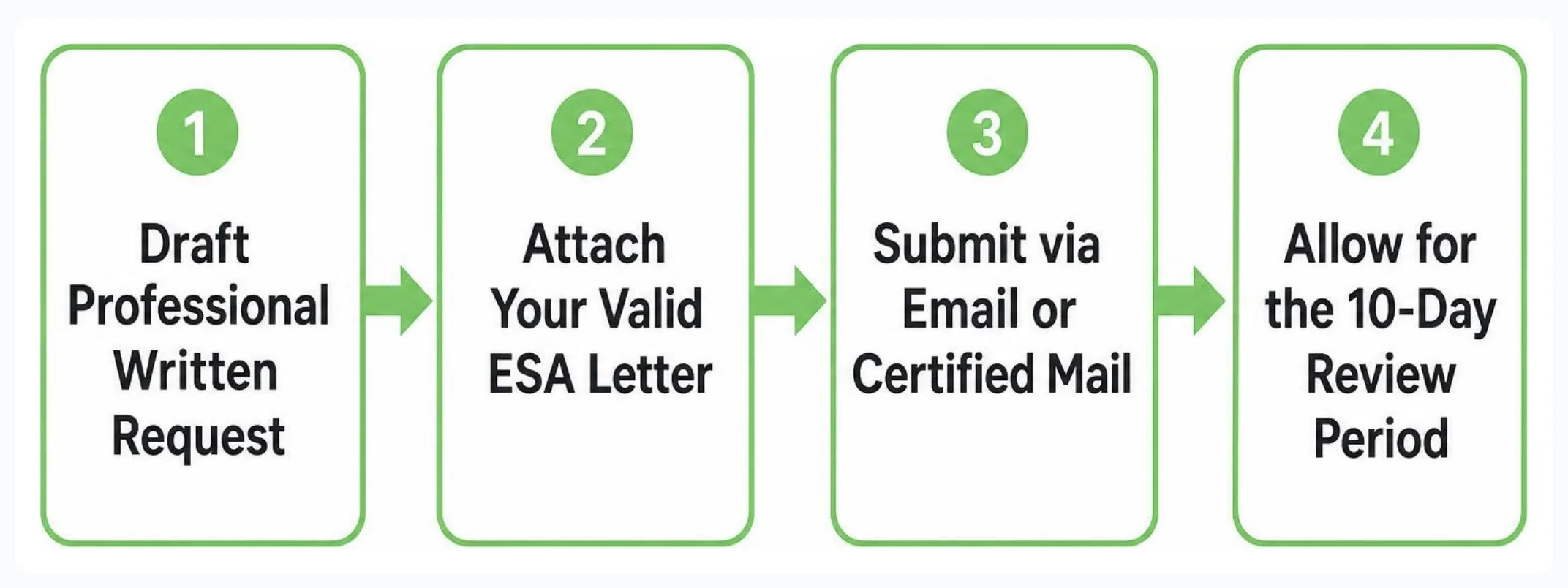
Follow these steps to submit your accommodation request:
- Draft a Professional Written Request: While oral requests are technically recognized under federal rules, always submit your request in writing. Reference the Fair Housing Act and clearly state that you are requesting a reasonable accommodation for an assistance animal.
- Attach Your Valid ESA Letter: Include your clinician's letter when supporting documentation is needed, and check whether an update is justified under applicable law. You do not need to provide your full medical records or diagnostic history.
- Provide Animal Identification and Care Records: Include your animal’s name, species, breed, and confirmation that vaccinations and municipal licenses are up to date.
- Choose a Verifiable Delivery Method: Send the document package via email with read receipts enabled, or mail it using Certified Mail with Return Receipt Requested. If delivering in person, request a signed and dated acknowledgment of receipt.
- Allow for the Review Period: Housing providers should respond within a reasonable time; check applicable state or local requirements rather than assuming a nationwide 10-day deadline.
- Maintain Your Paper Trail: Save copies of all correspondence, text messages, emails, and notes from phone conversations.
Timing Your Disclosure: Before vs. After Signing the Lease
A frequent dilemma for renters is determining when to notify a landlord about an emotional support animal. An accommodation request may arise during an application or an existing tenancy. Check the protections and procedures that apply to your rental, and make the request as soon as practical; in some circumstances, a housing provider may require a request before the animal moves into a pet-free unit.
However, timing your disclosure strategically can help protect you from covert bias:
- Disclosing Before Lease Signing: Being open upfront can build good rapport with transparent landlords. However, some landlords may quietly reject your application under the guise of an alternative reason (such as credit score or employment history) to avoid accommodating the animal.
- Disclosing After Approval or Lease Signing: If you are considering requesting accommodation after approval or lease signing, seek advice about the timing and applicable requirements before bringing the animal onto the premises. An approved application can help document that you met the landlord's financial and screening qualifications.
In analyses like Texas rental accommodation rules, the timing and protection of an accommodation request should be assessed under applicable law. Lease signing alone does not guarantee protection for every ESA request.
Landlord Rights, Denial Grounds, and State-Specific Protections
While the Fair Housing Act offers strong protections, it is not an absolute pass. Landlords are entitled to engage in an interactive dialogue, verify provider legitimacy, and assess safety considerations.
When a Landlord Can Legally Deny an Assistance Animal
Where applicable housing law protects an ESA request, denial requires an individualized assessment. Possible grounds include the following, subject to applicable law and whether another reasonable accommodation could address the concern:
- Direct Threat to Health and Safety: If an animal exhibits documented aggressive behavior, lunges at other residents, or has an unprovoked bite history, the landlord may reject the accommodation. Denials cannot be based on stereotypes about a breed; they must reflect the specific animal's documented conduct.
- Substantial Physical Damage to Property: If an animal causes severe structural damage that cannot be managed with standard precautions, the request can be denied.
- Undue Financial or Administrative Burden: If accommodating the animal imposes significant, unmanageable costs or fundamentally alters the property's operational model.
- Insurance Concerns: An insurance restriction does not automatically justify denial. Any claimed undue burden requires an individualized assessment, including whether reasonable alternatives are available.
- Property Exemptions: Some owner-occupied small buildings, qualifying privately rented single-family homes, and certain religious or private-club housing may qualify for limited FHA exemptions. Detailed conditions apply, and state or local law may still protect the tenant.
State-Specific Housing Rules and Legal Protections
While federal law sets the baseline, state statutes often add specific rules regarding documentation verification and tenant responsibilities. We provide comprehensive state resources to help you navigate local laws:
- Review our complete overview of state ESA laws and HUD enforcement changes.
- Renters on the West Coast can consult our dedicated California ESA housing guidelines.
- Southeastern residents should review our detailed guide on Florida emotional support animal statutes.
- Tenants in the Lone Star State can refer to our Texas landlord-tenant disability laws guide.
Resolving Disputes and Responding to Denials
If your landlord unreasonably delays responding to your request, attempts to impose pet fees, or issues an unauthorized pet lease notice, do not panic. Many initial disputes stem from a property manager's unfamiliarity with assistance animal laws rather than direct bad faith.
Follow this process to resolve accommodation disputes:
- Respond in Writing with Legal Context: Send a courteous letter reaffirming your rights under the Fair Housing Act (42 U.S.C. § 3604(f)(3)(B)). Clarify that your animal is a medically recommended assistance animal rather than a pet, and ask for a written explanation of any denial.
- Request an Interactive Dialogue: Ask the housing provider to discuss the request and any information needed before making a final decision. Ask what additional information they need regarding the clinician's letter.
- File an Administrative Complaint: Ask a fair-housing organization or attorney which complaint or court route applies. Under HUD's current enforcement approach, its Office of Fair Housing and Equal Opportunity (FHEO) pursues animal-accommodation cases involving trained assistance animals, not untrained ESAs. A state civil-rights agency or private legal claim may offer another route, depending on applicable law.
- Seek Disability Legal Advocacy: Contact local fair housing organizations or legal aid clinics that provide free representation for tenants dealing with disability discrimination.
Frequently Asked Questions About ESA Letters for Renting
Conclusion
Securing rental housing when you rely on an emotional support animal should not be an overwhelming battle. When your ESA qualifies for protection under applicable housing law, accommodations may include exceptions to pet fees and ordinary breed restrictions. Protections and enforcement routes vary by state and legal circumstances.
The cornerstone of a smooth accommodation request is a legitimate, compliant recommendation letter from a licensed healthcare provider. At My ESA MD, we provide fast, doctor-led telehealth evaluations backed by licensed physicians, clear flat-fee pricing, and a money-back guarantee if you do not qualify.
Take the first step toward securing your home with confidence: get evaluated for an emotional support animal letter today.
Ready to Talk to a Doctor?
Book a telehealth evaluation with a licensed MD. One flat fee, no memberships, and real people who answer the phone.