
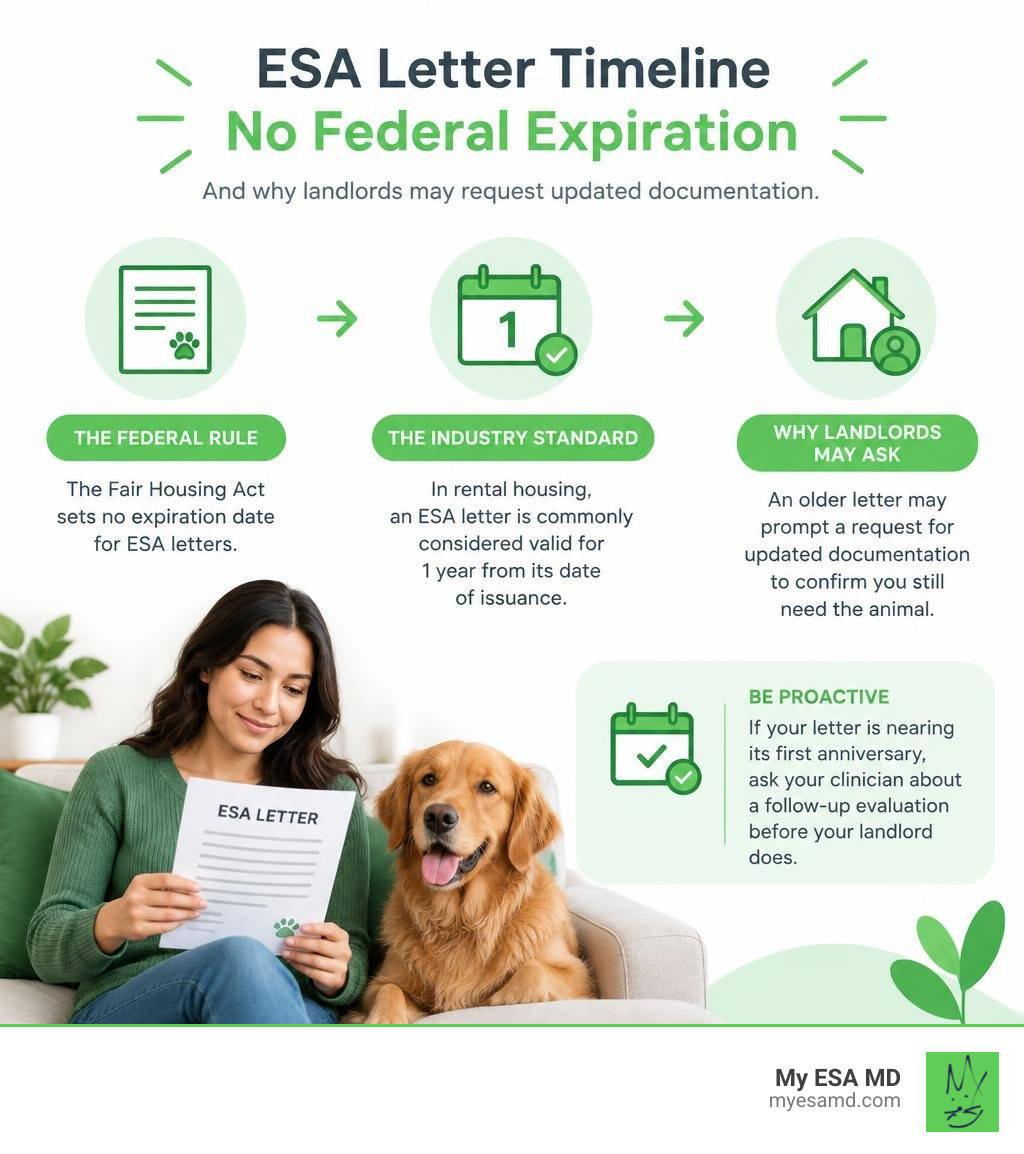
An ESA letter valid for 1 year is a common housing practice, not a federal expiration rule. The Fair Housing Act sets no expiration date. A missing expiration date does not itself establish whether an accommodation request must be approved. Documentation requirements and available protections depend on applicable law; older documentation may prompt questions about your current disability-related need.
If your letter is nearing its first anniversary, ask your clinician about a follow-up evaluation before your landlord requests one. A current letter can help prevent delays, especially when you are moving or renewing a lease.
I'm Joscelyn Rieser, director at My ESA MD, where I help make doctor-led telehealth evaluations clear and accessible to renters. My work has shown me how confusing the idea of an ESA letter valid for 1 year can be, so this guide starts with what the rule does—and does not—mean for your housing rights.
Why Are ESA Letters Often Updated Annually for Rental Housing?
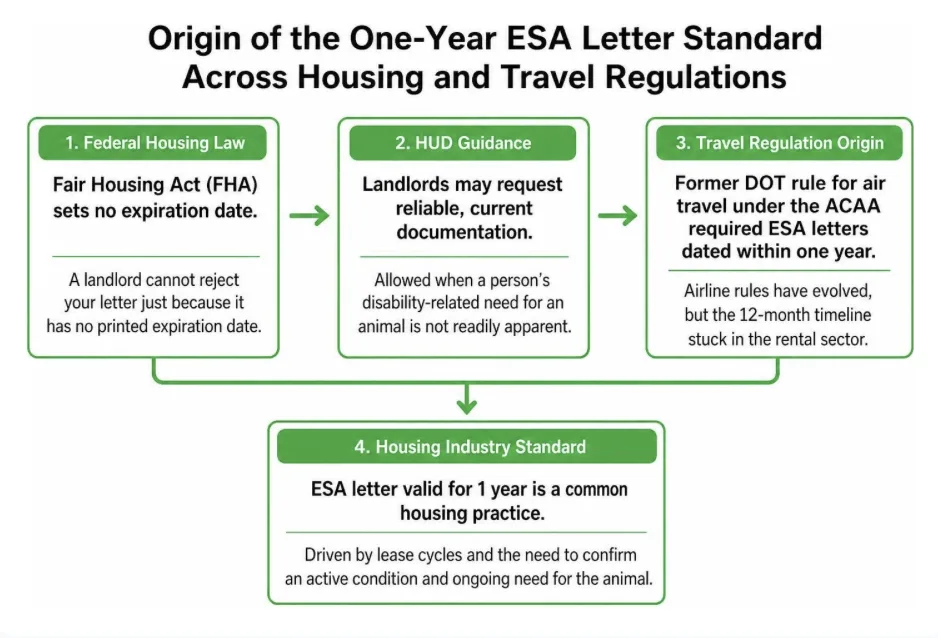
If you have read the text of the Fair Housing Act (FHA), you might notice that there is zero mention of an annual expiration date. Federal housing law does not state that an ESA letter turns into a pumpkin after 365 days. However, in day-to-day property management, treating an ESA letter as valid for 1 year from its date of issuance is the industry standard.
The Fair Housing Act itself has not changed. In May 2026, however, the U.S. Department of Housing and Urban Development (HUD) changed its enforcement approach, focusing animal-related accommodation charges on trained assistance animals. State and local law may provide additional protections for ESAs, so an annual letter is not a nationwide guarantee of approval.
Historically, this one-year standard also has roots outside housing. The convention traces back partly to a former Department of Transportation (DOT) rule for air travel under the Air Carrier Access Act (ACAA), which specifically mandated that ESA documentation be dated within one year of a flight. While airline rules have since evolved, the 12-month timeline stuck firmly in the rental sector.
This LegalClarity guide on how long ESA letters last discusses the annual-renewal convention in more detail.
Why Some Housing Providers Prefer Recent ESA Documentation
Why do property managers focus so heavily on the 12-month mark? The primary reason is that mental health is dynamic. A condition you managed three years ago may have improved, changed, or required different therapeutic interventions today.
- Alignment with Lease Cycles: Most residential leases run on a 12-month schedule. When lease renewals arrive, property managers review tenant files, and requesting updated accommodation records is standard operating procedure.
- Keeping Documentation Current: An older letter may prompt questions about your current disability-related need. Whether updated documentation can be required depends on applicable law and the circumstances.
- Internal Risk Management: Landlords must balance accommodating tenants with enforcing community pet rules. An updated letter can document a clinician’s recent assessment; it does not by itself prove ongoing supervision.
| Feature | Housing Law and Current Enforcement | DOT Airline Regulations (ACAA) |
|---|---|---|
| Federal Expiration Rule | None explicitly written in statute | Previously 1 year (pre-2021) |
| Documentation and Acceptance | No automatic approval based on letter age; applicable law and circumstances matter | Former ESA documentation rule no longer applies |
| Scope of Protection | Housing coverage has exemptions; ESA protections and enforcement vary by jurisdiction | ESAs are not recognized as service animals under current federal airline rules |
| Pet Fees / Deposits | May be waived for a qualifying accommodation under applicable law | Airline pet policies and fees apply |
State Laws Targeting Letter Mills and Requiring Therapeutic Relationships
In recent years, states across the country have enacted strict laws to crack down on fraudulent ESA websites and "letter mills"—services that sell instant certificates without real clinical interaction.
State requirements differ. For example, California residents seeking documentation for an emotional support dog generally follow a 30-day clinical relationship process. Check the requirements that apply to your state and animal. For state-specific protections and an explanation of the federal enforcement changes, review ESA laws by state and HUD changes.

Fair Housing Act Protections and What Makes an ESA Letter Legitimate
An ESA letter documents a disability-related need; it does not automatically establish a right to an accommodation. The Fair Housing Act remains in place, but current federal enforcement is narrower, and state or local law may provide additional ESA protections. A qualifying accommodation under applicable law may include the following:
- Pet Fees and Deposits: A qualifying accommodation may require waiving pet-related fees and deposits.
- Breed and Size Limits: A qualifying accommodation may require exceptions to ordinary pet restrictions, subject to lawful, individualized grounds for denial.
- No-Pets Policies: Applicable housing law may require an exception. Sound documentation alone does not guarantee approval.
Understanding these protections starts with what qualifies as an emotional support animal and checking the housing laws that apply where you live.
Essential Components Landlords Look for in Valid Documentation
A proper ESA letter is not a certificate, a badge, or an ID card; it is a formal medical recommendation written on professional stationery. Commonly useful documentation details include the following; exact requirements vary by jurisdiction:
- Clinician's Credentials: The provider’s full name, professional title, medical or clinical license number, state of licensure, and licensing board.
- Letterhead and Contact Information: Professional clinic letterhead with an address, phone number, and official email.
- Issuance Date: A clear, recent date showing when the evaluation took place.
- Confirmation of Disability: A statement that you have a physical or mental impairment that substantially limits one or more major life activities. (The clinician does not need to disclose your specific diagnosis.)
- Therapeutic Nexus: Clear explanation of how the animal alleviates symptoms or provides emotional support that helps you function.
- Jurisdiction Alignment: Confirmation that the clinician is licensed to practice in your state.
Emotional Support Animals vs. Service Animals and Airline Regulations
It is critical to distinguish emotional support animals from service animals:
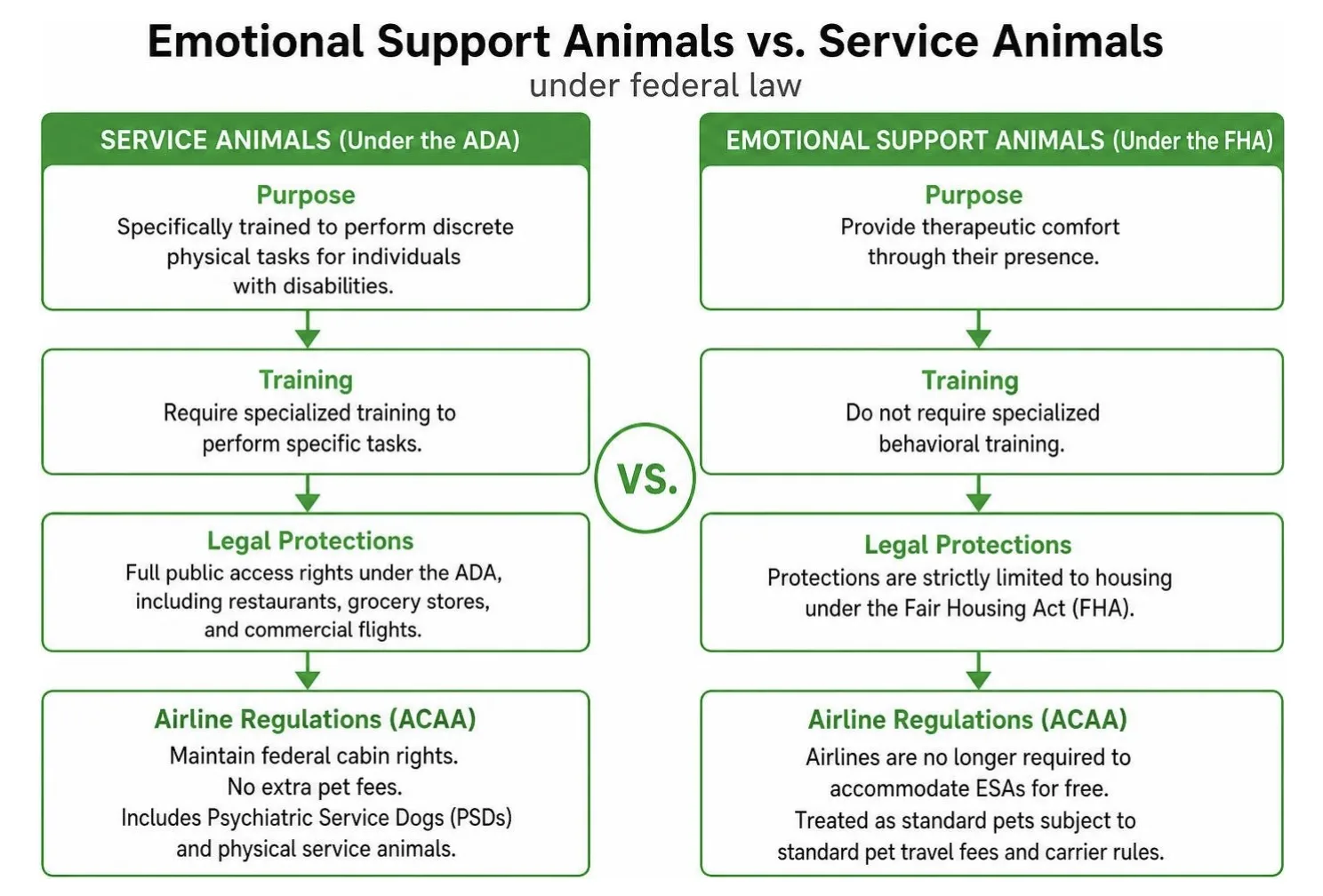
- Service Animals: Under the Americans with Disabilities Act (ADA), service animals are generally dogs individually trained to perform disability-related work or tasks, including psychiatric tasks. They generally have public-access rights in places such as restaurants and grocery stores, subject to legal exceptions. Airline access is governed separately by the Air Carrier Access Act (ACAA).
- Emotional Support Animals (Under the FHA): Provide therapeutic comfort through their presence. They do not require specialized behavioral training, and ESA status alone does not confer the ADA public-access rights of a trained service animal; housing protections depend on applicable law.
Under current Department of Transportation regulations, airlines are not required to accommodate emotional support animals for free in the passenger cabin. Airlines may apply their pet policies, including applicable travel fees and carrier rules. Trained service dogs, including psychiatric service dogs, may qualify for cabin travel under the ACAA, subject to its requirements.
Online Registries, Instant Certificates, and Landlord Verification
One of the quickest ways to have an accommodation denied is by presenting a registration badge or instant certificate purchased online.

There is no official, government-recognized national registry for emotional support animals. Websites that promise "instant lifetime registration," downloadable ID cards, or official-looking plastic badges are scams. An online certificate or registration is not a substitute for a clinical evaluation and does not by itself establish housing rights.
Many landlords and property managers know how to spot these documents. When you submit an accommodation request, property managers regularly verify the authenticity of your letter by checking your clinician's active license on state licensing board databases. If you have questions about what landlords are legally permitted to ask, browse through our helpful FAQ section.
How to Keep Your ESA Documentation Current
Ask your clinician whether a follow-up assessment is appropriate and check whether your housing situation calls for updated documentation. Annual renewal is not a federal requirement or a guarantee of protection.
- Track Your Anniversary Date: Check the date on your current letter. Mark your calendar for 30 to 45 days before the one-year mark.
- Schedule an Annual Re-Evaluation: Connect with your healthcare professional to review your mental health status and discuss how your animal continues to assist you.
- Update Documentation When Appropriate: If your clinician finds an ongoing need and updated documentation is appropriate, request a new letter.
- Check Before Submitting: A lease renewal does not itself establish a federal obligation to submit a new ESA letter. Check applicable requirements before sending updated documentation.
At My ESA MD, we provide telehealth-issued emotional support animal housing letters written directly by licensed MDs, usually the same day when medically appropriate and permitted by state law. California residents with dogs follow the required 30-day process. As a family-run, doctor-led service, we offer transparent flat-fee pricing, zero ongoing membership fees, and a 100% money-back guarantee if you do not qualify. You can learn more about how the evaluation and renewal process works through our straightforward clinical platform.
Typical Renewal Costs
The cost of a legitimate clinical ESA evaluation varies by provider and location. Be cautious of services that charge recurring monthly subscription fees; a renewal should be a single, flat-fee assessment. At My ESA MD, returning patients receive a 20% discount on their renewal.
Steps to Take If a Landlord Illegally Denies Your ESA Request
A current clinical letter does not make every denial unlawful. If you believe a denial violates the housing laws that apply to you, consider these steps:
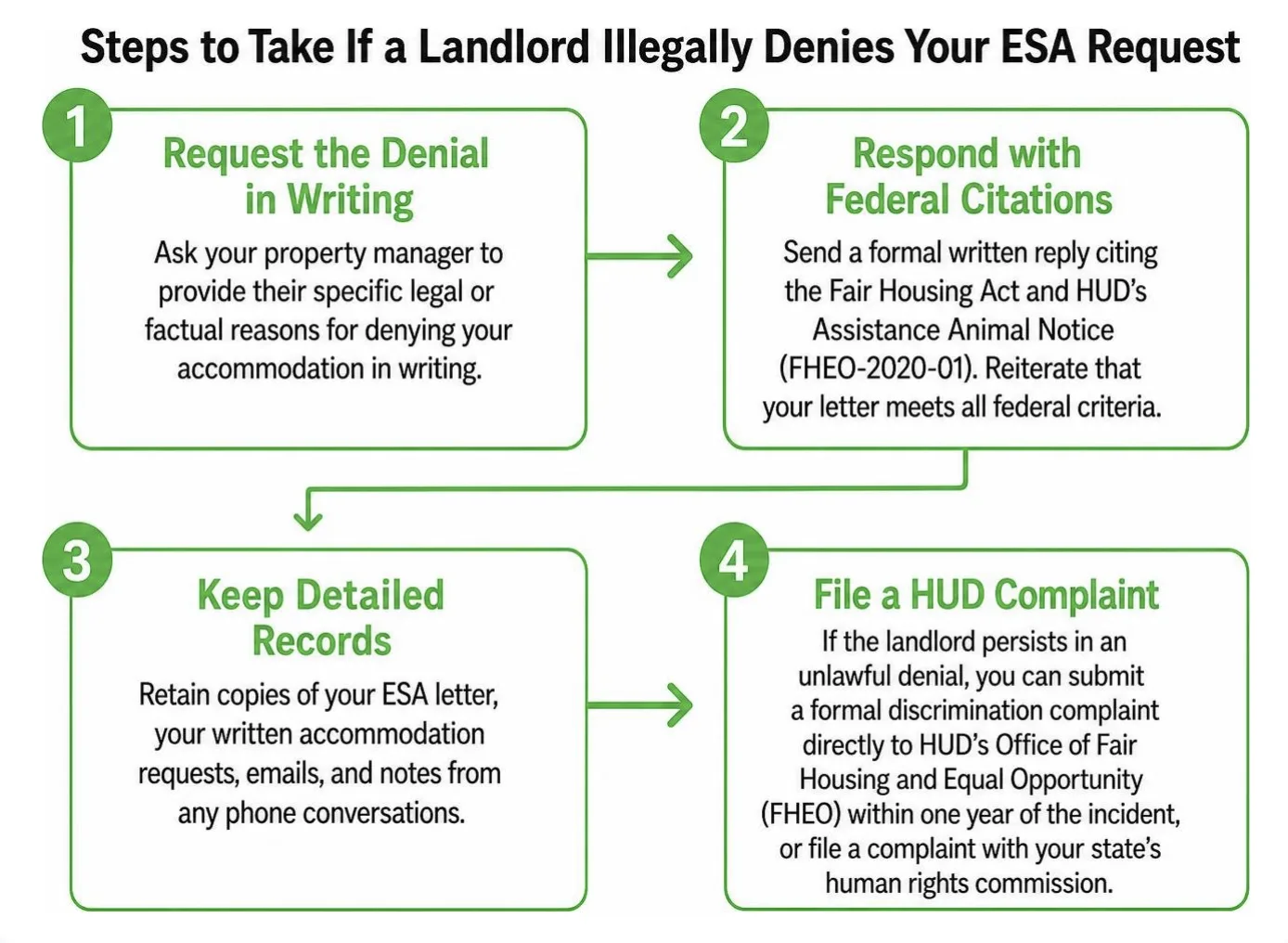
- Request the Denial in Writing: Ask your property manager to provide their specific legal or factual reasons for denying your accommodation in writing.
- Respond Under Applicable Law: Explain the basis for your accommodation request under applicable federal, state or local law. Do not assume that a letter alone satisfies every legal requirement.
- Keep Detailed Records: Retain copies of your ESA letter, your written accommodation requests, emails, and notes from any phone conversations.
- File a Complaint: If the landlord persists in an unlawful denial, you can file a complaint with your state's human rights commission, or submit a formal discrimination complaint directly to HUD’s Office of Fair Housing and Equal Opportunity (FHEO) within one year of the incident. HUD’s May 2026 enforcement approach limits animal-related reasonable-cause findings and recommended charges to trained assistance animals. For an untrained ESA, also check available state or local complaint routes and their deadlines.
Frequently Asked Questions About ESA Letter Expiration
Conclusion
Federal law does not set an expiration date for ESA letters. A follow-up evaluation may help keep documentation current, but annual renewal does not guarantee approval, fee waivers or protection. Review the law where you live, including state protections and the changes to federal enforcement, before relying on an ESA letter for housing.
If you are planning an upcoming move or need to refresh your documentation, start by evaluating your eligibility for an emotional support animal with our licensed medical team today.
Time to Renew Your Letter?
Book a telehealth evaluation with a licensed MD. One flat fee, no memberships, and real people who answer the phone.