
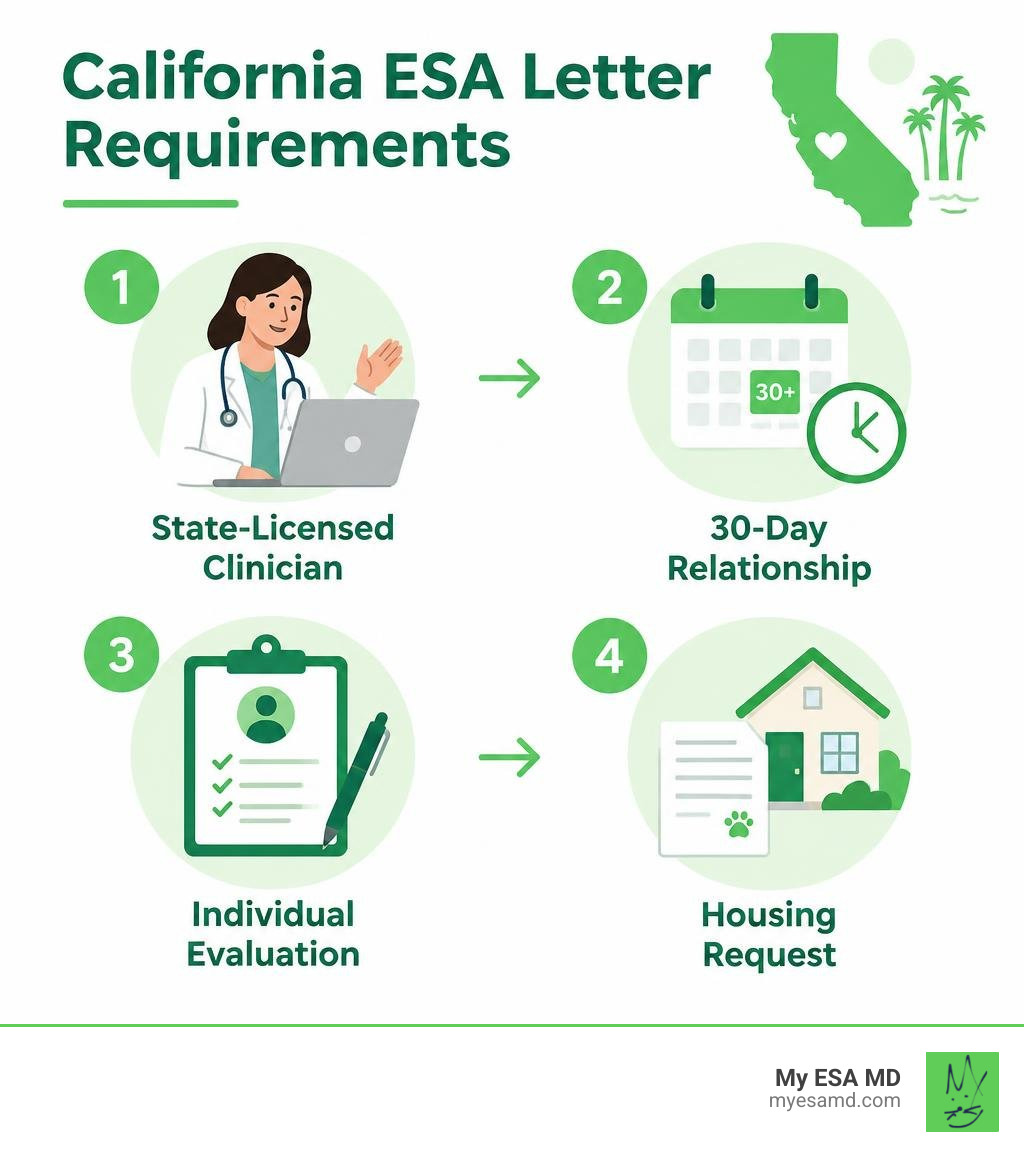
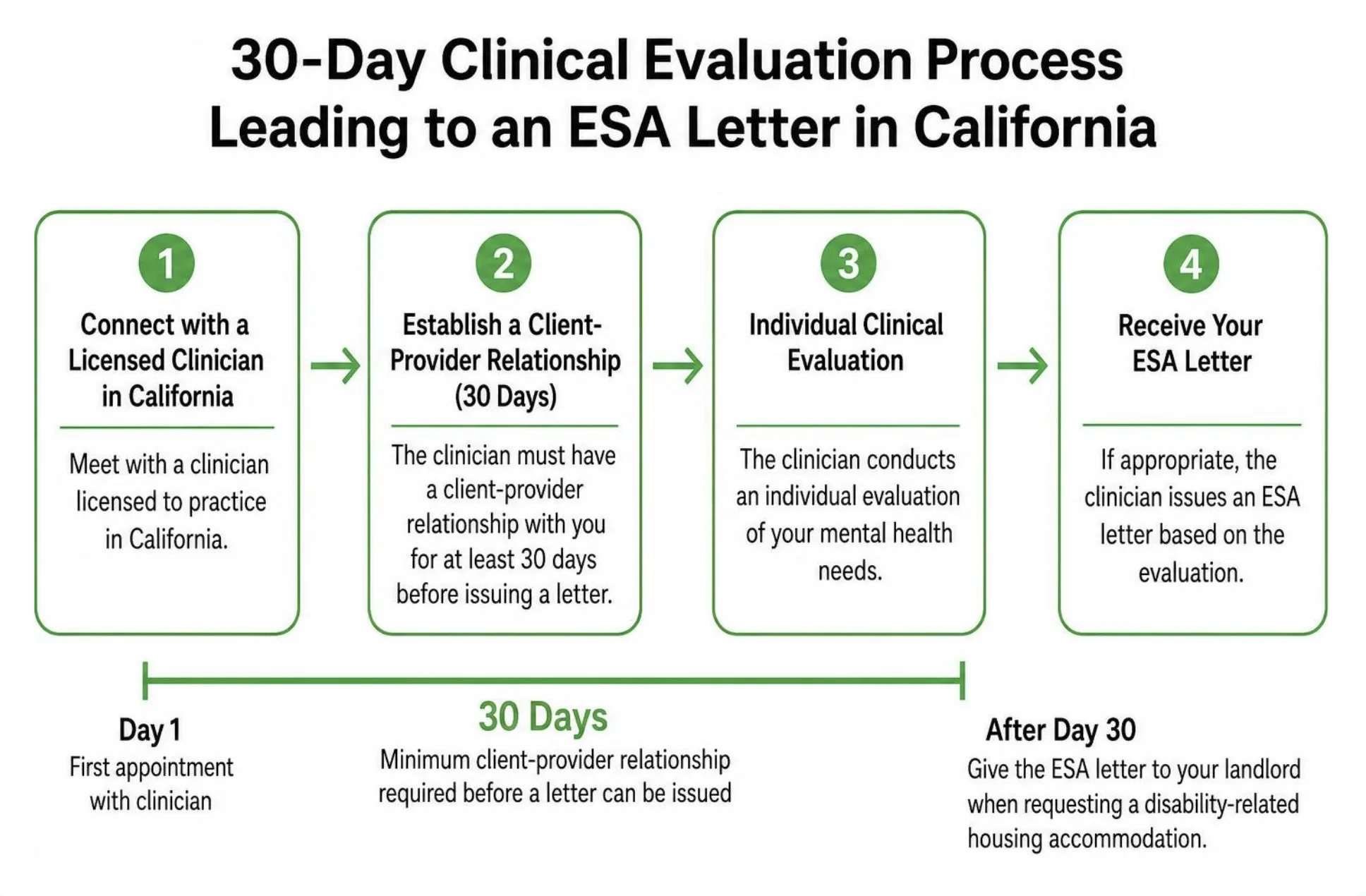
To get an ESA letter in California, meet with a clinician licensed to practice in the state. For documentation concerning an emotional support dog, AB 468 generally requires a client-provider relationship of at least 30 days and a clinical evaluation. A limited statutory exception applies to individuals verified to be homeless. You can then give the letter to your landlord when you request a disability-related housing accommodation. Telehealth visits can be part of this process, but an instant questionnaire cannot replace a clinical evaluation or any applicable 30-day relationship requirement.
California law generally protects a qualifying emotional support animal even in housing with a no-pets rule. A landlord cannot charge pet rent or a pet deposit for the animal, though you remain responsible for damage it causes.
I'm Joscelyn Rieser, director at My ESA MD. I use my telehealth coordination and web development experience to make searches like "esa letter california" easier to navigate.
Legal Standards for an ESA Letter in California
Navigating mental health housing rights in the Golden State requires a clear understanding of state statutes. Finding relief from a disabling mental or emotional condition is essential, and an assistance animal can offer immense therapeutic comfort. However, obtaining legitimate documentation requires following formal medical and legal channels.

To ensure your request stands up to property management review, you must establish clinical necessity with a qualified healthcare professional. If you are unsure whether your condition qualifies, exploring who is eligible for an emotional support animal can help clarify the diagnostic criteria healthcare providers look for during an evaluation.
AB 468's 30-Day Rule for Emotional Support Dog Documentation
In 2021, the California Legislature enacted Assembly Bill 468 (AB 468), fundamentally changing how emotional support animal letters are issued across the state. Under California Health and Safety Code Section 122318, any licensed health care practitioner who provides documentation establishing an individual's need for an emotional support dog must satisfy clear statutory mandates.
For emotional support dog documentation, the professional generally must establish a client-provider relationship at least 30 days before issuing the letter, subject to a limited statutory exception for individuals verified to be homeless. The law was designed to eliminate fraudulent, instantaneous certificates that bypassed legitimate medical care. The law separately requires a clinical evaluation of the individual's need for an emotional support dog; simply waiting 30 days is not enough.
In-State Licensing and Telehealth Requirements
For emotional support dog documentation governed by AB 468, the practitioner must hold an active license authorizing services within its scope in the jurisdiction where the documentation is provided. This includes:
- Licensed Physicians and Psychiatrists (governed by the Medical Board of California)
- Licensed Marriage and Family Therapists (LMFTs)
- Licensed Clinical Social Workers (LCSWs)
- Licensed Professional Clinical Counselors (LPCCs)
- Licensed Clinical Psychologists
Clinicians treating patients located in California generally need authorization to practice in California; applicable licensing and telehealth requirements should be verified.
Telehealth evaluations are completely lawful and widely used across the state, provided the practitioner adheres to standard California telehealth regulations, holds an active in-state license, and satisfies any applicable clinical relationship requirement.
Documentation That May Not Satisfy California Requirements
Landlords and property managers are increasingly trained to identify invalid or substandard documentation. Documentation will generally fail to satisfy California legal requirements if:
- It is an automated certificate based solely on a web quiz, without an individualized clinical evaluation.
- For emotional support dog documentation governed by AB 468, the practitioner lacks the active license required to provide services in the jurisdiction where the documentation is provided.
- The documentation comes solely from a commercial pet registry website selling badges, ID cards, or certificates without a clinician's individualized diagnostic assessment.
- Documentation governed by AB 468 omits required practitioner-license details: license number, license type, effective date, and jurisdiction.
California Fair Housing Protections and State vs. Federal Law
Housing rights for emotional support animals in California are anchored by strong state civil rights statutes. The primary engine of tenant protection is the Fair Employment and Housing Act (FEHA), enforced by the California Civil Rights Department (CRD), alongside the Unruh Civil Rights Act.
Together, these state laws establish an extensive framework protecting tenants against disability-based discrimination. When comparing state statutes against national policies, reviewing ESA laws by state and HUD changes illustrates how state-level civil rights protections can diverge from federal directives.
FEHA Protections vs. 2026 Federal HUD Guidance
In May 2026, the U.S. Department of Housing and Urban Development (HUD) issued updated enforcement guidance concerning assistance animals under the federal Fair Housing Act (FHA). Under this guidance, HUD’s Office of Fair Housing and Equal Opportunity (FHEO) will find reasonable cause and recommend charges in animal-accommodation cases only for animals trained to provide disability-related assistance. The guidance did not repeal or amend the Fair Housing Act.
However, California law provides independent, broader protections. Under FEHA, California housing providers must accommodate untrained emotional support animals as a reasonable accommodation for people with documented disabilities. FEHA also applies to smaller landlords and certain owner-occupied properties that might otherwise claim exemptions under federal statutes.
| Legal Parameter | Federal Fair Housing Act (HUD 2026 Guidance) | California Fair Employment & Housing Act (FEHA) |
|---|---|---|
| Untrained Emotional Support Animals Covered? | HUD’s Office of Fair Housing and Equal Opportunity (FHEO) May 2026 guidance limits reasonable-cause findings and recommended charges to trained assistance animals; the FHA statute remains unchanged. | Yes, fully protected as a reasonable accommodation |
| 30-Day Clinical Relationship Mandated? | No federal statutory timeline | Separate AB 468 rule generally applies to emotional support dog documentation, with a limited homelessness exception |
| Small Landlord Coverage | Certain exemptions (e.g., Mrs. Murphy exemption) | Broader coverage in some small-landlord situations; exemptions differ from federal law |
| Enforcement Agency | HUD / Federal Courts | California Civil Rights Department (CRD) |
For further details regarding state enforcement policies, you can read the Civil Rights Department guidance on emotional support animals.
Key Differences: Emotional Support Animals vs. Service Animals
It is crucial to understand that emotional support animals and service animals serve distinct roles under the law. Understanding what an emotional support animal is helps prevent common misunderstandings regarding public access.
- Service Animals: Under the Americans with Disabilities Act (ADA), service animals are dogs individually trained to perform work or tasks directly related to a person's disability. Separate ADA provisions require reasonable modifications for trained miniature horses when applicable assessment criteria are met. Service dogs are granted public access rights to enter restaurants, grocery stores, hotels, and public transportation.
- Emotional Support Animals (FEHA): Animals of various species that provide therapeutic comfort, affection, and emotional stability to alleviate symptoms of a mental or psychiatric disability. ESAs do not require task-specific training. Crucially, ESA status alone does not confer service-animal public-access rights. This article focuses on housing; workplace accommodation questions involve a separate, case-specific legal framework.
Tenant Rights and Housing Provider Obligations

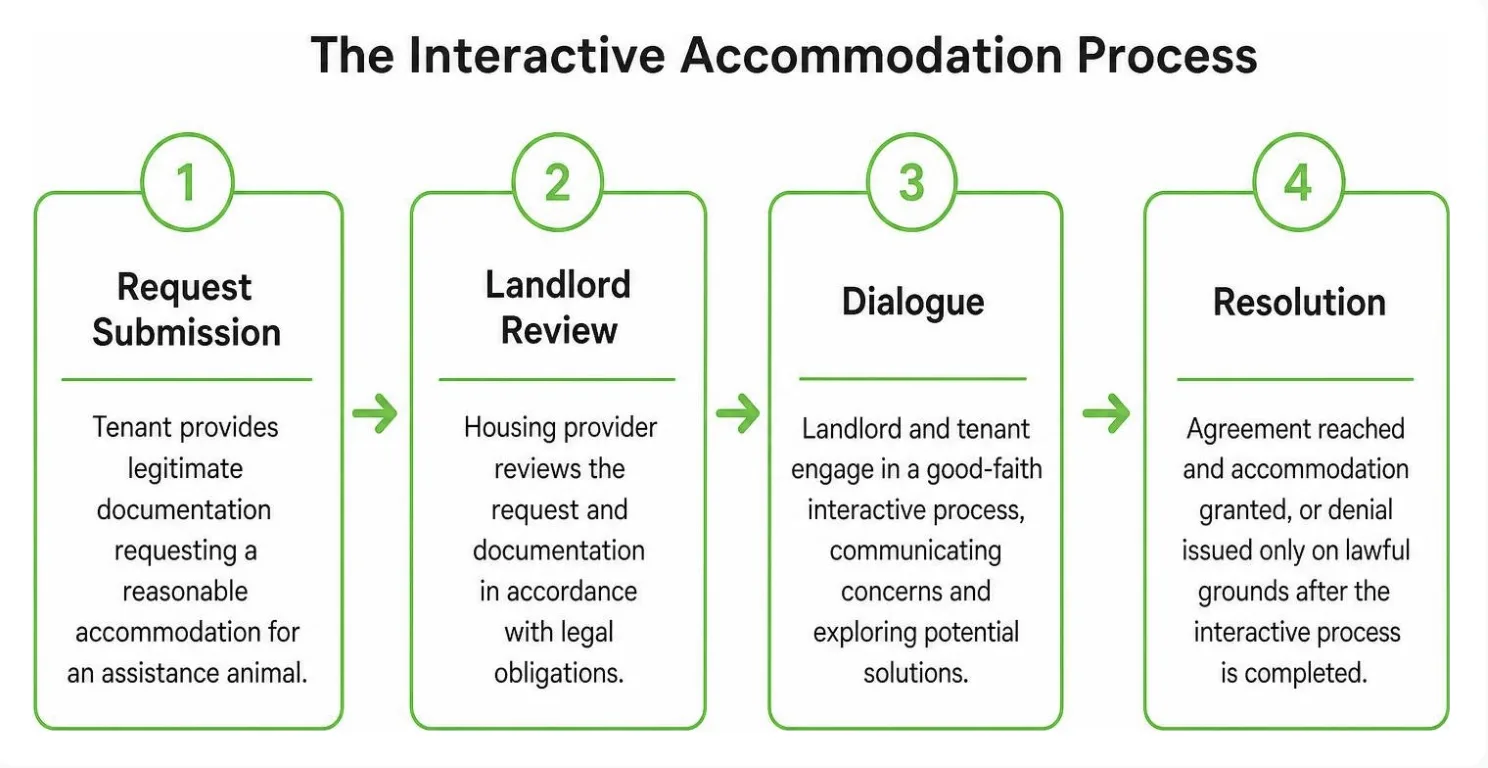
When a tenant provides legitimate documentation requesting a reasonable accommodation for an assistance animal, property managers have clear legal obligations under our guide to ESA laws in CA. Housing providers must adjust their standard lease rules to allow the tenant equal use and enjoyment of their dwelling.
Pet Fees, Deposits, and Breed or Weight Restrictions
Under California law, an emotional support animal is legally classified as an assistance animal, not a pet. As a result:
- No Pet Rent or Surcharges: Landlords cannot charge extra monthly pet rent.
- No Pet Deposits: Landlords cannot charge a supplemental pet security deposit.
- No Breed, Size, or Weight Bans: Landlords cannot deny an ESA based on breed stereotypes (such as banning pit bulls, German shepherds, or Rottweilers) or general weight and size limits. Each animal must be evaluated on its own specific behavior.
- Tenant Financial Responsibility: While pet fees are prohibited, tenants remain entirely liable for any actual physical damage the animal causes to the rental unit or common grounds, which can be deducted from standard security deposits.
Accommodations for Multiple Emotional Support Animals
A tenant in California can legally request accommodation for more than one emotional support animal. The request should explain the disability-related need for each animal. The animals do not necessarily have to address different symptoms. Any denial must rest on applicable accommodation standards, not simply the number of animals or generalized space concerns.
Lawful Grounds for Landlord Denials and the Interactive Process
A housing provider cannot summarily reject an ESA request simply because they dislike pets or maintain a strict no-animals lease policy. A landlord may lawfully deny an accommodation request only under very narrow circumstances:
- Direct Threat to Health and Safety: The specific animal poses a demonstrable, direct threat to the health or safety of other residents that cannot be mitigated by reasonable measures.
- Substantial Property Damage Risk: An individualized assessment shows that the specific animal would cause substantial physical damage to others' property, and reasonable measures cannot sufficiently reduce or eliminate that risk.
- Undue Financial or Administrative Burden: The accommodation would impose an unmanageable financial or operational hardship on the property owner.
- Fundamental Operational Alteration: Granting the request would fundamentally alter the basic nature of the housing provider's operations.
When needed to evaluate a reasonable-accommodation request, housing providers must engage in a good-faith interactive process—a discussion with the tenant to clarify the disability-related need, address concerns, and consider reasonable alternatives rather than rejecting a request automatically.
Navigating the ESA Accommodation Process in California
Securing your housing rights requires an organized, transparent approach. Because property managers must verify medical documentation carefully, having authentic clinical records ensures your housing request proceeds smoothly. Our clinical team at My ESA MD provides more than just an ESA letter by offering direct clinical backing and landlord verification support if questions arise.
How to Obtain an Authentic ESA Letter in California
Obtaining an official letter involves a structured, clinically sound pathway:
- Clinical Intake and Health History: You begin by completing an initial mental health screening detailing your symptoms and medical history.
- Consultation with a California-Licensed Clinician: You meet with a licensed physician, psychologist, or therapist authorized to practice in California.
- Applicable Waiting Period: For emotional support dog documentation, AB 468 generally requires the client-provider relationship to begin at least 30 days before the letter is issued, subject to a limited statutory exception for individuals verified to be homeless. This dog-specific rule does not automatically apply to other ESA species.
- Comprehensive Evaluation: The doctor assesses whether your emotional or psychiatric condition limits one or more major life activities under California's disability standard and whether an assistance animal offers meaningful symptom relief.
- Issuance of Signed Documentation: You receive a formal, signed clinical letter written on the provider's professional letterhead, complete with license details.
To review the full clinical evaluation pathway, you can explore our complete overview of how it works.
What Information a Landlord Can and Cannot Request
Understanding your medical privacy rights prevents unlawful intrusions into your personal health history.
What Landlords May Request When the Disability or Disability-Related Need Is Not Apparent:
- Reliable information establishing a disability when it is not apparent; a healthcare professional’s letter is one possible source, not the only acceptable form of verification.
- Reliable information confirming the disability-related need for the animal, without requiring disclosure of a diagnosis or detailed symptoms.
- Verification of the clinician's active license number and contact information.
What Landlords CANNOT Request:
- Access to your private medical records or clinical therapy notes.
- Specific diagnostic labels, detailed medical charts, or psychiatric histories.
- Unnecessary disclosure of detailed medical information through additional forms.
- Proof of task-specific training or certification merely because the animal is an ESA.
Avoiding Misrepresentation in ESA Documentation
California distinguishes emotional support dogs from trained service dogs. AB 468 requires practitioners to notify clients that knowingly and fraudulently representing oneself as the owner or trainer of a guide, signal, or service dog is unlawful.
Use documentation based on a genuine clinical evaluation, and do not represent an ESA as a trained service dog. If documentation is disputed, seek advice about your specific circumstances rather than assuming that criminal penalties or eviction automatically follow.
Frequently Asked Questions About California ESA Housing Laws
For quick answers to common tenant questions, check our comprehensive FAQ page.
Conclusion
Understanding California's assistance animal laws ensures that you can live comfortably with your emotional support animal without facing unlawful housing discrimination. California's FEHA protections operate independently of AB 468's documentation requirements. For emotional support dogs, AB 468 generally requires a clinical evaluation and a provider relationship established at least 30 days before documentation, subject to a limited statutory homelessness exception.
At My ESA MD, we are a family-run, doctor-led telehealth practice dedicated to providing authentic clinical care. California-licensed Medical Doctors (MDs) conduct thorough evaluations through secure telemedicine consultations, offering transparent flat-fee pricing, zero recurring membership fees, and a complete money-back guarantee if you do not qualify.
Ready to start your clinical evaluation? Get your ESA letter backed by licensed California physicians today.
Ready to Talk to a Doctor?
Book a telehealth evaluation with a licensed MD. One flat fee, no memberships, and real people who answer the phone.
Approved by: Dr. Rick Rieser, MD — Medical Director, My ESA MD. Stanford-trained physician, 30+ years of clinical experience.