The ADA does not give emotional support animals the same public-access rights as trained service animals. In rental housing, the Fair Housing Act may instead require a landlord to make a reasonable accommodation for an emotional support animal, even in a no-pets building. An approved assistance animal is not subject to pet rent, pet fees, or a pet deposit, though the tenant can be responsible for damage it causes.
A May 2026 HUD memo narrowed how the agency handles complaints involving untrained emotional support animals. It did not repeal the Fair Housing Act or erase stronger state protections. If you need an accommodation, make your request in writing and keep a copy.
I’m Joscelyn Rieser, director at My ESA MD, where I help coordinate access to doctor-led telehealth evaluations and ESA housing letters. My work has given me practical experience helping renters understand ADA and ESA housing laws and prepare documentation for their housing requests.
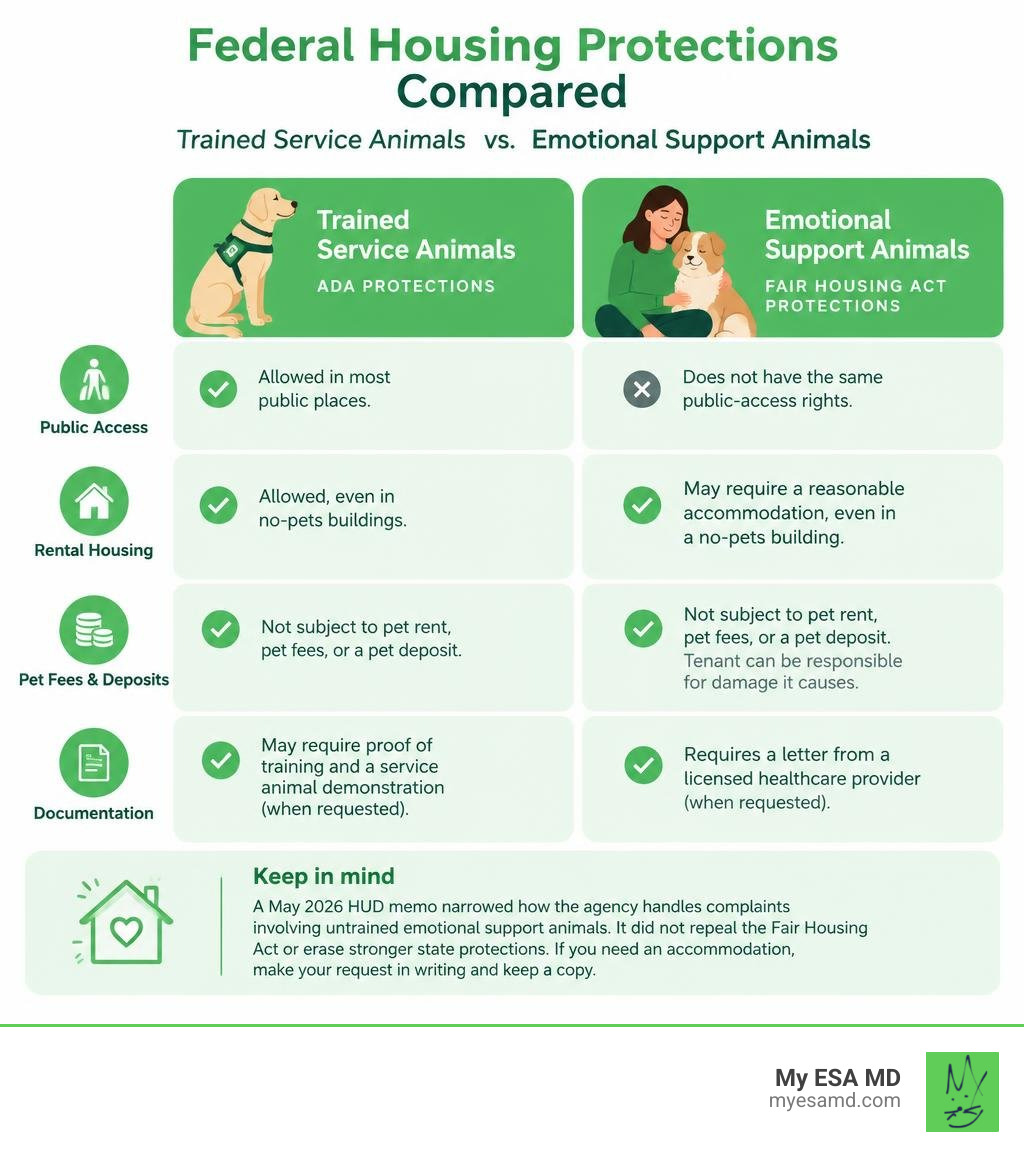
ADA and ESA Housing Laws: Service Animals vs. Emotional Support Animals
Navigating federal disability rules can feel overwhelming, especially when acronyms like ADA, FHA, and HUD start bouncing around. A major point of confusion for both renters and housing providers is treating the Americans with Disabilities Act (ADA) and the Fair Housing Act (FHA) as if they are the exact same rulebook. They are not.
The Americans with Disabilities Act—specifically Title II (state and local governments) and Title III (public accommodations)—governs public spaces. It ensures that individuals with disabilities can bring their trained service animals into grocery stores, restaurants, hotels, and retail shops. The ADA is designed for public access.
In contrast, the Fair Housing Act, enacted in 1968 and amended in 1988 to add disability protections, protects people from discrimination in residential dwellings. The FHA does not focus on whether an animal can walk through a restaurant dining room; it focuses on ensuring that an individual with a mental, emotional, or physical impairment has an equal opportunity to use and enjoy their home.
Housing accommodation requests can involve task-trained service animals or emotional support animals (ESAs). ESAs do not have public-access rights under the ADA. The FHA itself has not changed, but HUD now limits its animal-related FHA enforcement to trained assistance animals; independent state protections vary. To see how these rules apply beyond residential leases, review emotional support animal rights across housing and travel.
| Legal Feature | ADA Service Animal | FHA Emotional Support Animal (ESA) |
|---|---|---|
| Primary Governing Law | Americans with Disabilities Act (Titles II & III) | Fair Housing Act (42 U.S.C. § 3601 et seq.) |
| Primary Scope of Access | Public accommodations, businesses, government spaces | Residential dwellings, private rentals, campus housing |
| Species Allowed | Dogs; separate reasonable-modification rules address trained miniature horses | Varies by applicable housing law and the accommodation requested |
| Training Required? | Yes, individually trained to perform specific tasks | No specialized behavioral task training required |
| Allowed in No-Pet Housing? | Generally under applicable housing law, subject to exceptions | May qualify; state protections and enforcement routes vary |
| Subject to Pet Fees / Rent? | No pet fees for an approved assistance-animal accommodation | No pet fees for an approved assistance-animal accommodation |
| Public Grocery Store Access? | Yes | No |
Service Animal ADA Public Access vs. FHA Dwelling Rights
Under Department of Justice regulations for the ADA, a service animal is defined as a dog individually trained to do work or perform tasks for the benefit of an individual with a disability. Separate ADA provisions require reasonable modifications—adjustments to rules or practices—for individually trained miniature horses where appropriate. These tasks must be directly tied to the handler's physical, sensory, psychiatric, or intellectual impairment. Examples include guiding a person who is blind, alerting an individual who is deaf, pulling a wheelchair, or retrieving dropped medication.
Because service animals undergo specialized training, the ADA grants them sweeping public access rights. Staff at a business or public facility may ask only two specific questions if the necessity is not obvious:
- Is the animal required because of a disability?
- What work or task has the animal been trained to perform?
Staff cannot demand medical records, require specialized ID cards, or make the dog perform the task on command.
In residential housing, however, dwelling protections expand significantly under the Fair Housing Act. You are not restricted solely to task-trained dogs. An untrained animal that alleviates disability-related symptoms may support a housing accommodation request. However, HUD now limits its animal-related FHA enforcement to trained assistance animals, and independent state protections vary. If you are exploring whether your situation meets the legal threshold, learning about qualifying for an emotional support animal is the first step.
Psychiatric Service Dogs (PSDs) vs. Untrained ESAs
The boundary between an emotional support animal and a Psychiatric Service Dog (PSD) often causes confusion because both assist handlers dealing with mental health conditions like major depression, post-traumatic stress disorder (PTSD), severe anxiety, or panic disorders.
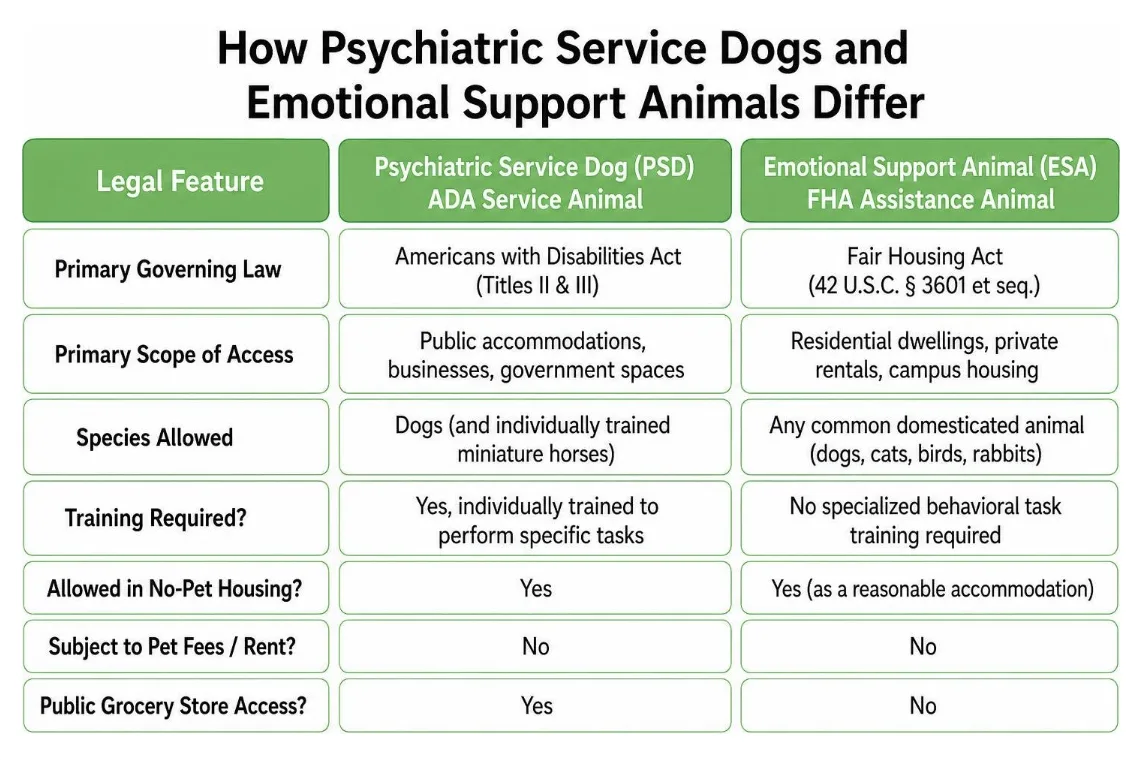
The key legal distinction lies in individualized task training:
- Psychiatric Service Dogs (PSDs): A PSD is trained to execute specific actions that mitigate a psychiatric symptom. For example, a PSD might apply deep pressure therapy (DPT) during a panic attack, wake a handler experiencing debilitating night terrors, interrupt self-harming behaviors, or perform room searches for an individual with severe PTSD. Because they are task-trained, PSDs are full service animals under the ADA and enjoy both public access and housing rights.
- Emotional Support Animals (ESAs): An ESA provides therapeutic relief, grounding, and comfort simply through its presence and companionship. No specialized trick, task, or obedience routine is required. A cat or dog may serve as an ESA when its presence alleviates symptoms of a person's disability; ordinary loneliness or anxiety alone does not establish eligibility for a housing accommodation.
Understanding these distinctions helps handlers assert their rights appropriately. For a deeper breakdown of municipal and federal frameworks, consult these District and federal assistance animal regulations.
Landlord Rules on Pet Fees, Breed Bans, and Accommodation Requests

A tenant can request an emotional support animal as a reasonable accommodation. Whether a landlord must grant the request depends on applicable law and the circumstances; HUD no longer pursues FHA complaints involving untrained ESAs under its current enforcement standard. An animal approved as an assistance-animal accommodation is not treated as an ordinary pet. Ordinary pet fees, pet deposits, pet rent, and blanket breed restrictions generally do not apply to an approved assistance-animal accommodation. Applicable animal-control, care, and safety requirements may still apply.
A good-faith dialogue with the housing provider can help clarify the request and any permissible documentation needs. Applicable law determines the provider's obligations.
Required Documentation Under ADA and ESA Housing Laws
Where applicable housing law protects the accommodation, a provider may be allowed to request reliable verification of a disability or disability-related need that is not apparent. Check the documentation rules that apply in your jurisdiction.
Documentation and privacy requirements depend on applicable law. An ESA letter from a licensed healthcare professional who has evaluated you may help document your disability-related need, but a letter does not guarantee approval or HUD enforcement. Seek local advice before disclosing a diagnosis or medical records.
This is not a universal legal-validity checklist. Depending on applicable state requirements, an ESA housing letter may:
- Be issued on the practitioner's official professional letterhead.
- Include the clinician’s license type, license number, state of practice, and contact information.
- Affirm that you have an impairment that substantially limits one or more major life activities.
- Confirm that the animal provides therapeutic benefit or alleviates symptoms associated with your condition.
An animal registry entry or certificate alone does not establish a disability-related need or guarantee a housing accommodation. To ensure your accommodation request is backed by legitimate clinical documentation, explore what goes into comprehensive ESA letter verification.
Pet Rent, Pet Deposits, and Weight Limits for Approved Assistance Animals
An animal approved as a disability-related housing accommodation is not treated as an ordinary pet. This does not mean every ESA request must be approved or will receive HUD enforcement.
For an approved assistance-animal accommodation, ordinary pet charges and blanket pet restrictions generally should not apply, including:
- Charging an upfront pet deposit or non-refundable pet intake fee.
- Charging monthly pet rent or surcharges.
- Enforcing property-wide weight limits (e.g., "no animals over 25 pounds").
- Enforcing blanket breed bans (e.g., prohibiting German Shepherds, Rottweilers, or Pit Bulls) solely based on breed stereotypes.
However, exemption from pet fees does not mean an exemption from financial accountability. If your ESA chews through baseboards, damages carpeting, or scratches doorframes, the housing provider may legally charge you for the actual repair costs or deduct those expenses from your standard, general security deposit at move-out (excluding ordinary wear and tear).
ESA accommodations may also be available in university housing, subject to applicable law and the institution's accommodation process. You can learn more about navigating emotional support animals in college housing or review established University campus accommodation policies to see how residence halls manage these accommodations.
The May 2026 HUD Enforcement Guidance and What Changed
Federal administrative policy underwent a shift on May 22, 2026, when the U.S. Department of Housing and Urban Development (HUD) issued an internal enforcement guidance memorandum. This document modified how HUD’s Office of Fair Housing and Equal Opportunity (FHEO) processes administrative complaints involving assistance animals.
The May 2026 enforcement guidance altered HUD’s internal administrative enforcement standard by leaning heavily on the ADA’s task-training benchmark when evaluating federal complaints.
Impact on Untrained Assistance Animals and Federal Inquiries
The May 22, 2026 memo created confusion among tenants and property managers. It is critical to understand what this internal change does—and does not—mean:
- Current HUD Enforcement Standard: FHEO will find reasonable cause and recommend charges in animal-related FHA accommodation complaints only when the animal is trained to provide disability-related assistance. Untrained ESAs do not meet this enforcement standard.
- Statutory Law Remains Unchanged: The Fair Housing Act statute has not been rewritten. Only Congress can amend the FHA, and federal courts retain judicial authority over fair housing interpretation.
- Private Right of Action Persists: Tenants retain their legal right under federal law to bring a private civil action in U.S. District Court for disability discrimination if a landlord unlawfully rejects a legitimate accommodation request.
- Section 504 Complaints Are Outside This Memo: The memo addresses FHA animal-accommodation complaints, not Section 504 complaints. Tenants in federally assisted housing should check whether Section 504 provides an additional accommodation route.
To see how individual jurisdictions have responded to these federal administrative adjustments, check our detailed state breakdown on state-specific ESA laws and federal policy changes.
State Fair Housing Protections and Stronger Local Statutes
Because federal administrative guidelines fluctuate, your primary shield as an ESA handler often rests on state and municipal law. Federal fair housing standards serve as a regulatory floor, not a ceiling. States have full authority to establish civil rights protections that exceed federal baselines.
Some states provide independent ESA protections; others rely on broader fair-housing rules or federal-linked standards. Check the current legal basis and enforcement process in your state:
- California: Check California's current disability-related housing accommodation and documentation requirements. Review our complete guide to California ESA legal protections.
- New Jersey: Check how New Jersey law applies to your support-animal accommodation request. Learn more about regional enforcement through these Service and support animal legal standards.
- Other states: Consult the linked state-by-state guide to identify the applicable legal protections and complaint process. An ESA letter alone does not establish that a denial is unlawful.
Legal Exceptions, Disputes, and Protecting Your Housing Rights
While fair housing protections are broad, they are not limitless. Housing providers are not required to grant an accommodation under every circumstance. Understanding where the legal boundaries lie protects you from unintentional lease violations.
Permissible Housing Exemptions Under ADA ESA Housing Laws
Federal fair-housing coverage has property exemptions, and a covered provider may also have grounds to deny a particular accommodation. State or local law may provide additional protections:
- The "Mrs. Murphy" Exemption: Certain owner-occupied buildings containing no more than four dwelling units in total, including the owner's unit.
- Single-Family Housing Sold or Rented Without a Broker: Certain single-family homes sold or rented by qualifying private owners who own no more than three such homes, subject to additional statutory conditions, including restrictions on broker involvement and discriminatory advertising.
- Direct Threat to Health and Safety: If an animal exhibits documented, unprovoked aggression, bites other residents, or poses a direct safety hazard that cannot be mitigated by reasonable measures.
- Substantial Property Damage: Objective evidence shows that the specific animal would cause substantial physical damage to others' property that cannot be reduced or eliminated by a reasonable accommodation.
- Fundamental Alteration or Undue Burden: An accommodation request that imposes severe administrative or financial burdens on the property owner (an insurer's cancellation threat alone does not automatically establish an undue burden; the circumstances and reasonable alternatives require assessment).
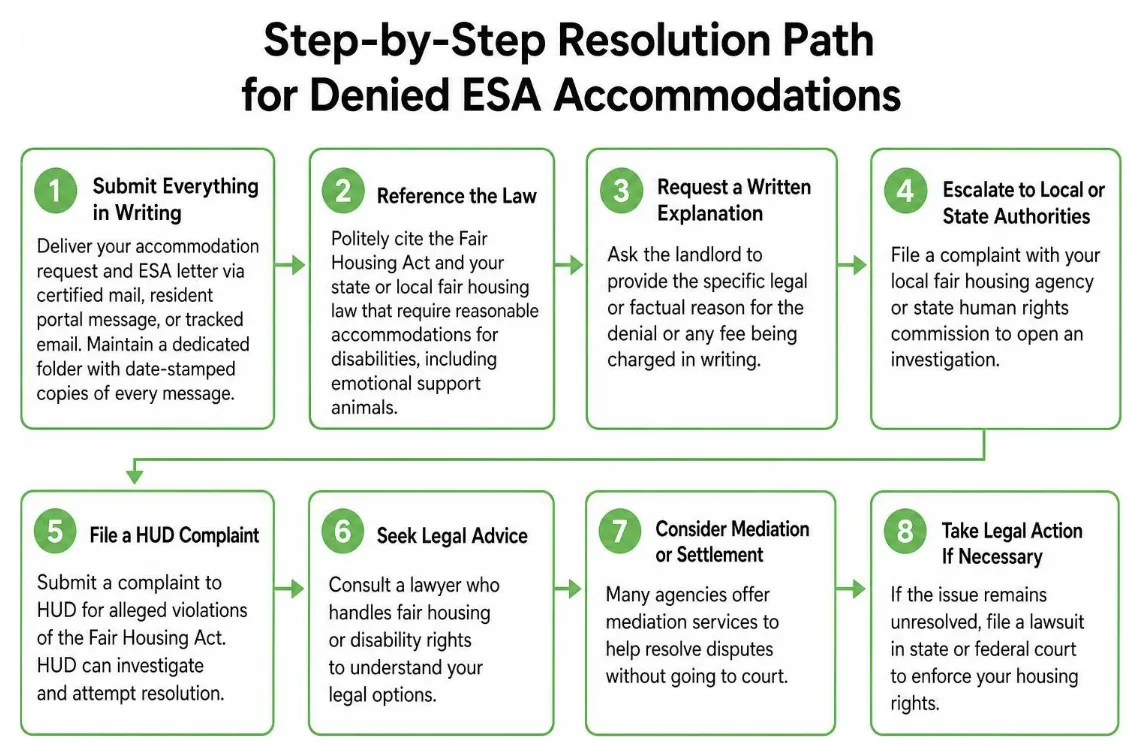
Steps to Take When Landlords Deny Accommodation or Charge Illegal Fees
If your housing provider ignores your request, demands unlawful fees, or issues an outright denial, take systematic steps to protect your tenancy:
- Submit Everything in Writing: Always deliver your accommodation request and ESA letter via certified mail, resident portal message, or tracked email. Maintain a dedicated folder containing date-stamped copies of every message.
- Follow Up Promptly: There is no universal federal 10-business-day deadline. Ask for a response, follow up in writing, and check applicable state or local timing requirements.
- Engage in the Interactive Dialogue: If your landlord raises concerns about property rules or animal behavior, respond calmly in writing. Provide documentation demonstrating your animal is housebroken, vaccinated, and well-behaved.
- Issue a Formal Clarification Letter: Explain that an approved assistance-animal accommodation is not subject to ordinary pet charges or blanket pet restrictions, and identify the law applicable to your request.
- File an Administrative Complaint: If the housing provider continues to violate your rights, contact your state or local civil rights agency or legal aid about available complaint routes. HUD's current FHA enforcement standard excludes untrained ESAs, so filing with FHEO may not lead to enforcement; other legal routes may remain available. For quick answers to common issues during this process, visit our common assistance animal questions hub.
Frequently Asked Questions About ADA and ESA Housing Laws
Conclusion
Securing your right to live with an assistance animal comes down to understanding how federal and state laws operate together. The ADA secures public access for trained service dogs, while ESA housing rights depend on disability-related need, applicable law, and the circumstances. The FHA itself has not changed, but HUD limits its animal-related FHA enforcement to trained assistance animals. Independent state protections vary, and an approved assistance-animal accommodation is not subject to ordinary pet fees or blanket pet restrictions.
At My ESA MD, we believe that managing your mental wellness should never put your housing at risk. Our family-run, doctor-led telehealth service connects you directly with state-licensed medical doctors who evaluate your individual needs. We provide legitimate, fully compliant ESA housing letters backed by transparent flat-fee pricing, zero hidden subscriptions, and a full money-back guarantee if you do not qualify.
To take the next step in protecting your housing peace of mind, start by defining what is an emotional support animal and secure your valid documentation today.
Ready to Talk to a Doctor?
Book a telehealth evaluation with a licensed MD. One flat fee, no memberships, and real people who answer the phone.
Approved by: Dr. Rick Rieser, MD — Medical Director, My ESA MD. Stanford-trained physician, 30+ years of clinical experience.