A Maryland renter may qualify for an emotional support animal (ESA) housing accommodation if they have a disability and the animal helps with a need related to that disability. A landlord must consider the request individually; an ESA letter does not guarantee approval. Maryland housing accommodation guidance explains the state's approach.
Maryland protections remain in place. After the federal government changed its fair housing enforcement in 2025 and 2026, the Maryland Commission on Civil Rights announced that it will continue to evaluate emotional support animal requests under Maryland law, even when the animal has not been trained to perform a specific task. That means renters in Baltimore, Annapolis, Silver Spring, Rockville, Frederick, and communities across the state can still request an ESA housing accommodation. Dr. Rick Rieser is licensed in Maryland, so Maryland residents can complete a telehealth evaluation from home.
I’m Joscelyn Rieser, director at My ESA MD, where I help make doctor-led telehealth evaluations easier to understand. My background in web development and service coordination helps me explain who is eligible for an ESA housing accommodation.
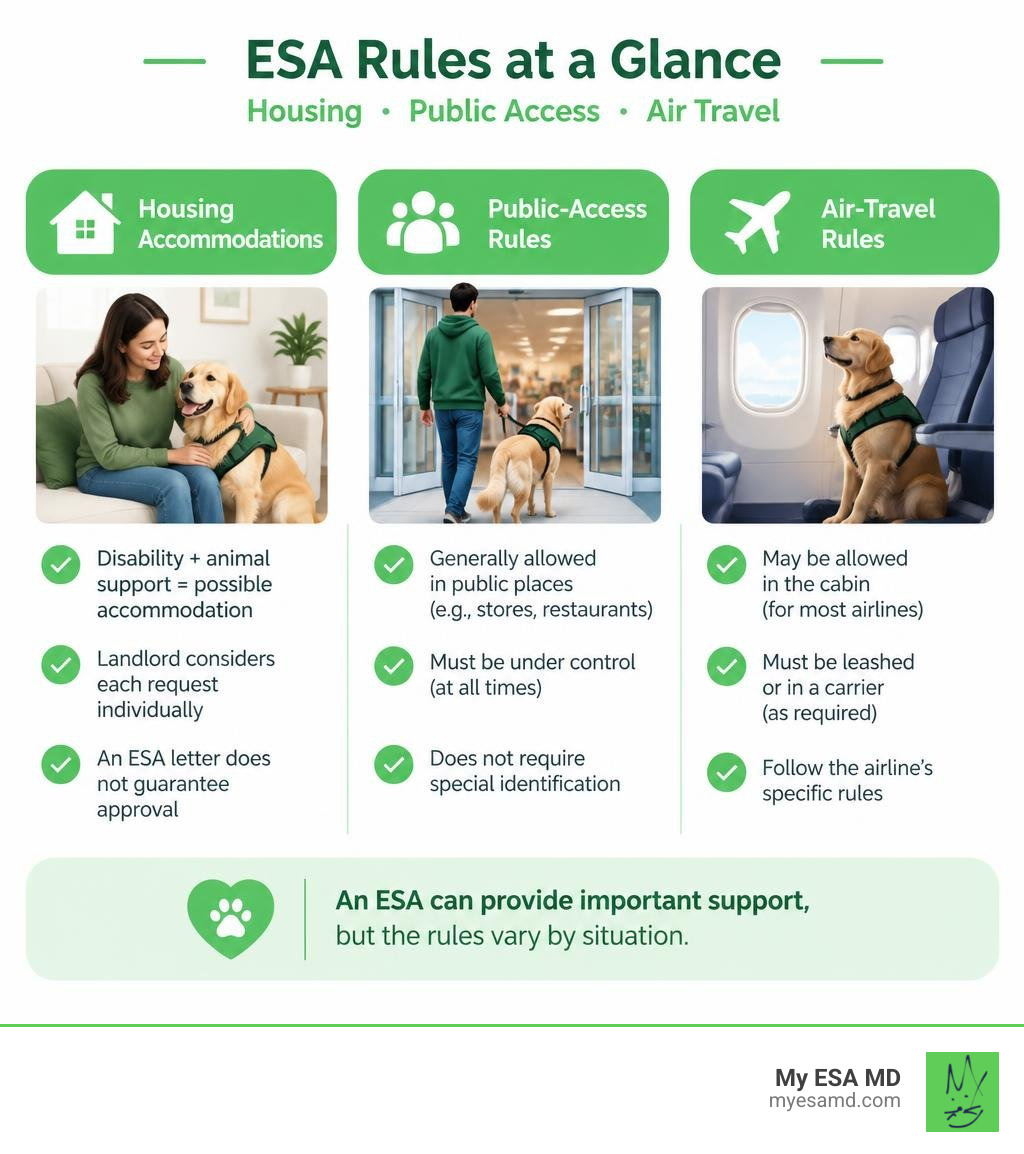
An ESA housing request may be appropriate when a person has a disability and needs an animal’s support to have an equal opportunity to use and enjoy their home. The request depends on the person’s circumstances and the connection between the disability and the animal’s assistance. A diagnosis, a pet preference, or owning an animal alone does not automatically establish eligibility.
The housing provider may need reliable information if either the disability or the disability-related need is not apparent. That information should be limited to what is reasonably needed to assess the request. A tenant generally does not need to provide a complete medical history.
What makes an animal an emotional support animal?
An emotional support animal provides comfort or other support that helps address a disability-related need. Unlike a service animal under the Americans with Disabilities Act, an ESA does not need specialized training to perform a specific task.
The key distinction is the reason for the accommodation: the animal must help with a need related to a person’s disability. Wanting a pet or finding that an animal makes life more enjoyable, without that disability-related connection, is not enough by itself.
What does a housing provider need to know?
A housing provider needs enough information to understand that the person has a disability-related need for an assistance animal. If that need is not obvious, the provider may ask for reliable supporting information. The request can be made in writing, and clear written communication can help keep track of what was requested and when.
A tenant need not volunteer a diagnosis or broad medical details simply to make a request. The goal is to establish the need for an accommodation, not to disclose private information that is unrelated to the decision.
How do Maryland housing protections work?
The federal Fair Housing Act and Maryland fair housing protections may require housing providers to make reasonable accommodations for people with disabilities. This can apply to rental housing and, depending on the circumstances, condominiums and homeowners associations.
An accommodation is not an automatic approval of every request. Housing providers may assess requests individually, including whether the animal is needed because of a disability and whether a recognized legal exception applies. Some properties or situations may fall outside particular fair-housing requirements, so the details matter.

What can a housing provider ask for?
If a disability-related need is not readily apparent, a provider may request reliable information that supports the need for the animal. Maryland also has rules about documentation and the qualifications of professionals who provide it. A provider may consider whether the professional is appropriately licensed and has a meaningful relationship with, or relevant knowledge of, the person seeking the accommodation.
A housing provider should not demand full medical records or information unrelated to the request. If you are unsure what documentation is appropriate, review the Maryland housing accommodation guidance or contact the Maryland Commission on Civil Rights for information about the rules that apply to your situation.
Can a housing provider charge pet fees for an assistance animal?
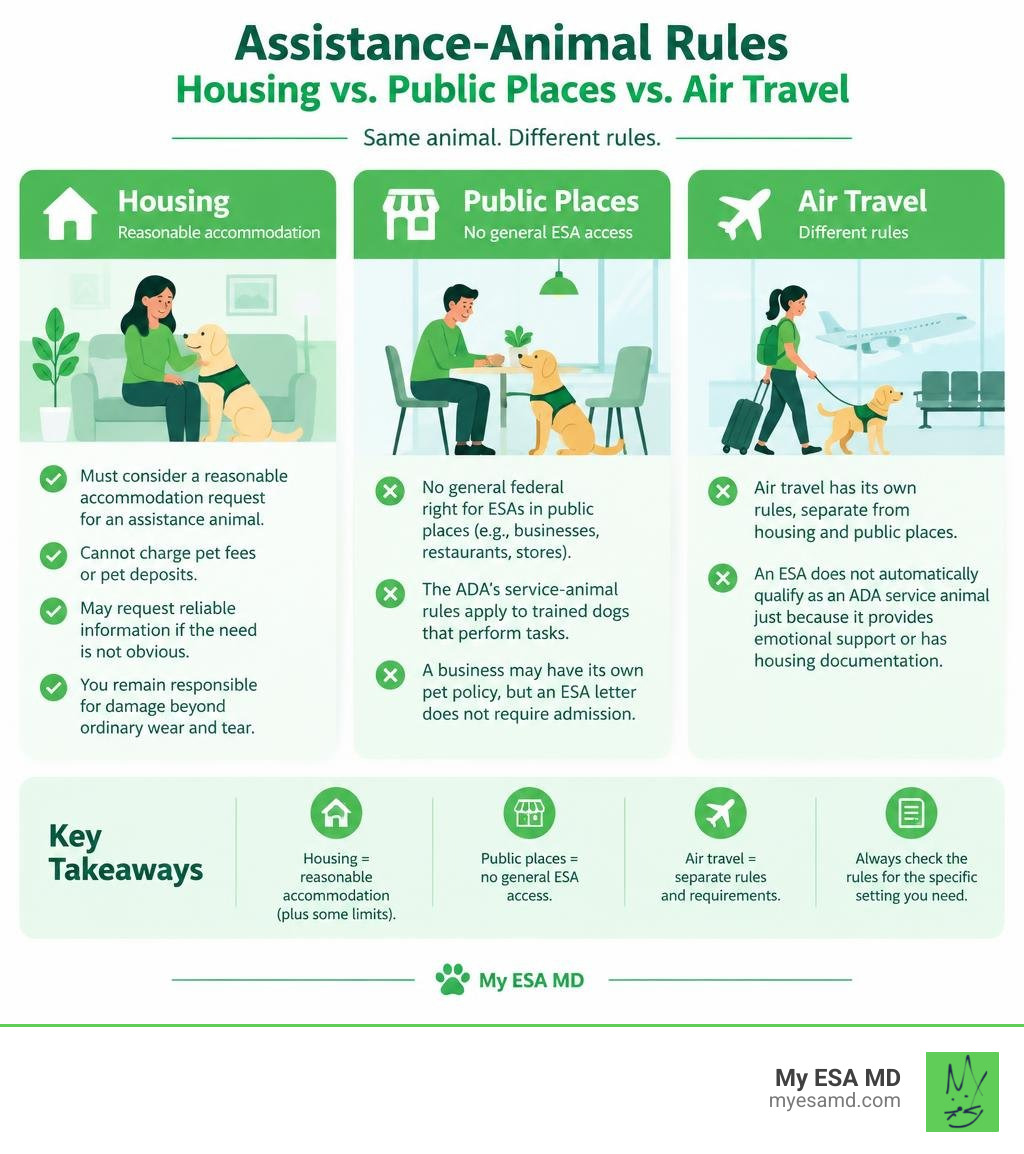
An assistance animal is not treated as a pet for the purpose of a reasonable accommodation request. A housing provider generally cannot charge a pet fee or pet deposit for an approved assistance animal.
That does not remove a tenant’s responsibility for damage. If an animal causes damage beyond ordinary wear and tear, a housing provider may seek payment under the same rules that apply to other tenant-caused damage. Animal-related concerns should be assessed on the facts rather than assumptions about a particular breed or type of animal.
What should an ESA letter include—and what does it not guarantee?
When documentation is needed, it should come from an appropriately qualified health-care professional who has evaluated the person or otherwise has a suitable basis to provide information about the disability-related need. In Maryland, the practitioner’s credentials and relationship with the person may matter.
Useful documentation may identify the professional and provide enough information to support the need for an assistance animal in housing. It should not disclose more private medical information than necessary. A letter is supporting documentation; it is not a registration, government certificate, or promise that a housing provider must approve the request.

How can you spot unreliable ESA documentation?
Be cautious of services or documents that promise instant approval, claim that buying a certificate automatically creates legal rights, or offer a registration as a substitute for an individualized assessment. There is no official ESA registry that a person must join to request a housing accommodation.
Reliable documentation should be based on an appropriate professional evaluation and should accurately address the person’s circumstances. A document that guarantees approval or suggests that an animal has unrestricted access everywhere may be misleading.
Where do ESA protections apply—and where do they not?
Housing accommodation rules are different from rules for public places and air travel. A housing provider may have to consider a disability-related request for an assistance animal, but that does not give an ESA a general right to enter businesses, restaurants, or other public places.
The ADA’s service-animal rules generally concern trained dogs that perform tasks for a person with a disability. An ESA does not become an ADA service animal simply because it provides emotional support or has housing documentation.
Are emotional support animals allowed in public places?
There is no general federal public-access right for ESAs under the ADA. Businesses and restaurants generally follow service-animal rules, not housing accommodation rules. A business may have its own pet policy, but an ESA letter does not require it to admit an animal.
Housing protections also do not automatically apply to workplaces, stores, or other settings. If you need access in a particular setting, check the rules that govern that setting rather than relying on housing documentation.
Can an ESA fly in the cabin?
Air travel has separate rules. Under current federal air-travel rules, airlines are not generally required to treat emotional support animals as service animals or allow them in the cabin on that basis. An airline may have its own policies for pets, including rules about advance notice, fees, carriers, and animal size.
Check directly with the airline before booking or traveling. Do not assume that a housing letter or ESA documentation guarantees cabin access.
How to request an ESA housing accommodation in Maryland
A clear, practical request can make it easier for a housing provider to understand what you need. Consider these steps:
- Make the request to the housing provider. Explain that you are requesting a reasonable accommodation to keep an assistance animal because of a disability-related need. You do not need to use special legal wording, but being specific can help.
- Provide relevant documentation if needed. If your disability or need is not apparent, ask a qualified professional about appropriate supporting information.
- Keep copies of communications. Save your request, any documents you provide, and the housing provider’s responses.
- Discuss questions or possible alternatives. A housing provider may ask for additional relevant information or discuss how the accommodation can work in practice.
- Follow up in writing. If you do not receive a response, ask for an update and keep a record of the follow-up.
The provider should consider the request individually rather than rely on a blanket rule against animals. If you believe your rights were violated, you can contact the Maryland Commission on Civil Rights to ask about fair-housing complaint options.
What can you do if your request is denied?
Ask for the decision and its reason in writing. Review whether the provider considered your individual circumstances and whether the information supplied addressed the disability-related need. If relevant information is missing, you may be able to provide clarification or ask the provider to reconsider.
If the denial seems discriminatory, contact the Maryland Commission on Civil Rights to discuss possible complaint options. You may also seek legal advice about your specific circumstances. A denial may have more than one explanation, so it is important to review the facts and applicable rules before deciding what to do next.
Frequently Asked Questions about Emotional Support Animals in Maryland
Conclusion
Maryland residents may request an ESA housing accommodation when an animal supports a need related to a disability. The housing provider should consider the request individually, and appropriate documentation may be needed when the disability or need is not apparent. Housing rules do not create general public-access rights or guarantee that an ESA can fly in an airplane cabin.
My ESA MD connects patients with licensed medical doctors for telehealth evaluations for people seeking an ESA housing letter. To explore emotional support animal eligibility and a telehealth evaluation, review your circumstances and consider whether an individualized evaluation may be appropriate.
Live in Maryland? Talk to a Licensed MD
Dr. Rieser is licensed in Maryland and sees patients by telehealth. One flat fee, no memberships, and real people who answer the phone.
Approved by: Dr. Rick Rieser, MD — Medical Director, My ESA MD. Stanford-trained physician, 30+ years of clinical experience.