
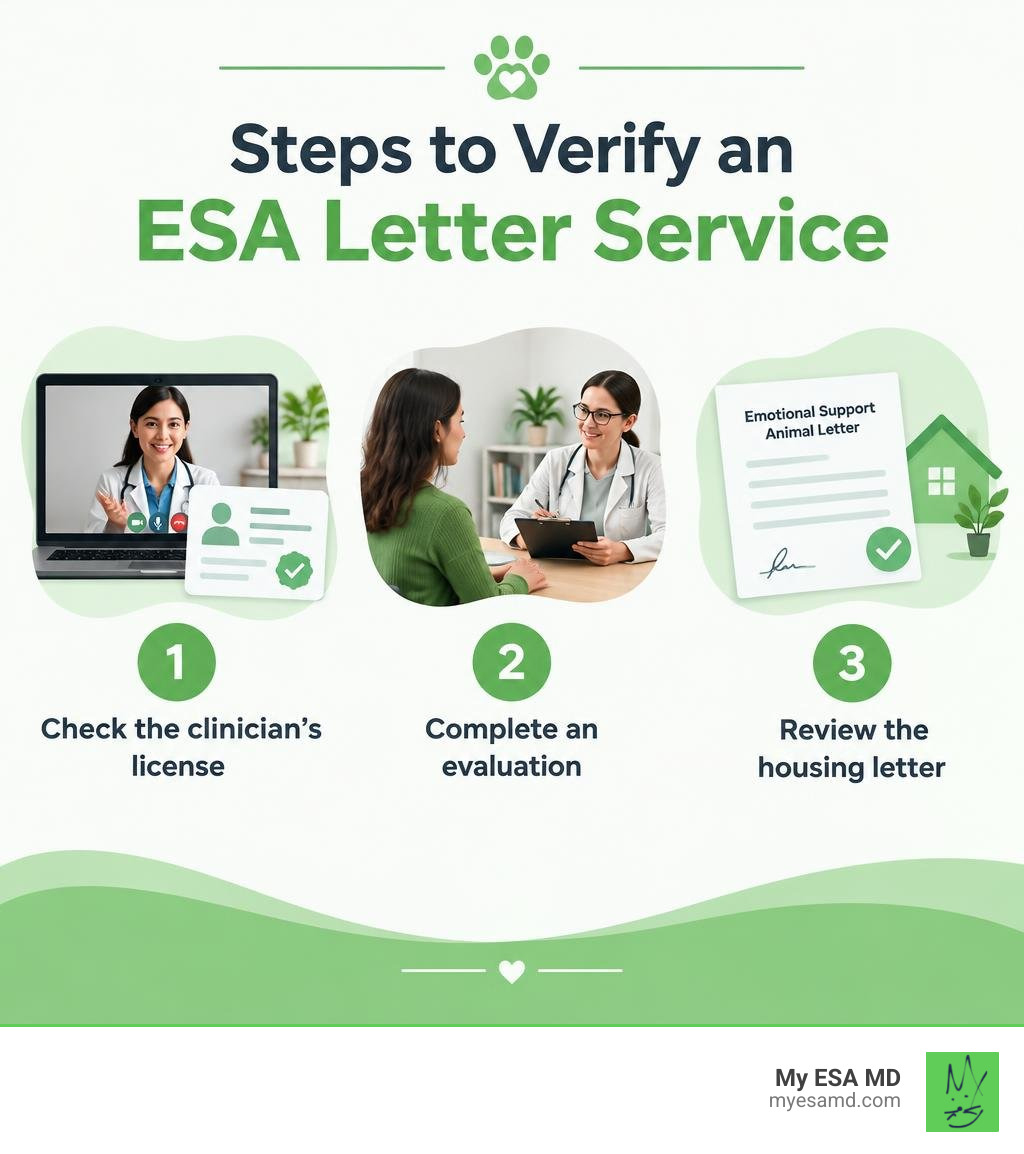
To get an esa dr letter for housing, choose a clinician licensed to practice in your state and complete a real clinical evaluation. The clinician should assess how your mental health condition affects daily life and whether the animal helps with that disability-related need. An instant approval without an evaluation is a warning sign.
A legitimate letter can support a request to keep an emotional support animal in rental housing, but paying for a letter does not guarantee that you qualify. This guide will help you check a service before you share your health information or pay.
I'm Joscelyn Rieser, director at My ESA MD, where I help coordinate doctor-led telehealth evaluations for ESA housing letters. My background in web development and telehealth operations informs this guide to finding a legitimate esa dr letter online.
Legal Protections and How an ESA Differs from Other Assistance Animals
Navigating disability housing laws can feel confusing, but understanding the core legal protections is essential. Under federal law, emotional support animals are categorized as assistance animals rather than ordinary household pets. Because of this distinction, qualified individuals can seek reasonable housing accommodations. To understand the legal groundwork, learning how to get an ESA letter for housing is the first step toward protecting your rights.

Service Animals vs. Emotional Support Animals vs. Therapy Animals
Many people confuse service animals, emotional support animals, and therapy animals. While all three provide meaningful support, they serve different functions and are governed by distinct legal standards:
- Service Animals: Defined under the Americans with Disabilities Act (ADA) as dogs (and in rare instances, miniature horses) individually trained to perform specific tasks or do work directly related to a person's physical, sensory, psychiatric, or intellectual disability. Examples include guiding visually impaired individuals, alerting someone with epilepsy to an impending seizure, or interrupting self-harm behaviors during a panic attack. Service animals have broad public access rights and can accompany their handlers into restaurants, stores, hotels, and public transportation.
- Emotional Support Animals (ESAs): Animals that provide therapeutic companionship and emotional comfort to alleviate symptoms of a diagnosed mental or psychiatric condition. ESAs do not require specialized behavioral or task training. While they do not have public access rights under the ADA to enter private businesses, depending on the state you live in, they may be protected in residential settings by state law. In states without their own ESA protections, HUD's enforcement office no longer brings charges on behalf of tenants with untrained emotional support animals, so the resident often has to do much more to show why the animal is needed.
- Therapy Animals: Animals trained alongside a handler to deliver comfort, affection, and emotional support to individuals in clinical or community settings, such as hospitals, hospices, nursing homes, and disaster relief centers. Therapy animals have no specialized federal housing or public access protections under the ADA or FHA.
| Feature | Service Animal | Emotional Support Animal (ESA) | Therapy Animal |
|---|---|---|---|
| Primary Federal Law | Americans with Disabilities Act (ADA) | Fair Housing Act (FHA) | None (Local volunteer agreements) |
| Specialized Task Training Required? | Yes (Specific disability-related tasks) | No (Companionship provides relief) | Yes (Therapy visitation training) |
| Public Access Rights (Stores, Cafes) | Yes | No | No (Only with facility permission) |
| Residential Housing Protections | Yes | Yes | No |
| Covered Species | Dogs and miniature horses | Any standard domestic animal | Various domestic species |
Federal Housing and Travel Regulations in 2026
The legal landscape surrounding assistance animals has evolved significantly in recent years. In September 2025, HUD withdrew its earlier assistance-animal guidance, and a May 2026 memo narrowed its enforcement focus to trained animals; the Fair Housing Act itself did not change, but protections now depend more on state law. Under the Fair Housing Act, landlords, housing associations, and property managers must provide reasonable accommodations for tenants with disabilities. Depending on the state you live in, when a tenant provides valid documentation from a licensed healthcare professional, landlords cannot:
- Enforce strict "no-pets" lease rules against the assistance animal.
- Charge pet deposits, non-refundable pet fees, or recurring monthly pet rent.
- Enforce general breed, weight, or size restrictions against legitimate assistance animals.
However, air travel regulations differ sharply from housing laws. Effective January 2021, the U.S. Department of Transportation amended regulations under the Air Carrier Access Act (ACAA). Commercial airlines are no longer required to recognize emotional support animals as assistance animals. Major commercial airlines treat ESAs as standard domestic pets, requiring them to comply with standard pet fees, carrier dimensions, and in-cabin pet guidelines. Only trained service dogs, including psychiatric service dogs, retain legal travel protections under the ACAA.
Understanding What a Legitimate ESA Dr Letter Requires
An authentic recommendation is not a certificate bought from a registry; it is a clinical document representing a formal medical assessment. Consulting a telehealth ESA doctor for housing letter ensures that your evaluation adheres to accepted psychiatric standards. Professional guidelines, such as the Resource Document on Emotional Support Animals by the American Psychiatric Association, highlight that clinicians must conduct thorough, defensible assessments.
DSM-5 Clinical Evaluation and the Functional Nexus
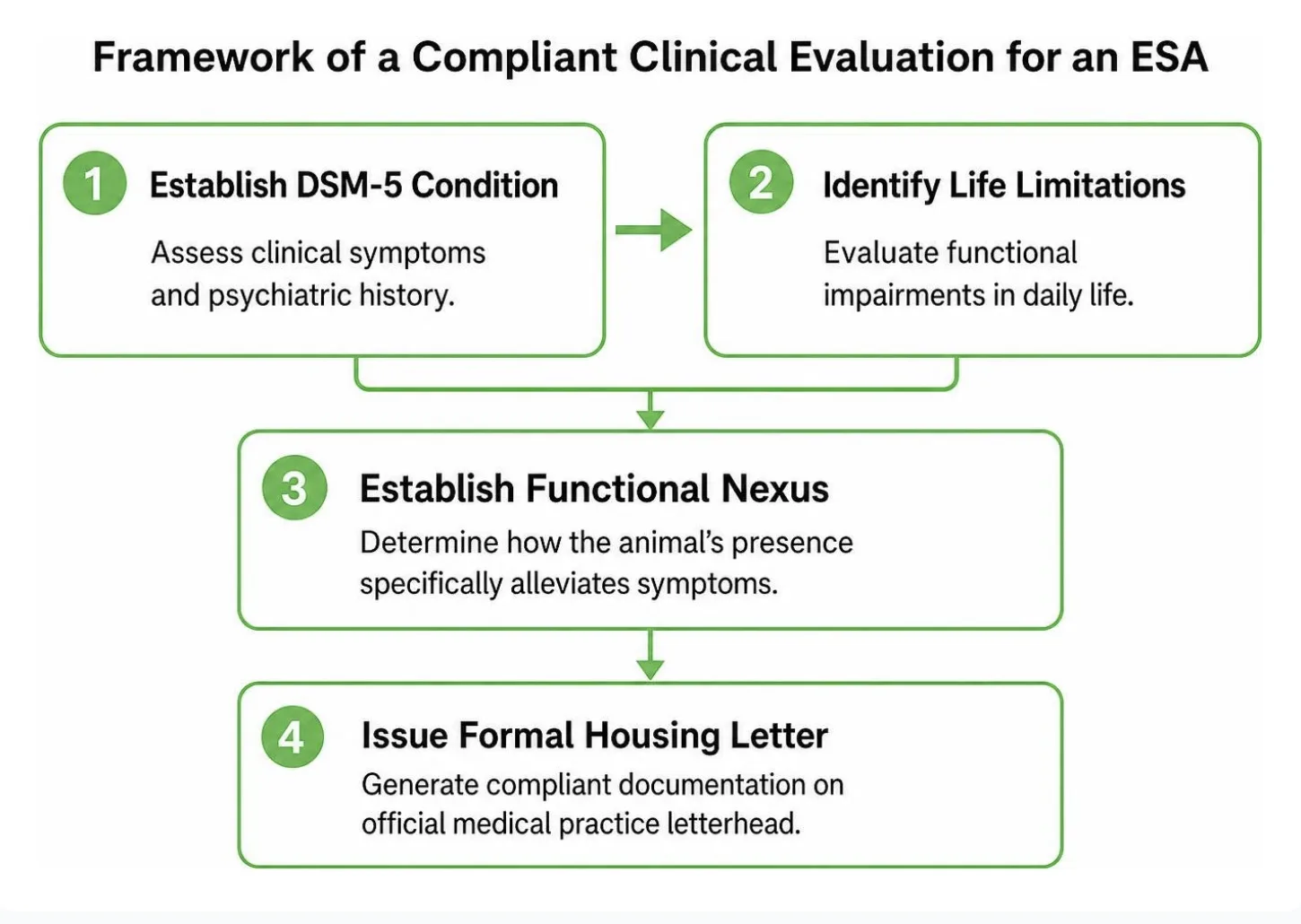
A compliant medical evaluation requires establishing two distinct prongs:
- A Diagnosed Mental Health Impairment: The clinician assesses whether the individual meets the criteria for a recognized mental or psychiatric condition under the Diagnostic and Statistical Manual of Mental Disorders (DSM-5-TR), such as generalized anxiety disorder, major depressive disorder, or post-traumatic stress disorder, that substantially limits one or more major life activities (e.g., sleeping, working, concentrating, socializing).
- The Therapeutic Nexus: The clinician must establish a clear functional connection between the animal's presence and the alleviation of symptoms. For instance, in a patient with severe clinical depression, a companion animal may provide daily structure and motivation to maintain daily routines, directly mitigating functional impairment.
Key Components of an Authentic ESA Dr Letter
To be legally compliant and accepted by housing providers, an ESA housing letter must be written on official medical practice letterhead and include:
- The clinician's full name, professional title, and clinical credentials (e.g., MD, DO, LCSW, LMFT, PsyD).
- The clinician’s active medical license number, license type, and the state where it was issued.
- The effective issuance date.
- Clear affirmation that the patient has a diagnosed mental impairment that substantially limits major life activities under fair housing law.
- Confirmation that the animal provides therapeutic support that alleviates one or more identified symptoms.
- The clinician’s signature and contact information for third-party verification.
Critically, a compliant letter preserves patient privacy. Under federal rules, healthcare providers should never disclose your specific diagnostic codes, detailed psychiatric records, or medical history to a landlord.
State-Specific Laws: California AB 468 and Florida Mandates
State legislatures have introduced specific statutory rules to curb fraudulent ESA letters:
- California (AB 468): Under California law, a healthcare practitioner issuing an ESA letter for an emotional support dog must hold an active license in the state, establish a genuine client-provider relationship at least 30 days prior to issuing an initial letter, and conduct a comprehensive clinical evaluation.
- Florida (Statute 760.27): Florida law states that ESA registrations, ID cards, certificates, and similar items obtained from the internet are not, by themselves, enough to establish a need for an emotional support animal. The practitioner providing documentation must have personal knowledge of the individual's disability.
How to Identify Legitimate Telehealth Providers vs. Online Scams
The internet is filled with deceptive websites selling invalid certifications and registration kits. If you want to know how to ask a licensed doctor for an ESA letter, understanding the difference between genuine telemedicine and fraudulent operations is critical.

Warning Signs of Fraudulent Online ESA Dr Letter Services
Recognizing these red flags will protect you from invalid paperwork:
- Instant Approvals: Any website promising a letter in 5 minutes after filling out an automated questionnaire without a real clinical consultation is fraudulent.
- "Official" Registries and Badges: There is no official or legally recognized government registry for ESAs. Websites selling IDs, badges, vests, or "lifetime registrations" are selling unneeded merchandise that carries zero legal weight under federal law.
- Lifetime Letters: Legitimate housing letters represent an ongoing clinical recommendation and generally require periodic re-evaluation. Websites advertising "permanent, lifetime protection" violate standard clinical practice.
| Feature | Legitimate Clinical Telehealth Services | Instant Letter Mills / Registries |
|---|---|---|
| Clinician Interaction | Direct evaluation with a state-licensed doctor | Automated questionnaire or zero interaction |
| Licensing Compliance | Licensed in the patient's home state | Out-of-state, unverified, or non-existent |
| Legal Validity | Recognized under the Fair Housing Act | Frequently rejected by landlords |
| Ancillary Products | Focuses strictly on clinical documentation | Aggressively upsells badges, vests, and fake IDs |
| Pricing Model | Transparent flat fees for clinical evaluations | Hidden subscriptions and renewal traps |
Validating Medical Credentials and Consultation Standards
Legitimate platforms connect you with physicians who are fully licensed in your specific state of residence. Before proceeding, confirm that the platform allows you to verify your doctor’s license number through your state’s medical licensing board portal. At My ESA MD, we operate as a family-run, doctor-led telehealth service. We offer transparent flat-fee pricing with no recurring monthly memberships and a money-back guarantee if the physician determines you do not qualify.
Step-by-Step Guide to Getting Approved by an Online Doctor
Obtaining legitimate documentation through a telemedicine provider involves a straightforward, legally compliant path:
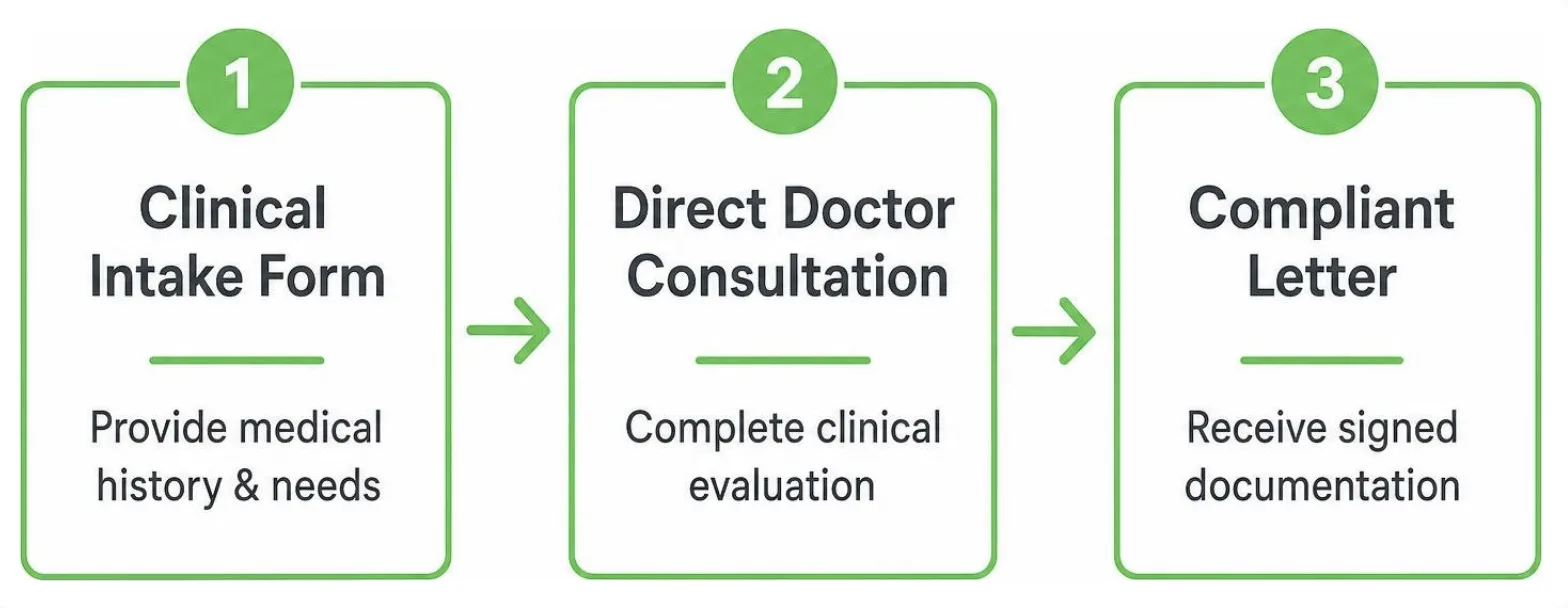
To review our complete clinical evaluation steps, explore how it works.
Preparing for Your Clinical Evaluation
During your appointment, the physician will review your mental health history, discussing:
- The primary emotional or psychological challenges you experience.
- Specific ways these symptoms interfere with daily activities like sleeping, focusing, or managing stress.
- How your animal’s companionship provides emotional stability, functional support, and symptom relief.
Being candid about your daily routines and symptoms helps the doctor conduct an accurate disability evaluation. When you are ready to begin, you can get your ESA letter through our doctor-led platform.
Presenting Your Accommodation Request to Housing Providers
Once you have your signed housing letter:
- Submit a written request for reasonable accommodation to your property manager or landlord.
- Attach a digital or printed copy of your clinician-signed ESA letter.
- Keep copies of all correspondence. Housing providers have a legal obligation to review reasonable accommodation requests promptly.
Frequently Asked Questions About ESA Documentation
For additional information regarding clinical evaluations and legal rights, visit our comprehensive FAQ section.
Conclusion
Securing legitimate documentation for an emotional support animal requires an authentic clinical evaluation from a licensed healthcare professional. Bypassing unverified online registries in favor of a doctor-led telehealth evaluation ensures that your accommodation request complies with current fair housing regulations while protecting your privacy.
If you are dealing with a qualifying mental health condition and believe an assistance animal can help you manage your daily life, learn more about who is eligible for an emotional support animal and take the first step toward securing your housing accommodations today.
Ready for a Real Evaluation?
Talk with a licensed MD about whether an emotional support animal is right for you. One flat fee, no memberships, and real people who answer the phone.
Approved by: Dr. Rick Rieser, MD — Medical Director, My ESA MD. Stanford-trained physician, 30+ years of clinical experience.