
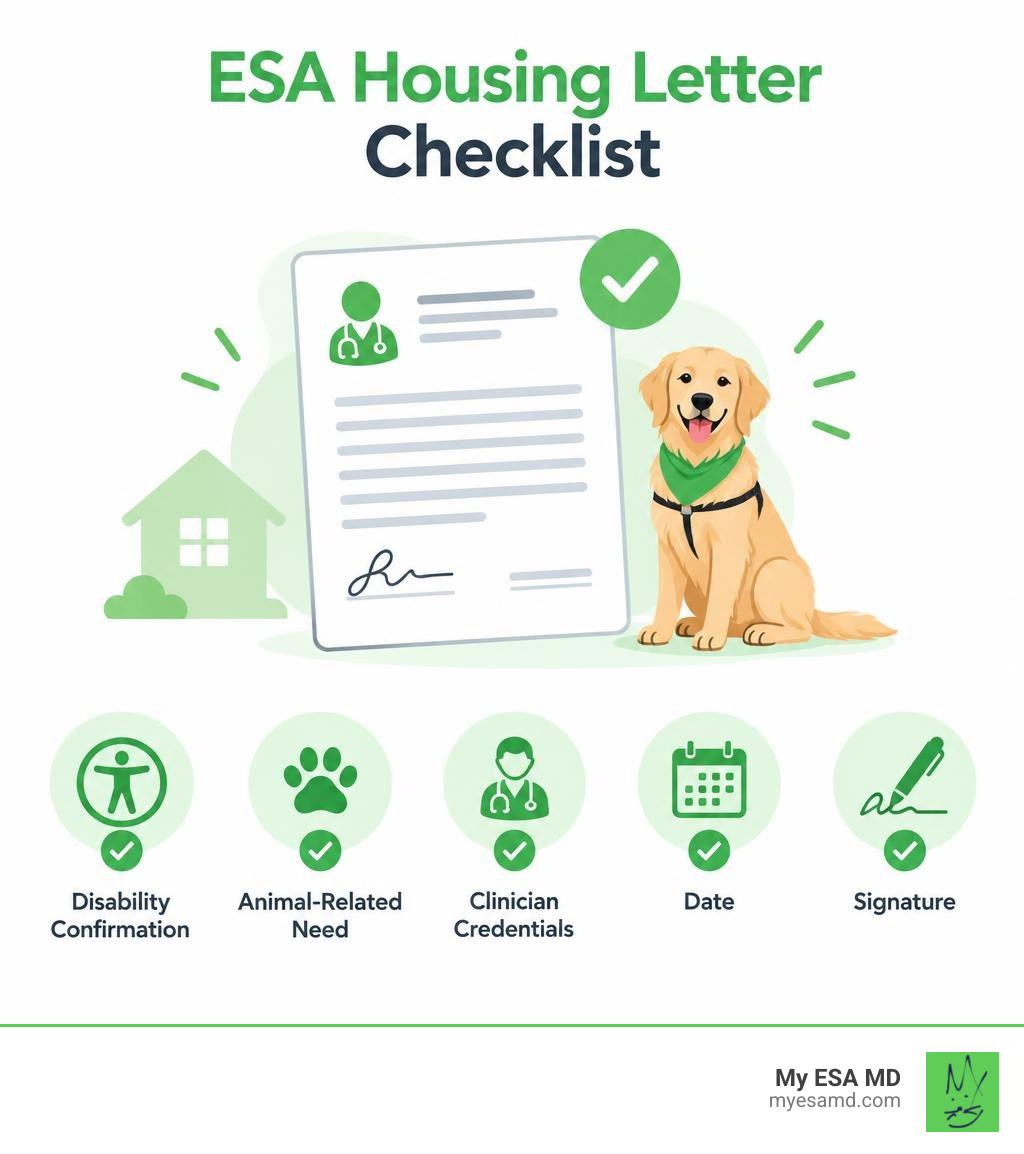
A sample emotional support animal letter for housing should confirm two things: the tenant has a disability under fair housing law, and the animal helps meet a need related to that disability. The clinician should put the letter on professional letterhead, sign and date it, and include credentials the landlord can verify. It does not need to name a diagnosis or include an ESA registry number.
The sections below show how to turn those points into a clinician's letter and a separate request to your landlord. The letter supports a request for a housing accommodation; it does not give an animal access to stores or flights.
I'm Joscelyn Rieser, director at My ESA MD, where I help coordinate a doctor-led telehealth service that connects patients with licensed medical doctors for ESA housing evaluations. My work in service coordination and web resources shapes this guide to using a sample emotional support animal letter for housing.
Legal Framework: What an Emotional Support Animal Letter for Housing Actually Grants
When you request an assistance animal in a rental property, you are exercising a federal right established under the Fair Housing Act (FHA). Federal housing law recognizes that assistance animals—including emotional support animals—are not ordinary pets. Instead, they serve as a reasonable accommodation necessary to afford an individual with a disability an equal opportunity to use and enjoy a dwelling.
Depending on the state you live in, having a valid letter may unlock specific emotional support animal housing rights that protect tenants from restrictive property rules:
- Waiver of "No-Pet" Rules: Landlords must allow your ESA to live with you, even in buildings with strict pet bans.
- Exemption from Pet Surcharges: Housing providers cannot charge upfront pet deposits, non-refundable pet fees, or recurring monthly pet rent for an assistance animal.
- Bypass of Breed and Weight Limits: Building restrictions on specific breeds or weight caps do not apply to assistance animals.
According to the Centers for Disease Control and Prevention (CDC), approximately 1 in 4 adults are living with a disability. For many of these individuals, an ESA provides therapeutic stability that makes independent daily living possible. However, the legal protections provided by an ESA letter are specifically tailored to residential settings.
Assistance Animals vs. Service Animals vs. Therapy Pets
Understanding the legal differences between various types of support animals helps avoid misunderstandings with landlords and business owners.
| Category | Primary Legal Protections | Specialized Training Required? | Public Access Rights (Stores, Restaurants) | Housing Protections (Exempt from Pet Rules/Fees) |
|---|---|---|---|---|
| Service Animal | Americans with Disabilities Act (ADA) | Yes (individually trained for specific tasks) | Yes | Yes |
| Emotional Support Animal (ESA) | Fair Housing Act (FHA) | No (provides therapeutic presence) | No | Yes |
| Therapy Animal | None (operates via facility permission) | Yes (temperament and facility training) | No | No |
Under the Americans with Disabilities Act, service animals are strictly defined as dogs (and in rare cases, miniature horses) trained to perform specific tasks directly related to an individual's physical, sensory, psychiatric, or intellectual disability. Service animals enjoy full public access rights.
In contrast, an emotional support animal provides comfort, companionship, and symptom mitigation without needing specialized task training. While the Fair Housing Act protects ESAs in residential dwellings, they do not have public access rights under the ADA. Furthermore, the Air Carrier Access Act (ACAA) no longer mandates that commercial airlines accommodate ESAs as service animals. For a closer look at these legal boundaries, see our breakdown of the differences between ADA and ESA housing laws.
Legitimate Landlord Exemptions Under Federal Housing Law
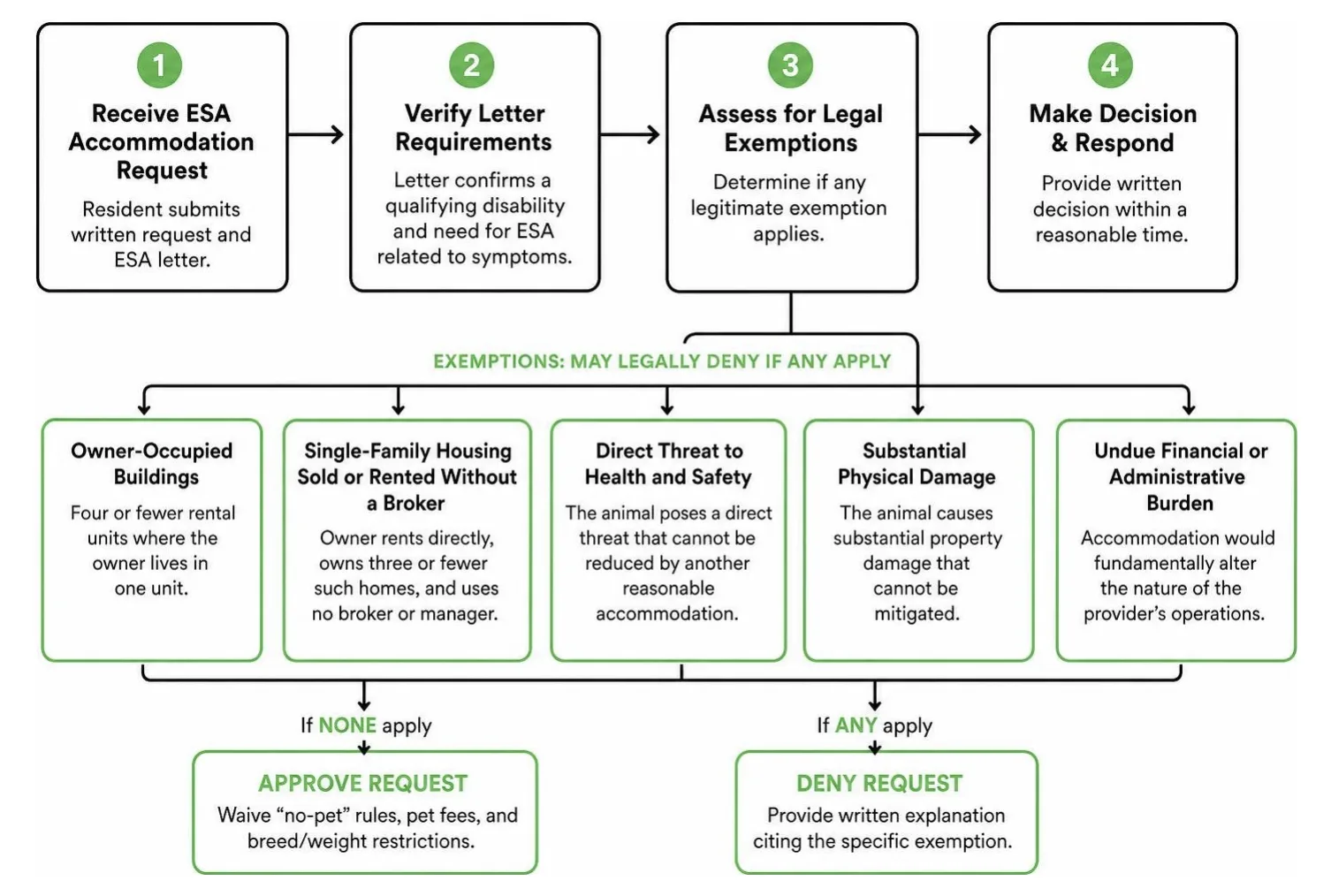
While the Fair Housing Act covers most rental properties across the country, certain narrow exemptions exist. A landlord may legally deny an ESA accommodation request under the following limited circumstances:
- Owner-Occupied Buildings: Buildings with four or fewer rental units where the property owner lives in one of the units.
- Single-Family Housing Sold or Rented Without a Broker: Single-family homes rented directly by an owner who owns three or fewer such single-family houses at one time, provided no real estate broker or management company is used.
- Direct Threat to Health and Safety: If an individual animal exhibits aggressive behavior, unprovoked biting, or poses a direct threat to the safety of other residents that cannot be reduced by another reasonable accommodation.
- Substantial Physical Damage: If the animal causes substantial damage to property that cannot be mitigated.
- Undue Financial or Administrative Burden: If accommodating the animal fundamentally alters the nature of the housing provider's operations.
Essential Elements of a Compliant Sample Emotional Support Animal Letter for Housing
A landlord or property manager needs to verify that your request is supported by reliable clinical documentation. Understanding how to get an ESA letter for housing begins with ensuring your documentation satisfies the two fundamental legal requirements under the Fair Housing Act:
- Verification of a Qualifying Disability: The clinician must confirm that you meet the definition of a person with a physical or mental impairment that substantially limits one or more major life activities (such as sleeping, concentrating, regulating mood, or caring for oneself).
- The Clinical Nexus: The clinician must establish a clear connection (nexus) between your functional limitations and the therapeutic support provided by the animal, showing how the animal alleviates symptoms.
Mandatory Clinical Details and Healthcare Provider Credentials
For an ESA housing letter to hold legal weight, it must originate from a licensed healthcare professional acting within the scope of their practice. Valid providers include licensed medical doctors (MDs), psychiatrists, clinical psychologists, licensed clinical social workers (LCSWs), licensed professional counselors (LPCs), and psychiatric-mental health nurse practitioners (PMHNPs).
A compliant verification letter must include:
- Professional letterhead featuring the provider's practice name, clinical address, phone number, and email.
- The provider's professional license type (e.g., Medical Doctor, LCSW).
- The provider's active license number and the state jurisdiction in which they are licensed.
- The date the letter was issued.
- A statement confirming an established professional relationship and clinical evaluation of the individual.
- The healthcare professional's physical or verifiable digital signature.
If you are wondering how to ask a licensed doctor for an ESA letter, discuss your daily functional challenges directly during your clinical consultation. For individuals seeking care remotely, consulting a telehealth ESA doctor for housing letter evaluation offers an efficient, legally compliant option, provided the physician holds an active license in your state.
What a Compliant Letter Must Avoid Disclosing

Many renters assume that an ESA letter needs to detail their private medical background. In reality, federal privacy regulations and housing guidelines strictly protect your medical confidentiality. A legally compliant letter must intentionally avoid disclosing:
- Specific DSM Diagnoses: The letter should never state your exact psychiatric or medical diagnosis (such as Major Depressive Disorder, Generalized Anxiety Disorder, or PTSD). Stating that you have an impairment that limits a major life activity is legally sufficient.
- Detailed Clinical Notes or Medical Records: Never attach therapy session notes, chart histories, or prescription logs.
- Online Registry or "Certification" Numbers: Commercial registry kits, novelty ID cards, and official-looking badges carry no legal standing under federal housing law and signal questionable documentation to experienced property managers.
- Behavioral or Temperament Guarantees: Clinicians evaluate human mental health, not animal obedience. A healthcare provider should not certify that an animal will never bark, bite, or scratch.
What a Legitimate ESA Housing Letter Looks Like
A legitimate letter is written by the licensed healthcare provider who evaluated you, so its wording will reflect your own evaluation rather than a fill-in-the-blank form.
The focus of the letter differs slightly depending on the type of animal involved.
Standard Sample Emotional Support Animal Letter for Housing (Household Pets)
When requesting an accommodation for a dog, cat, or other traditional pet, the letter focuses on general symptom relief and functional daily support. For dogs specifically, our guide on ESA dog letters for housing outlines how these clinical recommendations function alongside an emotional support animal apartment letter.
Sample Emotional Support Animal Letter for Housing With Unique Species
Common household animals (dogs, cats, small birds, rabbits, hamsters, gerbils, other rodents, fish, and turtles) are the animals most often accepted as assistance animals. If an individual relies on a unique, non-traditional species—such as a miniature goat, hedgehog, or reptile—the housing provider may ask for more information, so the clinical letter may need to include additional rationale explaining why a standard domesticated pet cannot fulfill the therapeutic role, detailing the specific therapeutic grounding or functional support the unique species provides.
Keep in mind that some species, such as hedgehogs, are illegal to keep as pets in certain places, including California, Hawaii, and New York City, and an ESA letter does not override those laws.
How Tenants Should Request Reasonable Accommodations from Landlords
Obtaining your medical ESA letter is the clinical half of the process; formally presenting it to your landlord is the administrative half. Learning how to use an ESA letter for rental property ensures your request is handled professionally and without unnecessary friction.
We recommend delivering your request in writing (via email, tenant portal, or certified mail with return receipt requested). This establishes a clear date stamp and documentation trail.
Writing Your Tenant Accommodation Request Letter

When you submit your medical letter, include a short, respectful cover letter requesting the accommodation.
Verification Limits: What Housing Providers Can and Cannot Ask
When a landlord receives your accommodation package, fair housing laws limit what they are generally permitted to ask, though the details vary by state.
What Landlords May Do:
- Verify that the letter came from a legitimate, licensed healthcare provider.
- Contact the provider's office to confirm that the clinician authored the letter and that the signature is authentic.
- Request verification of the disability and the need for the animal if the disability is not obvious.
What Landlords May NOT Do:
- Demand access to your medical records or psychiatric case files.
- Ask for your specific diagnosis, medical history, or the underlying cause of your disability.
- Require your healthcare provider to sign liability waivers or complete extensive, proprietary medical questionnaires (many landlords do use a short verification form, which your provider can complete).
- Require notarized documents, special training certificates, or third-party registry badges.
- Refuse an accommodation simply because the evaluation was conducted via telemedicine.
If a housing provider has questions, fair housing law generally expects them to engage in a good-faith interactive dialogue rather than issuing an immediate denial, though how this is enforced depends on the state you live in.
Frequently Asked Questions About ESA Housing Letters
Conclusion
A compliant ESA housing request relies on two clean, professional documents: an ethical verification letter from a licensed healthcare provider and your formal written accommodation request. When both documents clearly establish your legal disability and the therapeutic nexus of your animal without overstepping medical privacy limits, landlords can promptly verify and grant your accommodation.
My ESA MD connects patients with licensed medical doctors for doctor-led telehealth consultations. The doctors who evaluate patients through My ESA MD conduct comprehensive evaluations, and if the physician determines that an emotional support animal is appropriate, the provider issues documentation for your housing request. If you are exploring how an assistance animal can support your mental health, start by understanding what an emotional support animal is and how professional clinical care can help you secure your housing rights.
Need a Letter From a Licensed Doctor?
Talk with a licensed MD about whether an emotional support animal is right for you. One flat fee, no memberships, and real people who answer the phone.
Approved by: Dr. Rick Rieser, MD — Medical Director, My ESA MD. Stanford-trained physician, 30+ years of clinical experience.