
The most useful examples of emotional support animal letters show two things: the person has a disability, and the animal helps ease its effects at home. A letter for a dog or cat might say that the animal helps the patient manage symptoms that affect daily life. The clinician must make that statement based on an individual evaluation, not a copied template.
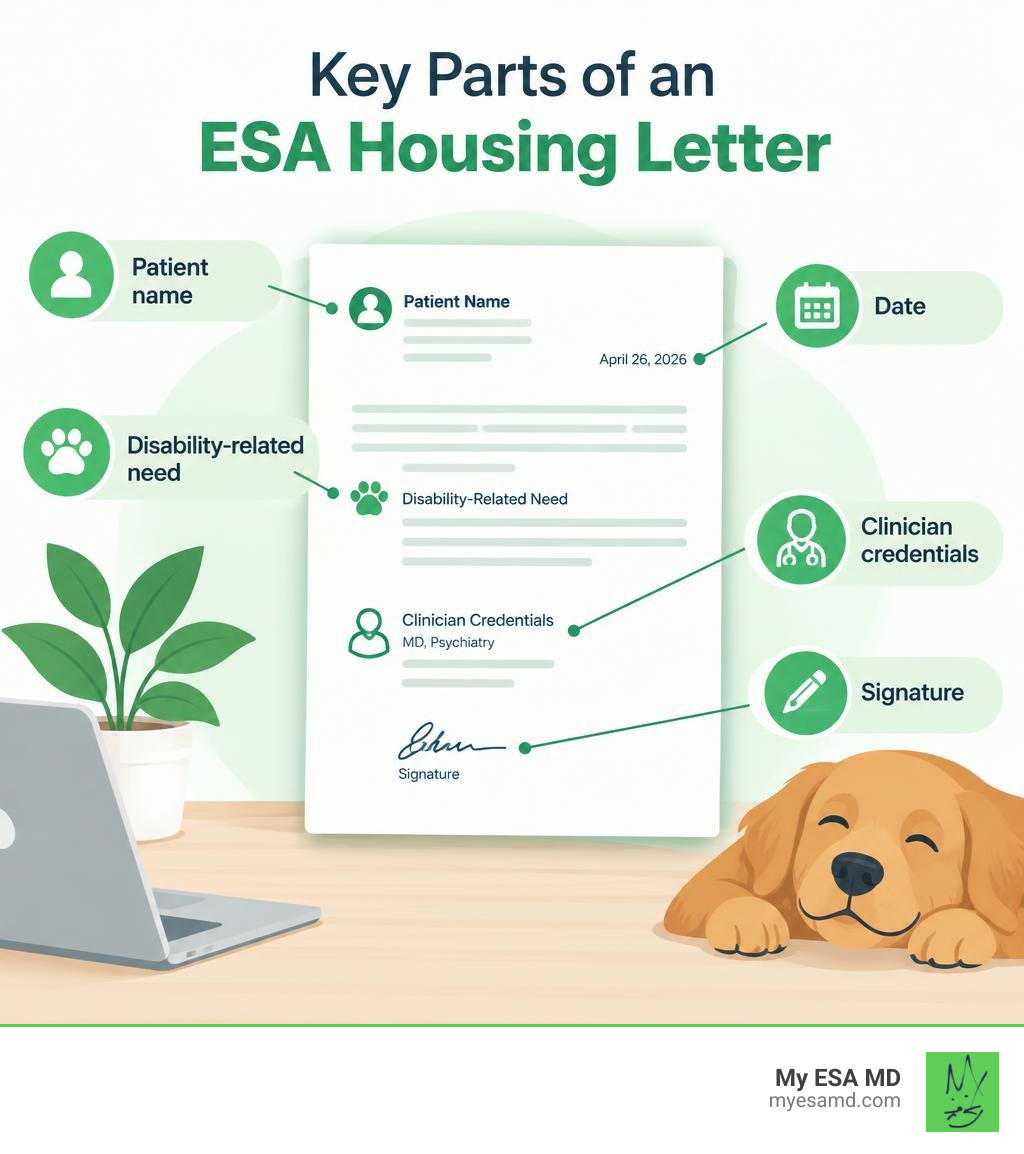
A credible housing letter also identifies the patient, gives the clinician's credentials and contact information, and includes a date and signature. It does not need to name the diagnosis. The examples below show how those details can fit together while protecting the patient's privacy. HUD changed its federal enforcement approach in May 2026. The Fair Housing Act itself did not change, but the protections available for an ESA housing request depend more on state law. A letter documents a request; it does not guarantee approval.
I'm Joscelyn Rieser, director at My ESA MD, where I help coordinate a doctor-led telehealth service for ESA housing letters. That work informs how I explain examples of emotional support animal letters and what readers should check before submitting one.
Legal Foundations and Clinical Standards for ESA Documentation
Navigating housing accommodations requires a solid grasp of federal disability protections. In the United States, roughly 1 in 4 adults live with a disability. For many of these individuals, the therapeutic companionship of an assistance animal plays a critical role in managing chronic mental health conditions.
However, writing an official verification letter is not a casual administrative favor—it is a formal disability determination carrying legal and clinical weight. The Fair Housing Act provides a framework for disability-related accommodation requests, but an ESA request should be assessed under current federal and applicable state rules rather than treated as automatically approved. Understanding what an emotional support animal is begins with recognizing that an ESA can provide disability-related support rather than companionship alone; its legal treatment depends on the rules applicable to the housing request.
| Animal Classification | Relevant Legal Framework | Specific Training Required? | General Public Access | Housing Protections (No Pet Fees / Breed Bans) |
|---|---|---|---|---|
| Emotional Support Animal (ESA) | Federal and applicable state housing rules | No specialized training required | No general public access | Depends on applicable law and the accommodation request |
| Service dog | ADA for public access; separate housing and airline rules | Yes (Individually trained for specific disability tasks) | Generally permitted under the ADA, subject to its limits | Separate housing accommodation rules apply |
| Therapy Animal | Facility permissions; no special rights from therapy status alone | Yes (Trained for social visits and obedience) | No (Only where invited, e.g., hospitals, schools) | No special housing rights from therapy status alone |
Airline access follows separate rules. Miniature horses have a separate ADA accommodation provision.
Distinguishing ESAs, Service Dogs, and Therapy Animals
It is crucial for clinicians and housing providers alike to maintain clear boundaries between different animal designations. A service dog is individually trained to perform specific tasks for a person with a disability, such as guiding someone with visual impairment, alerting a handler to an impending seizure, or interrupting self-harm behaviors. Because of this specialized training, service dogs generally have public access rights under the Americans with Disabilities Act (ADA), subject to the law's requirements and exceptions.
In contrast, an emotional support animal provides therapeutic comfort simply through its presence. An ESA does not require specialized task training, but its presence must alleviate at least one symptom or effect of an individual's mental or emotional disability. An ESA letter can document a disability-related housing request, but it does not itself guarantee an accommodation or exemption from pet fees or restrictions. Available protections depend on current federal and applicable state rules. ESA status alone does not confer ADA public access rights or a right to travel in an airplane cabin.
Misunderstandings around these definitions have led to high-profile travel incidents over the years, as chronicled in journalistic coverage that highlighted the friction caused when untrained animals entered public spaces under the mistaken assumption of ADA coverage. Therapy animals represent a third category: they are trained to provide comfort to groups of people in structured environments like hospitals or nursing homes, but their handlers do not receive special residential or public access rights under federal housing statutes.
Authorized Healthcare Providers and Telehealth Regulations
To be legally compliant, an ESA letter must be issued by a licensed healthcare professional acting within the scope of their practice and holding an active license in the patient's state of residence. Qualified issuers include:
- Licensed Medical Doctors (MDs) and Psychiatrists
- Licensed Clinical Social Workers (LCSW)
- Licensed Professional Counselors (LPC) or Mental Health Counselors (LMHC)
- Licensed Marriage and Family Therapists (LMFT)
- Psychiatric Nurse Practitioners (PMHNP)
- Licensed Clinical Psychologists
A legitimate ESA evaluation can take place through telehealth, with a licensed clinician conducting a real clinical assessment in accordance with applicable licensing rules. Evaluating who is eligible for an emotional support animal requires establishing a genuine provider-patient relationship.
State laws also introduce specific timing mandates that clinicians must follow. For example, My ESA MD's California patients seeking documentation for dogs follow a 30-day process required by state law. Clinicians should check current state requirements before issuing documentation; a letter does not guarantee enforceability or approval.
Common Components of an ESA Housing Letter
An ESA housing letter typically uses professional letterhead and includes identifying information and a clinical explanation of the disability-related need, while limiting disclosure of private medical details.

A comprehensive verification document is more than just an ESA letter; it represents an official clinical opinion establishing that an individual meets the definition of disability under fair housing statutes.
Core Identification and Clinical Nexus Requirements
A useful ESA housing letter explains the therapeutic nexus—the connection between the individual's functional limitation and the support provided by the animal. Common documentation details include:
- Professional Header: Full name of the clinician, professional title, practice name, business address, phone number, and email.
- Licensing Credentials: Professional credentials, licensing state, license number, and National Provider Identifier (NPI) where applicable.
- Client Identification: Full legal name of the patient and confirmation of an established provider-patient relationship.
- Disability Confirmation: An affirmative statement that the patient has a physical or mental impairment that substantially limits one or more major life activities (such as sleeping, concentrating, regulating emotion, or social interaction).
- Therapeutic Nexus Statement: A clear explanation that the animal alleviates one or more identified symptoms or functional limitations associated with the mental health condition.
- Animal Identification: Name, species, and breed (if known) of the animal.
- Date and Signature: The date of issuance and the clinician's signature. Check applicable requirements before assuming updated documentation is needed.
Protecting Client Privacy and HIPAA Safeguards
One of the most frequent mistakes inexperienced clinicians make is oversharing medical information. An ESA housing letter generally need not disclose the following private medical details:
- The patient’s specific DSM-5 diagnostic code or psychiatric diagnosis (e.g., Major Depressive Disorder, Generalized Anxiety Disorder, PTSD).
- Detailed clinical notes or treatment summaries.
- Medical history or prescription records.
A housing request generally does not require sharing full medical charts. Keeping the letter focused on functional limitations and disability-related benefit limits unnecessary disclosure; clinicians must follow applicable privacy and authorization requirements.
Illustrative Emotional Support Animal Letter Language for Housing
Illustrative wording, to be used only when supported by the clinician’s evaluation: “I recommend that [Patient] have a cat as an emotional support animal to help manage disability-related limitations in social interaction at home.” This is an example, not a legally approved template.
The following discussion illustrates documentation considerations, not a legally approved template. Clinicians should check current federal and applicable state requirements. For additional formats, clinicians can review sample verification letters from reputable housing advocacy organizations to see how various housing scenarios are documented.
Examples of Emotional Support Animal Letters for Standard Household Pets
The vast majority of ESA requests involve standard domesticated pets, such as dogs or cats. When providing examples of emotional support animal letters for standard household pets, clinicians should emphasize how the daily presence of the animal directly mitigates symptoms like emotional dysregulation, chronic panic, or severe depressive lethargy.
Examples of Emotional Support Animal Letters for Unique or Non-Traditional Species
For a non-traditional species, clinicians should document the individual's actual disability-related need and check current housing, state, and local animal rules rather than assume the species is permitted.
Verification Protocols, Landlord Limits, and Avoiding Fraud

Understanding how it works from both the patient and clinician perspective helps streamline housing approvals and prevents disputes between tenants and property managers.
Landlord Verification Boundaries Under Fair Housing Laws
Housing providers may seek to verify documentation, but the permissible scope of a request depends on applicable housing and privacy rules.
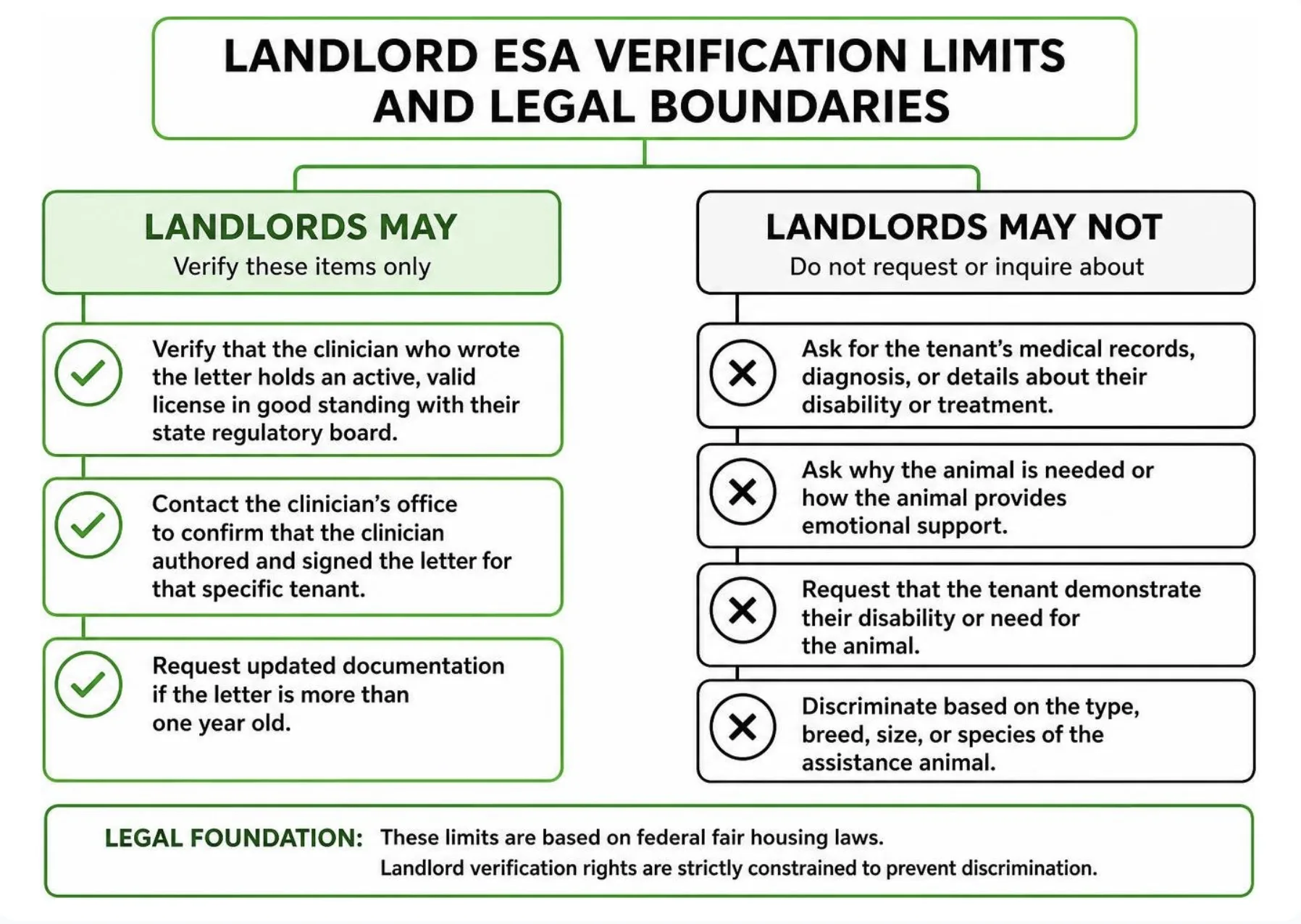
Verification requests should be assessed under applicable law. Common checks include:
- Verify that the clinician who wrote the letter holds an active, valid license in good standing with their state regulatory board.
- Contact the clinician’s office to confirm that the clinician authored and signed the letter for that specific tenant.
- Determine whether updated information is needed under applicable requirements; a letter's age alone should not be presented as a universal annual-renewal rule.
Requests for full medical records, detailed clinical discussions, additional forms, or objections to telehealth should be reviewed against current applicable law. Clinicians should limit disclosures to appropriate verification and follow privacy and authorization requirements.
When contacted for verification, a clinician's office should first confirm that disclosure is authorized and appropriate under applicable privacy rules. If so, a limited response could be: "Yes, [Clinician Name] evaluated [Tenant Name], authored this document on [Date], and signed it in support of an ESA accommodation." No further medical details should be disclosed.
Common Abuses, Commercial Registry Scams, and Red Flags
The market for assistance animal documentation has unfortunately seen an influx of commercial registry websites. Over the past decade, registrations and certificates sold by online vendors have surged dramatically.
Many unaccredited websites sell instant "ESA certifications," official-looking badges, registration numbers, and digital ID cards. Registrations, certificates, and ID cards generally do not establish legal housing rights. A legitimate ESA letter follows a real clinical evaluation; purchasing an instant document is not a substitute for that assessment.
Key red flags that property managers and ethical clinicians watch out for include:
- Letters issued without a genuine clinical evaluation.
- Documents referencing non-existent "Department of Justice ESA Registration Numbers."
- Letters written by providers not licensed in the state where the patient resides.
- Documents claiming public access rights under the ADA for an emotional support animal.
Frequently Asked Questions About ESA Documentation
For additional common inquiries about housing compliance and clinician guidelines, visit our comprehensive FAQ resource.
Conclusion
A useful emotional support animal letter balances clear clinical reasoning with patient privacy. Accurate documentation and compliance with applicable licensing rules can support a housing request, but approval and available protections depend on current federal and state rules.
At My ESA MD, we connect patients with licensed medical doctors who can issue ESA housing letters through telehealth, usually the same day, except in states that require a waiting period. California patients seeking letters for dogs follow a 30-day process required by state law. As a doctor-led, family-run service, we offer transparent flat-fee pricing with no recurring subscriptions or surprise memberships—backed by a 100% money-back guarantee if you do not qualify. If you or a client would like a physician to evaluate a disability-related need for an ESA housing letter, get your ESA letter with confidence today, or explore our blog for more guidance on federal assistance animal standards.
Ready to Talk to a Doctor?
Book a telehealth evaluation with a licensed MD. One flat fee, no memberships, and real people who answer the phone.
Approved by: Dr. Rick Rieser, MD — Medical Director, My ESA MD. Stanford-trained physician, 30+ years of clinical experience.