
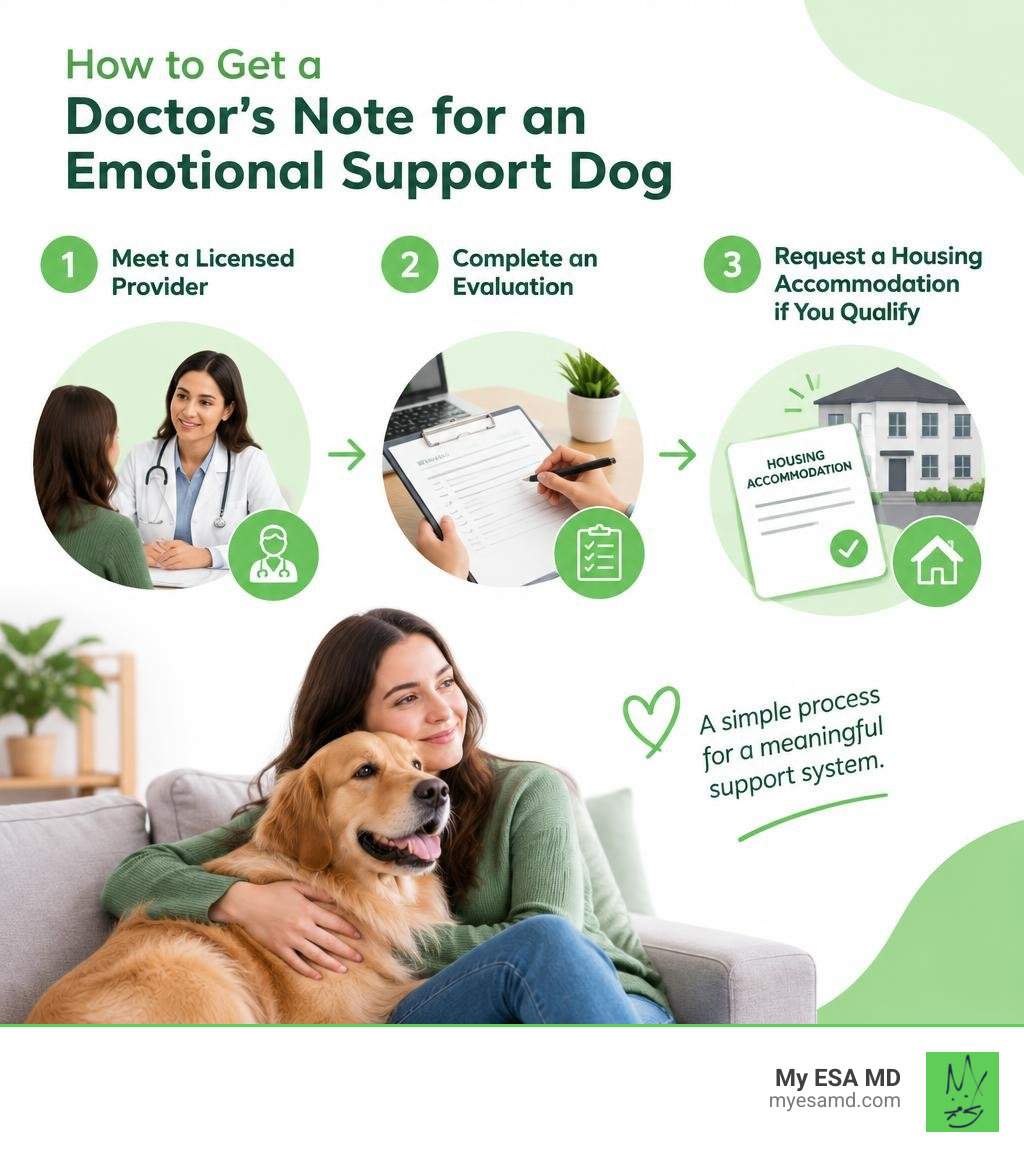
To get a dr note for emotional support dog housing, schedule an evaluation with a licensed medical provider. The provider will assess whether you have a disability-related need for your dog. If you qualify, they can write a letter you can submit to your housing provider when you request an accommodation. You do not need to buy a registration or certificate.
A letter is not automatic, and state rules may affect when a provider can issue one. This guide walks you through the steps and what to check before you submit your request.
I’m Joscelyn Rieser, director at My ESA MD, where I help make the dr note for emotional support dog process easier to understand. My background in web development and telehealth operations helps me explain each step clearly.
What Is a Dr Note for an Emotional Support Dog and What Does It Do?
When navigating rental rules, you might wonder what an emotional support animal is from a legal perspective. An emotional support animal (ESA) provides companionship, affection, and calming presence that mitigates symptoms of an emotional, psychological, or psychiatric disability.

A doctor's note for an emotional support dog serves as formal medical documentation. It establishes that an individual has a diagnosed mental health condition that substantially limits one or more major life activities and demonstrates a clear therapeutic connection (or "nexus") between the disability and the support provided by the dog. This note is the most common form of documentation used to request a reasonable housing accommodation.
Emotional Support Animals vs. Service Animals and Psychiatric Service Dogs
It is easy to confuse emotional support animals with service animals, but their legal definitions and access rights differ significantly under federal law.
- Service Animals (including Psychiatric Service Dogs): Covered under the Americans with Disabilities Act (ADA), these animals are individually trained to perform specific, measurable tasks directly related to their handler's disability (such as alerting to a panic attack, interrupting self-harm behaviors, or retrieving medication). They enjoy broad public access rights in stores, restaurants, and public transportation.
- Emotional Support Animals: Provide therapeutic relief and comforting presence without requiring specialized task training. Because they lack specialized training, ESAs do not have public access rights under the ADA and are not permitted in non-pet-friendly commercial establishments.
| Category | Legal Protections | Task Training Required? | Public Access Rights? | Applicable Laws |
|---|---|---|---|---|
| Service Animal (Physical) | Broad Disability Protections | Yes (Specialized physical tasks) | Yes (All public spaces) | ADA |
| Psychiatric Service Dog (PSD) | Broad Disability Protections | Yes (Specialized psychiatric tasks) | Yes (All public spaces) | ADA, ACAA, FHA |
| Emotional Support Dog (ESA) | Housing Accommodations | No (Provides comfort by presence) | No (Housing only) | Fair Housing Act and state laws |
Federal Protections Under the Fair Housing Act and Air Travel Rules
Under the federal Fair Housing Act (FHA), tenants with disabilities may request reasonable accommodations for an assistance animal, but since HUD's May 2026 enforcement memo, protection for an untrained emotional support dog depends more on state law. Where an accommodation is granted, a landlord must generally waive standard "no-pet" rules, breed restrictions, weight limits, and all pet-related deposits, pet rent, or application fees. Reviewing emotional support animal housing rights ensures you know what protections apply when presenting valid documentation.
In air travel, regulations have evolved. The U.S. Department of Transportation updated its regulations under the Air Carrier Access Act (ACAA), allowing airlines to treat emotional support animals as standard carry-on pets subject to regular airline pet fees, carrier size limits, and cargo policies. However, Psychiatric Service Dogs (PSDs) that are trained to perform specific tasks remain fully protected under the ACAA and fly in the aircraft cabin at no additional charge.
How to Get a Dr Note for an Emotional Support Dog in 3 Steps
Getting a valid doctor's note involves a clinical process rather than a registry purchase. Here is the step-by-step path to obtaining your documentation.
Who Qualifies for a Dr Note for an Emotional Support Dog?
To qualify, an individual must have an identifiable mental or emotional condition outlined in the Diagnostic and Statistical Manual of Mental Disorders (DSM-5-TR) that substantially limits daily life functions—such as sleeping, concentrating, regulating mood, or interacting with others. Conditions commonly evaluated include:
- Generalized anxiety disorder and panic attacks
- Major depressive disorder and chronic mood disorders
- Post-traumatic stress disorder (PTSD)
- Social anxiety and phobia-related distress
- Obsessive-compulsive disorder (OCD)
If you are exploring who is eligible for an emotional support animal, the essential factor is that your canine companion actively alleviates debilitating symptoms. In fact, a pre/post study of 11 subjects with serious mental illness reported significant reductions in loneliness, depression, and anxiety symptoms 12 months after living with an ESA.
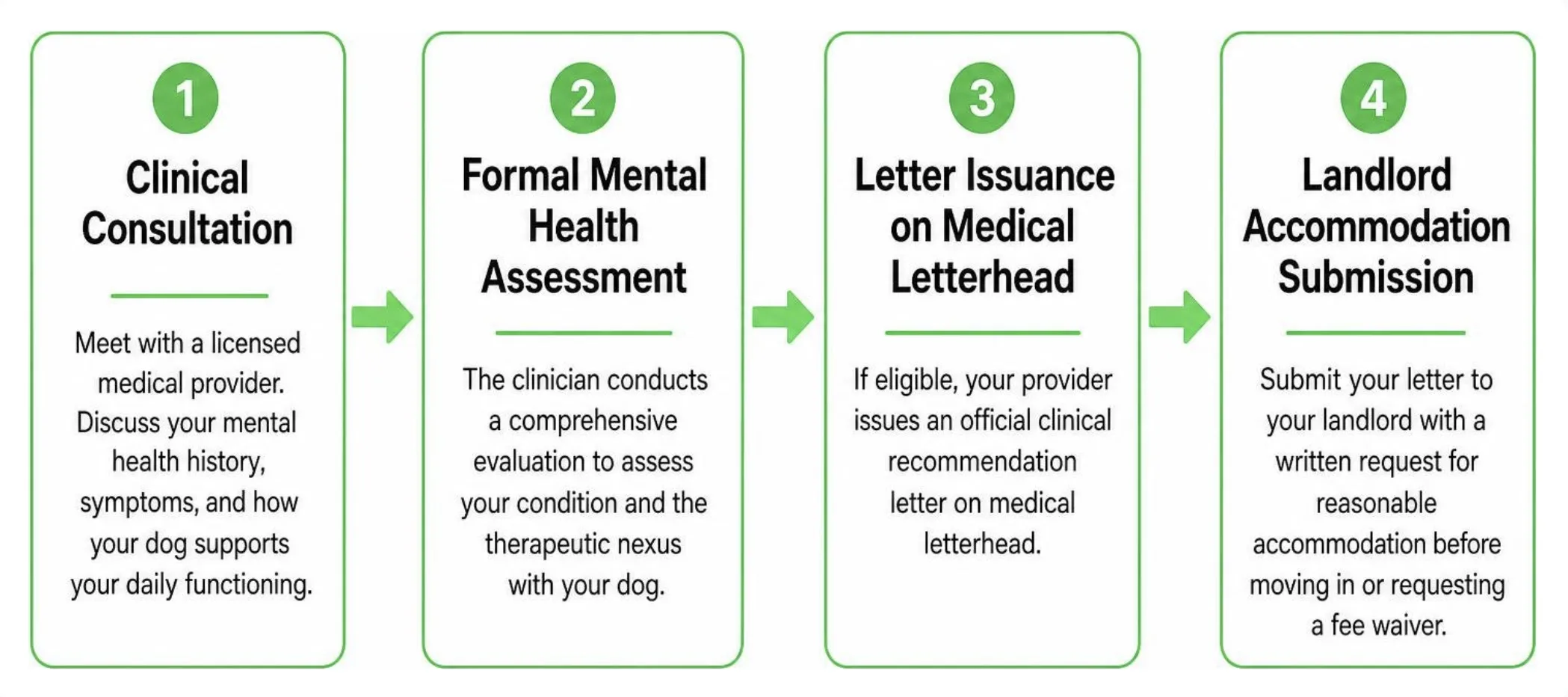
Step 1: Schedule an Appointment with a Licensed Medical Provider
Your first step is consulting a licensed healthcare practitioner (such as an MD, DO, psychiatrist, psychologist, or licensed therapist) who holds an active license in your jurisdiction.

Many people feel nervous discussing their psychological needs, but knowing how to ask a licensed doctor for an ESA letter makes the conversation straightforward. Openly discuss your mental health history, specific symptoms, and how your dog supports your daily functioning.
Step 2: Undergo a Comprehensive Mental Health Assessment
During your evaluation, the clinician will conduct a clinical interview to evaluate your functional limitations and assess the therapeutic nexus between your condition and the animal's presence. Interestingly, research indicates that 35.7% of mental health providers reported that they did not feel qualified to make an ESA determination, which is why working with experienced medical professionals who understand disability evaluations is so important.
Step 3: Receive and Submit Your Letter for Housing
Once your medical evaluation confirms eligibility, your provider issues an official clinical recommendation letter. You can then learn how to get an ESA letter for housing submitted to your landlord alongside a polite written request for reasonable accommodation before moving an animal into the unit or requesting a fee waiver.
Essential Clinical and Legal Standards for ESA Letters
Legitimate medical evaluations must comply with strict ethical, clinical, and administrative standards to ensure they withstand scrutiny from housing boards and landlords.
Key Elements That Make a Doctor’s Note for an Emotional Support Dog Legally Valid
A legally compliant doctor's note for an emotional support dog must be written on the provider's professional letterhead and contain precise information:
- The provider's full legal name, professional title, and clinical credentials (e.g., MD, DO, PsyD, LCSW).
- The practitioner’s active medical or mental health license number, state of issuance, and issue/expiration dates.
- Clear contact details (office telephone, professional address, and secure email).
- Verification of an established clinical relationship and an evaluation date.
- A formal statement confirming that the patient meets the criteria for an impairment under the Fair Housing Act and that the dog provides emotional support that alleviates one or more identified symptoms.
- The clinician's hand-written or secure digital signature.
Note: To safeguard patient privacy, the letter does not need to reveal your specific psychiatric diagnosis or detailed medical charts.
Navigating State-Specific Regulations in California and Florida
States have introduced legislation to establish standards for assistance animal documentation:
- California: Under California HSC 122318 legal requirements, healthcare practitioners issuing documentation for emotional support dogs must possess a valid, active license, conduct a thorough clinical evaluation, and establish a bona fide client-provider relationship at least 30 days prior to issuing an ESA letter (with specific statutory exceptions for verified homeless individuals).
- Florida: Florida statutes explicitly make it a misdemeanor of the second degree to knowingly provide false or fraudulent documentation for an emotional support animal, or to misrepresent an untrained pet as a service or assistance animal.
These laws protect tenants and medical providers by discouraging fraudulent online services while supporting individuals with genuine clinical needs.
Spotting and Avoiding Fraudulent ESA Letter Mills
The demand for assistance animals has grown dramatically; for instance, the number of registered emotional support and psychiatric service animals in California increased 1,000% (ten-fold) from 2002 to 2012. Unfortunately, this growth attracted disreputable commercial websites offering instant certificates without genuine clinical evaluations.
An investigative review into the fraudulent sale and issuance of emotional support animal letters revealed that many illegitimate platforms rely solely on 2-minute multiple-choice questionnaires and sell plastic badges, lifetime ID cards, or registry numbers.
Landlords are legally permitted to verify the authenticity of a provider's license. If a letter is traced to an unaccredited registry or an unlicensed vendor, housing providers can lawfully deny the accommodation request.
Frequently Asked Questions About Emotional Support Dog Notes
Yes. Depending on the state you live in, a landlord may be able to deny a request only under narrow circumstances. In states without their own ESA protections, the resident often has to do much more to show why the animal is needed. A landlord may deny a request if:
- The animal poses a direct, verifiable threat to the health or safety of other residents that cannot be mitigated.
- The specific dog causes substantial physical damage to the property.
- The accommodation creates an undue financial or administrative burden on the housing provider.
- The property is explicitly exempt from the Fair Housing Act (such as owner-occupied buildings with four or fewer units or single-family homes sold/rented without a broker). Some state laws, such as California's Fair Employment and Housing Act (FEHA), still cover many of these properties.
Conclusion
Securing an authentic, legally compliant doctor's note for an emotional support dog requires a real clinical evaluation from an active, licensed healthcare professional. When you work with legitimate clinicians who understand both federal housing protections and evolving state statutes, you ensure your accommodation request is well-documented and respected by housing providers.
At My ESA MD, we connect patients with licensed MDs who can issue emotional support animal housing letters through telehealth, usually the same day, except in states that require a waiting period. California patients seeking letters for dogs follow a 30-day process required by state law. As a family-run, doctor-led practice, we provide transparent flat-fee pricing, zero recurring memberships, and a full money-back guarantee if you don't qualify. Schedule your consultation today to protect your housing rights alongside your canine companion.
Ready to Talk to a Doctor?
Book a telehealth evaluation with a licensed MD. One flat fee, no memberships, and real people who answer the phone.
Approved by: Dr. Rick Rieser, MD — Medical Director, My ESA MD. Stanford-trained physician, 30+ years of clinical experience.