
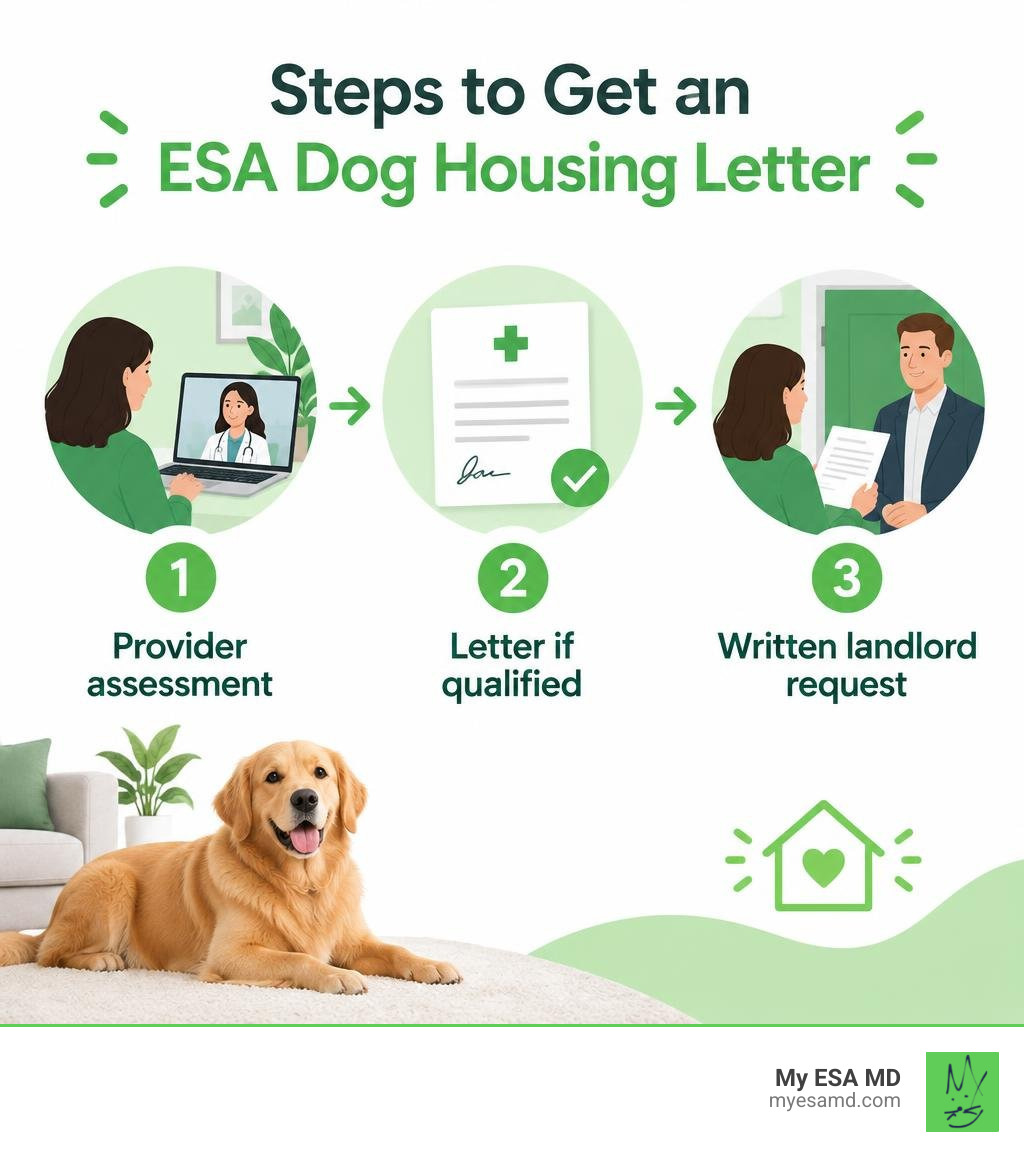
To get an ESA letter for an emotional support dog, meet with a licensed healthcare provider who can assess your disability-related need for the dog. If the provider supports the request, submit their housing letter with a written accommodation request to your landlord. Avoid sites that promise approval without an evaluation.
A letter can support a request to keep your dog in housing with a no-pet rule. It does not give your dog the same public-access rights as a service dog.
I'm Joscelyn Rieser, director at My ESA MD, where I help coordinate a doctor-led telehealth service for ESA housing letters. My work in web development and service coordination helps me explain what people searching for "ESA letter for emotional support dog" need to know about valid letters and online scams.
What an Emotional Support Dog Is, and What Its Letter Does
An emotional support dog is a pet that eases symptoms of a mental health condition just by being there. Your dog does not need special skills. Its comfort, routine, and companionship are the point. If you want the basics, we explain what an emotional support animal is in a separate guide.
The letter is the paperwork. It comes from a licensed professional and says you have a disability-related need for the animal. It is not a badge for your dog, and it does not turn a pet into a working animal.
ESA, Service Dog, and Therapy Dog: Know the Difference
These three get mixed up constantly, and the mix-up is how people end up disappointed at a restaurant door.
| Type | Main role | Task training | Public access |
|---|---|---|---|
| Emotional support dog | Comfort and therapeutic support for one person | Not required | No general public access; housing protections may apply, depending on the state |
| Service dog | Performs specific tasks tied to a disability | Individually trained | Broad access under the ADA |
| Therapy dog | Visits hospitals, schools, and similar places to comfort others | Temperament testing and organization certification | Only where invited |
Under the ADA, a service animal is a dog (or, in some cases, a miniature horse) trained to do specific tasks directly related to a disability. A psychiatric service dog might remind someone to take medication or turn on lights for a person with PTSD. An emotional support dog offers comfort without that task training.
Breed, Training, and Air Travel
Any dog can be an emotional support dog. Small companion breeds are popular, but a calm lab mix from a shelter qualifies just as well. Pick a dog whose energy and shedding fit your home. You can browse ESA dog and breed options if you are still choosing.
Formal training and certification are not legally required. Basic obedience is still wise, because landlords can act if a dog is dangerous or destructive, and a polite dog makes everyone's life easier.
As for flying, airlines are no longer required to treat emotional support animals differently from pets under the Air Carrier Access Act, following a Department of Transportation rule change. Most airlines now treat them as regular pets, so check your airline's current policy before you travel. In short, the letter is mainly about housing.
How to Get an ESA Letter for an Emotional Support Dog
Here is the legitimate path, step by step.
- Confirm you have a need. Think about your symptoms and how they affect daily life: sleep, work, social contact, getting out of the house.
- Book an evaluation with a licensed provider. This can be in person or by telehealth.
- Talk honestly. Expect questions about your symptom history, functional limitations, and treatment. The provider decides whether a dog supports your care.
- Receive a letter only if you qualify. A real assessment can end with a "no." That is a sign the process is honest.
- Send it to your landlord with a written request.

Conditions listed in the DSM-5, such as anxiety disorders, depression, PTSD, ADHD, bipolar disorder, and schizophrenia, are the kinds of conditions clinicians commonly consider. A diagnosis alone is not enough. The provider looks at how it limits you and how the dog helps.
Telehealth is a legitimate way to do this, but the provider must be licensed in your state. There is no such thing as instant approval, because a judgment about you needs a real conversation. Our walkthrough on how to get an ESA letter for housing covers the process in more detail.
Who Can Write an ESA Letter for an Emotional Support Dog?
The writer should be a licensed healthcare professional who is in a position to know about your condition and your need: a physician, psychologist, therapist, licensed clinical social worker, or psychiatrist. Some state rules are specific. In California, for example, a letter for an emotional support dog must come from a licensed health care practitioner who has had a client-provider relationship with you for at least 30 days. Still, a licensed clinician carries the most weight with landlords.
Things to check:
- The provider holds a current license in the state where you live.
- They actually evaluated you and are familiar with your history.
- You can verify them through their contact information.
If you are nervous about the conversation, our guide on how to ask a licensed doctor for an ESA letter can help. Clinicians can also read this psychiatric guidance on responding to ESA requests.
What Should an ESA Letter for an Emotional Support Dog Include?
A solid letter is short and clear. It should have:
- Provider letterhead and the date
- The provider's credentials and license details (type, state, number)
- A statement that you are their patient and that they know your history
- A statement that you have a disability-related need and that the dog helps with the limitations
- A recommendation for the animal
- Contact information so a landlord can verify it
What it should avoid matters just as much. The letter does not need to name your specific diagnosis, and good clinicians protect your privacy by leaving it out. Clinicians also often add that they vouch for how the dog helps you, not for how the dog behaves. And there is no official registry or certification for ESAs. Anything that says otherwise is selling you something.
How to Request an ESA Dog as a Housing Accommodation
The Fair Housing Act requires housing providers to consider reasonable accommodations for people with disabilities, which can include allowing an assistance animal despite a no-pet policy. When the need is not obvious, a landlord may ask for reliable documentation of the disability-related need. For a dog, that is where your provider's letter comes in.

Key points:
- A valid request can waive no-pet rules and pet fees or pet deposits, since an assistance animal is not legally a pet.
- Landlords can't demand a registry ID or a certificate.
- A request can be refused if the dog poses a direct threat to health or safety that can't be reduced, or if it would cause undue financial and administrative burden.
- Some housing is exempt from the Fair Housing Act, such as certain small owner-occupied buildings, so rules can vary.
- You remain responsible for damage and for keeping your dog under control.
Our page on emotional support animal housing rights goes deeper. Rely on current federal and state rules when preparing your request.
What to Include in a Tenant's Written Request
Put it in writing, always. A good request:
- States that you have a disability and are asking for a reasonable accommodation under the Fair Housing Act.
- Names the assistance animal (your dog) and briefly says how it helps with daily limitations.
- Mentions the attached provider letter.
- Gives your contact details.
- Asks for a response by a set date. Disability Rights North Carolina suggests ten business days, though the law only requires a prompt answer.
Keep copies of everything, including dates sent. If a landlord ignores you, delays unreasonably, or denies without good reason, you may be able to file a fair housing complaint with your state agency, depending on the state you live in. See these housing accommodation letter examples for wording, and read about ESA housing letter options if you need documentation.
How to Spot ESA Letter Scams and Protect Your Request
Scam sites count on you being stressed and in a hurry. Watch for these red flags:
- Instant approval or guaranteed acceptance. Real evaluations can end in a denial.
- No evaluation at all. A questionnaire alone is not an assessment.
- Pay-to-register offers. Registries, ID cards, vests, and certificates carry no legal weight.
- Hidden fees or subscriptions. Look for clear, flat pricing.
- Unverifiable providers. Fake or out-of-state licenses will get your letter rejected.
What a legitimate process looks like: clinician judgment, a discussion of functional impairment, a link to your treatment plan, and a look at whether a dog fits your life. A DSM-5 condition is a starting point, not a guarantee. Species matter too; dogs are the simplest case for housing, while exotic animals draw skepticism from clinicians. Obedience matters as well, since a disruptive dog can lose its protections.
Not sure where you stand? Read about emotional support animal eligibility before you spend a dime. Finally, be honest. Only people with a genuine need should seek a letter, because misuse makes landlords doubt everyone.
Conclusion
A legitimate ESA letter for your dog starts with a real assessment, and it is a housing tool, not a pass into stores or a certification. Choose your provider carefully, confirm their license, and send a clear written request.
My ESA MD, a family-run practice, connects patients with licensed MDs for telehealth evaluations. When clinically appropriate, the provider will issue a housing letter the same day, except in states like California where a waiting period is required. We charge a transparent flat fee, with no memberships, and offer a money-back guarantee if you don't qualify. Ready to see where you stand? Check eligibility for an emotional support animal with us today.
Is an Emotional Support Dog Right for You?
Talk with a licensed MD about whether an emotional support animal is right for you. One flat fee, no memberships, and real people who answer the phone.
Approved by: Dr. Rick Rieser, MD — Medical Director, My ESA MD. Stanford-trained physician, 30+ years of clinical experience.